Event submissions
Published
This submission belongs to the session S4. Novel Antimicrobial Agents: Discovery, Design, Synthesis and Action of the event The 4th International Electronic Conference on Antibiotics
Published date
19 May, 2025
Academic Editor
'%3e%3cpath%20d='M12.6657%2010.9104C12.4185%2010.325%2012.0599%209.79327%2011.6097%209.34482C11.1609%208.89508%2010.6293%208.5365%2010.0442%208.28888C10.0389%208.28626%2010.0337%208.28495%2010.0285%208.28233C10.8446%207.69279%2011.3752%206.73249%2011.3752%205.64904C11.3752%203.8542%209.92103%202.39999%208.1262%202.39999C6.33136%202.39999%204.87715%203.8542%204.87715%205.64904C4.87715%206.73249%205.40774%207.69279%206.22393%208.28364C6.21869%208.28626%206.21345%208.28757%206.20821%208.29019C5.62129%208.5378%205.09463%208.89284%204.64265%209.34613C4.1929%209.79493%203.83432%2010.3266%203.58671%2010.9117C3.34345%2011.4845%203.21226%2012.0987%203.20023%2012.7209C3.19988%2012.7349%203.20233%2012.7488%203.20744%2012.7619C3.21255%2012.7749%203.22022%2012.7867%203.22998%2012.7968C3.23975%2012.8068%203.25142%2012.8147%203.26431%2012.8202C3.2772%2012.8256%203.29105%2012.8284%203.30504%2012.8284H4.09109C4.14874%2012.8284%204.19459%2012.7825%204.1959%2012.7262C4.2221%2011.7148%204.62823%2010.7676%205.34617%2010.0497C6.08899%209.30683%207.0755%208.89808%208.1262%208.89808C9.17689%208.89808%2010.1634%209.30683%2010.9062%2010.0497C11.6242%2010.7676%2012.0303%2011.7148%2012.0565%2012.7262C12.0578%2012.7838%2012.1037%2012.8284%2012.1613%2012.8284H12.9474C12.9613%2012.8284%2012.9752%2012.8256%2012.9881%2012.8202C13.001%2012.8147%2013.0126%2012.8068%2013.0224%2012.7968C13.0322%2012.7867%2013.0398%2012.7749%2013.0449%2012.7619C13.0501%2012.7488%2013.0525%2012.7349%2013.0522%2012.7209C13.0391%2012.0947%2012.9094%2011.4855%2012.6657%2010.9104ZM8.1262%207.9024C7.52486%207.9024%206.9589%207.6679%206.53312%207.24211C6.10733%206.81633%205.87283%206.25037%205.87283%205.64904C5.87283%205.0477%206.10733%204.48174%206.53312%204.05596C6.9589%203.63018%207.52486%203.39567%208.1262%203.39567C8.72753%203.39567%209.29349%203.63018%209.71927%204.05596C10.1451%204.48174%2010.3796%205.0477%2010.3796%205.64904C10.3796%206.25037%2010.1451%206.81633%209.71927%207.24211C9.29349%207.6679%208.72753%207.9024%208.1262%207.9024Z'%20fill='%235D1EE1'/%3e%3c/g%3e%3c/svg%3e) Marc Maresca
Marc MarescaCitation
Marina L. Georgieva, Vladimir V. Sokolov, Ivan V. Mironov, Kseniya V. Malysheva, Aleksandr Yu. Simonov, Igor B. Levshin, Vera Sadykova, Antimicrobial potential of Emericellopsis sp. E102 strain and isolation of new compound with antibacterial activity against Gram-negative bacteria , in Proceedings of The 4th International Electronic Conference on Antibiotics, 21 May–23 May 2025, MDPI: Basel, Switzerland
Share
Email
Facebook
Twitter
LinkedIn
Antimicrobial potential of Emericellopsis sp. E102 strain and isolation of new compound with antibacterial activity against Gram-negative bacteria
'%3e%3cpath%20d='M12.6647%2010.9104C12.4176%2010.325%2012.0589%209.7933%2011.6088%209.34485C11.16%208.89511%2010.6283%208.53653%2010.0432%208.28891C10.038%208.28629%2010.0327%208.28498%2010.0275%208.28236C10.8437%207.69282%2011.3743%206.73252%2011.3743%205.64907C11.3743%203.85423%209.92005%202.40002%208.12522%202.40002C6.33038%202.40002%204.87618%203.85423%204.87618%205.64907C4.87618%206.73252%205.40677%207.69282%206.22296%208.28367C6.21772%208.28629%206.21248%208.2876%206.20724%208.29022C5.62031%208.53783%205.09365%208.89287%204.64167%209.34616C4.19192%209.79496%203.83334%2010.3266%203.58573%2010.9117C3.34247%2011.4846%203.21128%2012.0987%203.19925%2012.721C3.1989%2012.735%203.20135%2012.7489%203.20646%2012.7619C3.21157%2012.7749%203.21924%2012.7868%203.22901%2012.7968C3.23877%2012.8068%203.25045%2012.8148%203.26334%2012.8202C3.27623%2012.8256%203.29007%2012.8284%203.30406%2012.8284H4.09012C4.14776%2012.8284%204.19362%2012.7825%204.19493%2012.7262C4.22113%2011.7148%204.62726%2010.7676%205.34519%2010.0497C6.08802%209.30686%207.07452%208.89811%208.12522%208.89811C9.17592%208.89811%2010.1624%209.30686%2010.9052%2010.0497C11.6232%2010.7676%2012.0293%2011.7148%2012.0555%2012.7262C12.0568%2012.7839%2012.1027%2012.8284%2012.1603%2012.8284H12.9464C12.9604%2012.8284%2012.9742%2012.8256%2012.9871%2012.8202C13%2012.8148%2013.0117%2012.8068%2013.0214%2012.7968C13.0312%2012.7868%2013.0389%2012.7749%2013.044%2012.7619C13.0491%2012.7489%2013.0515%2012.735%2013.0512%2012.721C13.0381%2012.0947%2012.9084%2011.4856%2012.6647%2010.9104ZM8.12522%207.90243C7.52388%207.90243%206.95792%207.66793%206.53214%207.24215C6.10636%206.81636%205.87185%206.2504%205.87185%205.64907C5.87185%205.04773%206.10636%204.48177%206.53214%204.05599C6.95792%203.63021%207.52388%203.3957%208.12522%203.3957C8.72655%203.3957%209.29252%203.63021%209.7183%204.05599C10.1441%204.48177%2010.3786%205.04773%2010.3786%205.64907C10.3786%206.2504%2010.1441%206.81636%209.7183%207.24215C9.29252%207.66793%208.72655%207.90243%208.12522%207.90243Z'%20fill='%235D1EE1'/%3e%3c/g%3e%3c/svg%3e)
Marina L. Georgieva 1,2
Vladimir V. Sokolov 3
Ivan V. Mironov 3
Kseniya V. Malysheva 3
Aleksandr Yu. Simonov 3
Igor B. Levshin 3
Vera Sadykova 3
1. Laboratory for Taxonomic Study and Collection of Cultures of Microorganisms, Gause Institute of New
Antibiotics, St. Bolshaya Pirogovskaya, 11, 119021 Moscow, Russia
2. Faculty of Biology, Lomonosov Moscow State University, 1-12 Leninskie Gory, Moscow 119234, Russia
3. Gause Institute of New Antibiotics, 11 B Pirogovskaya St, Moscow 119021, Russia
Abstract
In recent decades, the interest in the Emericellopsis genus as producers of bioactive molecules has increased significantly due to the isolation of new compounds with potential pharmaceutical applications. The species of this genus produce a spectrum of peptide antibiotics with antibacterial and antifungal activity.
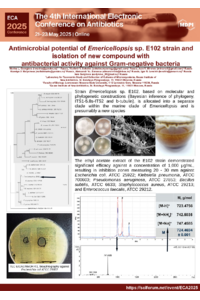
Evaluation of the spectrum of antibiotic activity has allowed us to choose a promising producer of new antibacterial compounds, the Emericellopsis sp. E102 strain derived from saline soils. Strain E102, based on molecular and phylogenetic constructions, is allocated into a separate clade within the marine clade of Emericellopsis and is presumably a new species. In this research, three previously undescribed compounds were isolated from the fungal strain E102, grown in both Czapek–Dox and PDB liquid culture media. The ethyl acetate extract of the E102 strain demonstrated significant efficacy against a concentration of 1,000 μg/mL, resulting in inhibition zones measuring 20 - 30 mm against Escherichia coli, ATCC 25922; Klebsiella pneumonia, ATCC 700603; Pseudomonas aeruginosa, ATCC 27853; Bacillus subtilis, АТСС 6633; Staphylococcus aureus, ATCC 29213; and Enterococcus faecalis, ATCC 29212. Based on HPLC separation of the ethanol concentrates, an active compound was obtained and investigated further. The monoisotopic mass of the compound, determined using MS, was 724.5 g/mol. Using the Chemcalc.org service, the most probable gross formulas ffor the required component were determined. Based on the calculations presented, there is a high probability that the substance has a sterane framework.
The work of Vladimir V. Sokolov and Marina L. Georgieva was supported by the Russian Science Foundation (grant #25-24-00291). The work of Ivan V. Mironov was carried out with institutional funding from the Gause Institute of New Antibiotics.
Keywords
Antimicrobial
Emericellopsis
antibiotic
peptides
Poster
sciforum_ECA2025.pdf
Isolation, Purification and Antifungal Activity of Daidzeins Produced by Halotolerant Streptomyces sampsonii INA01478
Pharmacological Evaluation Essential Oils from Cinnamomum verum and Artemisia herba alba: Chemical Profiling and Bioactive Applications in Oxidative Stress and Inflammation