Event submissions
Published
This submission belongs to the session S4. Novel Antimicrobial Agents: Discovery, Design, Synthesis and Action of the event The 4th International Electronic Conference on Antibiotics
Published date
19 May, 2025
Academic Editor
'%3e%3cpath%20d='M12.6657%2010.9104C12.4185%2010.325%2012.0599%209.79327%2011.6097%209.34482C11.1609%208.89508%2010.6293%208.5365%2010.0442%208.28888C10.0389%208.28626%2010.0337%208.28495%2010.0285%208.28233C10.8446%207.69279%2011.3752%206.73249%2011.3752%205.64904C11.3752%203.8542%209.92103%202.39999%208.1262%202.39999C6.33136%202.39999%204.87715%203.8542%204.87715%205.64904C4.87715%206.73249%205.40774%207.69279%206.22393%208.28364C6.21869%208.28626%206.21345%208.28757%206.20821%208.29019C5.62129%208.5378%205.09463%208.89284%204.64265%209.34613C4.1929%209.79493%203.83432%2010.3266%203.58671%2010.9117C3.34345%2011.4845%203.21226%2012.0987%203.20023%2012.7209C3.19988%2012.7349%203.20233%2012.7488%203.20744%2012.7619C3.21255%2012.7749%203.22022%2012.7867%203.22998%2012.7968C3.23975%2012.8068%203.25142%2012.8147%203.26431%2012.8202C3.2772%2012.8256%203.29105%2012.8284%203.30504%2012.8284H4.09109C4.14874%2012.8284%204.19459%2012.7825%204.1959%2012.7262C4.2221%2011.7148%204.62823%2010.7676%205.34617%2010.0497C6.08899%209.30683%207.0755%208.89808%208.1262%208.89808C9.17689%208.89808%2010.1634%209.30683%2010.9062%2010.0497C11.6242%2010.7676%2012.0303%2011.7148%2012.0565%2012.7262C12.0578%2012.7838%2012.1037%2012.8284%2012.1613%2012.8284H12.9474C12.9613%2012.8284%2012.9752%2012.8256%2012.9881%2012.8202C13.001%2012.8147%2013.0126%2012.8068%2013.0224%2012.7968C13.0322%2012.7867%2013.0398%2012.7749%2013.0449%2012.7619C13.0501%2012.7488%2013.0525%2012.7349%2013.0522%2012.7209C13.0391%2012.0947%2012.9094%2011.4855%2012.6657%2010.9104ZM8.1262%207.9024C7.52486%207.9024%206.9589%207.6679%206.53312%207.24211C6.10733%206.81633%205.87283%206.25037%205.87283%205.64904C5.87283%205.0477%206.10733%204.48174%206.53312%204.05596C6.9589%203.63018%207.52486%203.39567%208.1262%203.39567C8.72753%203.39567%209.29349%203.63018%209.71927%204.05596C10.1451%204.48174%2010.3796%205.0477%2010.3796%205.64904C10.3796%206.25037%2010.1451%206.81633%209.71927%207.24211C9.29349%207.6679%208.72753%207.9024%208.1262%207.9024Z'%20fill='%235D1EE1'/%3e%3c/g%3e%3c/svg%3e) Marc Maresca
Marc MarescaCitation
Tamara Anđić, Ana Ignjatijević, Stefana Vuletić, Tea Ganić, Biljana Nikolić, Stefana Cvetković, Antibacterial Activity and Safety Assessment of Agrimonia Eupatoria Ethanolic–Aqueous Extract, in Proceedings of The 4th International Electronic Conference on Antibiotics, 21 May–23 May 2025, MDPI: Basel, Switzerland
Share
Email
Facebook
Twitter
LinkedIn
Antibacterial Activity and Safety Assessment of Agrimonia Eupatoria Ethanolic–Aqueous Extract
'%3e%3cpath%20d='M12.6647%2010.9104C12.4176%2010.325%2012.0589%209.7933%2011.6088%209.34485C11.16%208.89511%2010.6283%208.53653%2010.0432%208.28891C10.038%208.28629%2010.0327%208.28498%2010.0275%208.28236C10.8437%207.69282%2011.3743%206.73252%2011.3743%205.64907C11.3743%203.85423%209.92005%202.40002%208.12522%202.40002C6.33038%202.40002%204.87618%203.85423%204.87618%205.64907C4.87618%206.73252%205.40677%207.69282%206.22296%208.28367C6.21772%208.28629%206.21248%208.2876%206.20724%208.29022C5.62031%208.53783%205.09365%208.89287%204.64167%209.34616C4.19192%209.79496%203.83334%2010.3266%203.58573%2010.9117C3.34247%2011.4846%203.21128%2012.0987%203.19925%2012.721C3.1989%2012.735%203.20135%2012.7489%203.20646%2012.7619C3.21157%2012.7749%203.21924%2012.7868%203.22901%2012.7968C3.23877%2012.8068%203.25045%2012.8148%203.26334%2012.8202C3.27623%2012.8256%203.29007%2012.8284%203.30406%2012.8284H4.09012C4.14776%2012.8284%204.19362%2012.7825%204.19493%2012.7262C4.22113%2011.7148%204.62726%2010.7676%205.34519%2010.0497C6.08802%209.30686%207.07452%208.89811%208.12522%208.89811C9.17592%208.89811%2010.1624%209.30686%2010.9052%2010.0497C11.6232%2010.7676%2012.0293%2011.7148%2012.0555%2012.7262C12.0568%2012.7839%2012.1027%2012.8284%2012.1603%2012.8284H12.9464C12.9604%2012.8284%2012.9742%2012.8256%2012.9871%2012.8202C13%2012.8148%2013.0117%2012.8068%2013.0214%2012.7968C13.0312%2012.7868%2013.0389%2012.7749%2013.044%2012.7619C13.0491%2012.7489%2013.0515%2012.735%2013.0512%2012.721C13.0381%2012.0947%2012.9084%2011.4856%2012.6647%2010.9104ZM8.12522%207.90243C7.52388%207.90243%206.95792%207.66793%206.53214%207.24215C6.10636%206.81636%205.87185%206.2504%205.87185%205.64907C5.87185%205.04773%206.10636%204.48177%206.53214%204.05599C6.95792%203.63021%207.52388%203.3957%208.12522%203.3957C8.72655%203.3957%209.29252%203.63021%209.7183%204.05599C10.1441%204.48177%2010.3786%205.04773%2010.3786%205.64907C10.3786%206.2504%2010.1441%206.81636%209.7183%207.24215C9.29252%207.66793%208.72655%207.90243%208.12522%207.90243Z'%20fill='%235D1EE1'/%3e%3c/g%3e%3c/svg%3e)
Tamara Anđić 1
Ana Ignjatijević 1
Stefana Vuletić 1
Tea Ganić 1
Biljana Nikolić 1
Stefana Cvetković 1
1. Chair of Microbiology, Faculty of Biology, University of Belgrade, Studentski trg 16, 11000 Belgrade, Serbia
Abstract
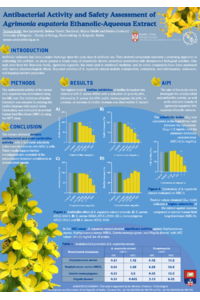
Bacterial infections are difficult to treat due to multi-drug resistance, a global health challenge. Plant secondary metabolites, known for their broad spectrum of biological activities, offer a promising alternative. These compounds, particularly phenolics, are recognized for their antibacterial mechanisms and their potential to enhance the efficacy of conventional antibiotics. Agrimonia eupatoria, a plant from the Rosaceae family, is rich in phenolics and demonstrates a range of bioactivities, including antibacterial activity [1]. This study aimed to evaluate the antibacterial and antibiofilm properties of a 70% ethanolic–aqueous extract of the Agrimonia eupatoria herb, as well as its cytotoxicity and bacterial selectivity to assess its safety. The microdilution assay results demonstrated the extract to be significantly active against Staphylococcus aureus, Staphylococcus aureus MRSA, Listeria monocytogenes, and Shigella flexneri, with MIC values of 0.31 mg/mL for all strains, interpreted according to the MIC classification of Tamokou et al. [2 ]. Further, crystal violet staining of the biofilm biomass demonstrated the most notable antibiofilm effect against S. aureus MRSA, with a decrease in the biofilm biomass of up to 85.40%, followed by the effects against S. aureus (63.67%) and L. monocytogenes (62.24%). An increase in the biofilm biomass was observed in S. flexneri, which could be attributed to a stress response. To evaluate the safety of the extract, the selectivity index was calculated as the ratio between the cytotoxic (IC50) and antimicrobial effect (MIC). The positive values obtained showed the higher selectivity of the extract towards bacteria compared to that for normal human fetal lung fibroblasts, i.e., MRC-5 cells (IC50 = 1.52 mg/mL). The obtained results show that A. eupatoria possesses antibacterial and antibiofilm activity, which supports further research into its molecular mechanisms of action and potential synergistic effects with the available antibiotics. This strategy could target different sites of the bacterial cells and the pathways involved in biofilm formation, thereby improving antibacterial activity and preventing the development of resistance.
Keywords
Agrimonia eupatoria
antibacterial activity
antibiofilm activity
novel antimicrobial agents
plant extract
Poster
Andjic et al._Antibacterial Activity and Safety Assessment of Agrimonia eupatoria Ethanolic-Aqueous Extract.pdf
Pharmacological Evaluation Essential Oils from Cinnamomum verum and Artemisia herba alba: Chemical Profiling and Bioactive Applications in Oxidative Stress and Inflammation
Targeting FabZ: Design and Synthesis of Potential Inhibitors