Event submissions
Published
This submission belongs to the session S4. Novel Antimicrobial Agents: Discovery, Design, Synthesis and Action of the event The 4th International Electronic Conference on Antibiotics
Published date
19 May, 2025
Academic Editor
'%3e%3cpath%20d='M12.6657%2010.9104C12.4185%2010.325%2012.0599%209.79327%2011.6097%209.34482C11.1609%208.89508%2010.6293%208.5365%2010.0442%208.28888C10.0389%208.28626%2010.0337%208.28495%2010.0285%208.28233C10.8446%207.69279%2011.3752%206.73249%2011.3752%205.64904C11.3752%203.8542%209.92103%202.39999%208.1262%202.39999C6.33136%202.39999%204.87715%203.8542%204.87715%205.64904C4.87715%206.73249%205.40774%207.69279%206.22393%208.28364C6.21869%208.28626%206.21345%208.28757%206.20821%208.29019C5.62129%208.5378%205.09463%208.89284%204.64265%209.34613C4.1929%209.79493%203.83432%2010.3266%203.58671%2010.9117C3.34345%2011.4845%203.21226%2012.0987%203.20023%2012.7209C3.19988%2012.7349%203.20233%2012.7488%203.20744%2012.7619C3.21255%2012.7749%203.22022%2012.7867%203.22998%2012.7968C3.23975%2012.8068%203.25142%2012.8147%203.26431%2012.8202C3.2772%2012.8256%203.29105%2012.8284%203.30504%2012.8284H4.09109C4.14874%2012.8284%204.19459%2012.7825%204.1959%2012.7262C4.2221%2011.7148%204.62823%2010.7676%205.34617%2010.0497C6.08899%209.30683%207.0755%208.89808%208.1262%208.89808C9.17689%208.89808%2010.1634%209.30683%2010.9062%2010.0497C11.6242%2010.7676%2012.0303%2011.7148%2012.0565%2012.7262C12.0578%2012.7838%2012.1037%2012.8284%2012.1613%2012.8284H12.9474C12.9613%2012.8284%2012.9752%2012.8256%2012.9881%2012.8202C13.001%2012.8147%2013.0126%2012.8068%2013.0224%2012.7968C13.0322%2012.7867%2013.0398%2012.7749%2013.0449%2012.7619C13.0501%2012.7488%2013.0525%2012.7349%2013.0522%2012.7209C13.0391%2012.0947%2012.9094%2011.4855%2012.6657%2010.9104ZM8.1262%207.9024C7.52486%207.9024%206.9589%207.6679%206.53312%207.24211C6.10733%206.81633%205.87283%206.25037%205.87283%205.64904C5.87283%205.0477%206.10733%204.48174%206.53312%204.05596C6.9589%203.63018%207.52486%203.39567%208.1262%203.39567C8.72753%203.39567%209.29349%203.63018%209.71927%204.05596C10.1451%204.48174%2010.3796%205.0477%2010.3796%205.64904C10.3796%206.25037%2010.1451%206.81633%209.71927%207.24211C9.29349%207.6679%208.72753%207.9024%208.1262%207.9024Z'%20fill='%235D1EE1'/%3e%3c/g%3e%3c/svg%3e) Marc Maresca
Marc MarescaCitation
Aurélie Herrero, Laurie Bibens, Virginie Morel, François Peltier, Jean-Paul Becker, Christine Cezard, Alexandra Dassonville-Klimpt, Pascal Sonnet, Targeting FabZ: Design and Synthesis of Potential Inhibitors, in Proceedings of The 4th International Electronic Conference on Antibiotics, 21 May–23 May 2025, MDPI: Basel, Switzerland
Share
Email
Facebook
Twitter
LinkedIn
Targeting FabZ: Design and Synthesis of Potential Inhibitors
'%3e%3cpath%20d='M12.6647%2010.9104C12.4176%2010.325%2012.0589%209.7933%2011.6088%209.34485C11.16%208.89511%2010.6283%208.53653%2010.0432%208.28891C10.038%208.28629%2010.0327%208.28498%2010.0275%208.28236C10.8437%207.69282%2011.3743%206.73252%2011.3743%205.64907C11.3743%203.85423%209.92005%202.40002%208.12522%202.40002C6.33038%202.40002%204.87618%203.85423%204.87618%205.64907C4.87618%206.73252%205.40677%207.69282%206.22296%208.28367C6.21772%208.28629%206.21248%208.2876%206.20724%208.29022C5.62031%208.53783%205.09365%208.89287%204.64167%209.34616C4.19192%209.79496%203.83334%2010.3266%203.58573%2010.9117C3.34247%2011.4846%203.21128%2012.0987%203.19925%2012.721C3.1989%2012.735%203.20135%2012.7489%203.20646%2012.7619C3.21157%2012.7749%203.21924%2012.7868%203.22901%2012.7968C3.23877%2012.8068%203.25045%2012.8148%203.26334%2012.8202C3.27623%2012.8256%203.29007%2012.8284%203.30406%2012.8284H4.09012C4.14776%2012.8284%204.19362%2012.7825%204.19493%2012.7262C4.22113%2011.7148%204.62726%2010.7676%205.34519%2010.0497C6.08802%209.30686%207.07452%208.89811%208.12522%208.89811C9.17592%208.89811%2010.1624%209.30686%2010.9052%2010.0497C11.6232%2010.7676%2012.0293%2011.7148%2012.0555%2012.7262C12.0568%2012.7839%2012.1027%2012.8284%2012.1603%2012.8284H12.9464C12.9604%2012.8284%2012.9742%2012.8256%2012.9871%2012.8202C13%2012.8148%2013.0117%2012.8068%2013.0214%2012.7968C13.0312%2012.7868%2013.0389%2012.7749%2013.044%2012.7619C13.0491%2012.7489%2013.0515%2012.735%2013.0512%2012.721C13.0381%2012.0947%2012.9084%2011.4856%2012.6647%2010.9104ZM8.12522%207.90243C7.52388%207.90243%206.95792%207.66793%206.53214%207.24215C6.10636%206.81636%205.87185%206.2504%205.87185%205.64907C5.87185%205.04773%206.10636%204.48177%206.53214%204.05599C6.95792%203.63021%207.52388%203.3957%208.12522%203.3957C8.72655%203.3957%209.29252%203.63021%209.7183%204.05599C10.1441%204.48177%2010.3786%205.04773%2010.3786%205.64907C10.3786%206.2504%2010.1441%206.81636%209.7183%207.24215C9.29252%207.66793%208.72655%207.90243%208.12522%207.90243Z'%20fill='%235D1EE1'/%3e%3c/g%3e%3c/svg%3e)
Aurélie Herrero 1
Laurie Bibens 1
Virginie Morel 1
François Peltier 1
Jean-Paul Becker 1
Christine Cezard 2

Alexandra Dassonville-Klimpt 1

Pascal Sonnet 1
1. AGIR, UR 4294, Université de Picardie Jules Verne, 80025 Amiens, France
2. CNRS UMR 6219, Laboratoire des Glucides, Université de Picardie-Jules-Verne, 80025 Amiens, France
Abstract
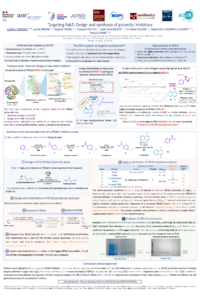
Antimicrobial resistance (AMR) poses a critical threat to global public health. Multidrug-resistant bacteria, including A. baumannii, P. aeruginosa, and S. aureus, are major causes of hospital-acquired infections. This resistance phenomenon has also spread to parasites such as P. falciparum, the most virulent form of malaria. Therefore, new treatments targeting essential biological pathways that are not addressed by current agents are urgently needed to minimize potential cross-resistance.
Microbial fatty acid biosynthesis, relying on the fatty acid synthase system (FAS-II), is essential for microbial membrane lipid synthesis. The FAS-II enzymes, which are absent in humans, provide a selective target, minimizing the risk of off-target effects on human fatty acid synthesis. Their highly conserved active site amino acid sequences support their broad-spectrum antimicrobial potential, and the available crystal structures in the Protein Data Bank (PDB) offer an excellent opportunity for structure-based drug design. Among the FAS-II enzymes, FabZ dehydratase appears as a promising yet underexplored target in the fight against AMR.
Based on the results of Sharma et al. (2003), we demonstrated that quinoline derivatives, such as NAS91 (IC50 Pf = 12 µM ; IC50 PfFabZ = 7.5 µM), inhibit PfFabZ activity and suppress P. falciparum growth. Structural analyses of NAS91-PfFabZ co-crystals revealed key ligand–enzyme interactions, guiding us in the rational design of 37 new 8-arylquinolines. These compounds were evaluated in vitro against a large panel of bacteria and P. falciparum, where a first hit, 4c, stood out (IC50 Pf = 13.7 µM). Additionally, their corresponding complexes with different FabZ structures available in the PDB were analyzed by means of detailed in silico studies. Here, we will present the optimized structures of new inhibitors, derived from comprehensive in vitro and in silico findings, as well as their organic synthesis. The optimized production of FabZ enzymes from H. pylori and P. falciparum, required for enzymatic assays, will also be presented.
Keywords
antimicrobial drugs
FabZ
fatty acid biosynthesis
quinolines
Poster
ECA2025-AurelieHerrero-Poster.pdf
Antibacterial Activity and Safety Assessment of Agrimonia Eupatoria Ethanolic–Aqueous Extract
Biofilm formation on the surface of medical devices: a growing concern for hospital-acquired infections