Event submissions
Published
This submission belongs to the session S4. Novel Antimicrobial Agents: Discovery, Design, Synthesis and Action of the event The 4th International Electronic Conference on Antibiotics
Published date
19 May, 2025
Academic Editor
'%3e%3cpath%20d='M12.6657%2010.9104C12.4185%2010.325%2012.0599%209.79327%2011.6097%209.34482C11.1609%208.89508%2010.6293%208.5365%2010.0442%208.28888C10.0389%208.28626%2010.0337%208.28495%2010.0285%208.28233C10.8446%207.69279%2011.3752%206.73249%2011.3752%205.64904C11.3752%203.8542%209.92103%202.39999%208.1262%202.39999C6.33136%202.39999%204.87715%203.8542%204.87715%205.64904C4.87715%206.73249%205.40774%207.69279%206.22393%208.28364C6.21869%208.28626%206.21345%208.28757%206.20821%208.29019C5.62129%208.5378%205.09463%208.89284%204.64265%209.34613C4.1929%209.79493%203.83432%2010.3266%203.58671%2010.9117C3.34345%2011.4845%203.21226%2012.0987%203.20023%2012.7209C3.19988%2012.7349%203.20233%2012.7488%203.20744%2012.7619C3.21255%2012.7749%203.22022%2012.7867%203.22998%2012.7968C3.23975%2012.8068%203.25142%2012.8147%203.26431%2012.8202C3.2772%2012.8256%203.29105%2012.8284%203.30504%2012.8284H4.09109C4.14874%2012.8284%204.19459%2012.7825%204.1959%2012.7262C4.2221%2011.7148%204.62823%2010.7676%205.34617%2010.0497C6.08899%209.30683%207.0755%208.89808%208.1262%208.89808C9.17689%208.89808%2010.1634%209.30683%2010.9062%2010.0497C11.6242%2010.7676%2012.0303%2011.7148%2012.0565%2012.7262C12.0578%2012.7838%2012.1037%2012.8284%2012.1613%2012.8284H12.9474C12.9613%2012.8284%2012.9752%2012.8256%2012.9881%2012.8202C13.001%2012.8147%2013.0126%2012.8068%2013.0224%2012.7968C13.0322%2012.7867%2013.0398%2012.7749%2013.0449%2012.7619C13.0501%2012.7488%2013.0525%2012.7349%2013.0522%2012.7209C13.0391%2012.0947%2012.9094%2011.4855%2012.6657%2010.9104ZM8.1262%207.9024C7.52486%207.9024%206.9589%207.6679%206.53312%207.24211C6.10733%206.81633%205.87283%206.25037%205.87283%205.64904C5.87283%205.0477%206.10733%204.48174%206.53312%204.05596C6.9589%203.63018%207.52486%203.39567%208.1262%203.39567C8.72753%203.39567%209.29349%203.63018%209.71927%204.05596C10.1451%204.48174%2010.3796%205.0477%2010.3796%205.64904C10.3796%206.25037%2010.1451%206.81633%209.71927%207.24211C9.29349%207.6679%208.72753%207.9024%208.1262%207.9024Z'%20fill='%235D1EE1'/%3e%3c/g%3e%3c/svg%3e) Manuel Simões
Manuel SimõesCitation
Sofiia Sergeevna Sinelnikova, Anna Aleksandrovna Baranova, Vera Aleksandrovna Alferova, Olga Aleksandrovna Belozerova, Arseniy Aleksandrovich Sinichich, Screening of microbiome of bark beetle Ips typographus for antibiotic producers, in Proceedings of The 4th International Electronic Conference on Antibiotics, 21 May–23 May 2025, MDPI: Basel, Switzerland
Share
Email
Facebook
Twitter
LinkedIn
Screening of microbiome of bark beetle Ips typographus for antibiotic producers
'%3e%3cpath%20d='M12.6647%2010.9104C12.4176%2010.325%2012.0589%209.7933%2011.6088%209.34485C11.16%208.89511%2010.6283%208.53653%2010.0432%208.28891C10.038%208.28629%2010.0327%208.28498%2010.0275%208.28236C10.8437%207.69282%2011.3743%206.73252%2011.3743%205.64907C11.3743%203.85423%209.92005%202.40002%208.12522%202.40002C6.33038%202.40002%204.87618%203.85423%204.87618%205.64907C4.87618%206.73252%205.40677%207.69282%206.22296%208.28367C6.21772%208.28629%206.21248%208.2876%206.20724%208.29022C5.62031%208.53783%205.09365%208.89287%204.64167%209.34616C4.19192%209.79496%203.83334%2010.3266%203.58573%2010.9117C3.34247%2011.4846%203.21128%2012.0987%203.19925%2012.721C3.1989%2012.735%203.20135%2012.7489%203.20646%2012.7619C3.21157%2012.7749%203.21924%2012.7868%203.22901%2012.7968C3.23877%2012.8068%203.25045%2012.8148%203.26334%2012.8202C3.27623%2012.8256%203.29007%2012.8284%203.30406%2012.8284H4.09012C4.14776%2012.8284%204.19362%2012.7825%204.19493%2012.7262C4.22113%2011.7148%204.62726%2010.7676%205.34519%2010.0497C6.08802%209.30686%207.07452%208.89811%208.12522%208.89811C9.17592%208.89811%2010.1624%209.30686%2010.9052%2010.0497C11.6232%2010.7676%2012.0293%2011.7148%2012.0555%2012.7262C12.0568%2012.7839%2012.1027%2012.8284%2012.1603%2012.8284H12.9464C12.9604%2012.8284%2012.9742%2012.8256%2012.9871%2012.8202C13%2012.8148%2013.0117%2012.8068%2013.0214%2012.7968C13.0312%2012.7868%2013.0389%2012.7749%2013.044%2012.7619C13.0491%2012.7489%2013.0515%2012.735%2013.0512%2012.721C13.0381%2012.0947%2012.9084%2011.4856%2012.6647%2010.9104ZM8.12522%207.90243C7.52388%207.90243%206.95792%207.66793%206.53214%207.24215C6.10636%206.81636%205.87185%206.2504%205.87185%205.64907C5.87185%205.04773%206.10636%204.48177%206.53214%204.05599C6.95792%203.63021%207.52388%203.3957%208.12522%203.3957C8.72655%203.3957%209.29252%203.63021%209.7183%204.05599C10.1441%204.48177%2010.3786%205.04773%2010.3786%205.64907C10.3786%206.2504%2010.1441%206.81636%209.7183%207.24215C9.29252%207.66793%208.72655%207.90243%208.12522%207.90243Z'%20fill='%235D1EE1'/%3e%3c/g%3e%3c/svg%3e)
Sofiia Sergeevna Sinelnikova 1,2
Anna Aleksandrovna Baranova 1
Vera Aleksandrovna Alferova 1
Olga Aleksandrovna Belozerova 1
Arseniy Aleksandrovich Sinichich 1,3
1. Shemyakin-Ovchinnikov Institute of Bioorganic Chemistry, Miklukho-Maklaya 16/10, 117997 Moscow, Russia
2. Department of Biotechnology, A.P. Nelyubin Institute of Pharmacy, I.M. Sechenov First Moscow State Medical University (Sechenov University), Trubetskaya 8, building 2, Moscow, 119991, Russia
3. Department of Chemistry, Lomonosov Moscow State University, Leninskie Gory 1, Moscow 119991, Russia
Abstract
The study of antibiotic producers from natural sources plays an important role in the development of new drugs. One way to search for antibiotics is the isolation of microbial antibiotic producers from insects and their products [1]. Symbionts and insect-associated microorganisms represent an almost inexhaustible source of bioactive compounds, including antibiotics [2].
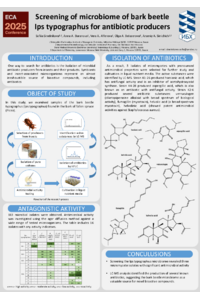
In this study, we examined samples of the bark beetle typographus (Ips typographus) found in the bark of fallen spruce (Picea). The bodies of insects, previously sedated with diethyl ether, were prewashed with 80% ethyl alcohol to exclude external contaminants. Then, they were homogenized using a sterile glass rod. The obtained mass was suspended in sterile water for inoculation. The inoculum was spread on 9 × 9 cm Petri dishes with brain heart infusion solid nutrient medium (with nystatin, 50 μg/mL), potato dextrose (with tobramycin, 25 μg/mL), nutrient agar (with nystatin, 50 μg/mL), and nutrient agar (with nystatin, 50 μg/mL, and nalidixic acid, 30 μg/mL). A total of 113 microbial isolates were obtained. Antimicrobial activity was screened using the agar diffusion method against a wide range of test microorganisms: a fungus (A. niger INA 00760), a yeast (C. albicans CBS 8836), Gram-positive bacteria (B. subtilis ATCC 6633, E. faecalis ATCC 29212), and Gram-negative bacteria (E. coli ATCC 25922).
As a result, three isolates of micromycetes with pronounced antimicrobial properties were selected for further study and cultivation in liquid nutrient media. The acitve substances were identified by LC-MS. Strain K1-26 produced harzianic acid. Strain K4-28 produced aspergillic acid. Strain K2-6 produced several antibiotic substances: verruculogen, fumagillin, helvolic acid, and helvolinic acid.
This work was supported by the Russian Science Foundation, project no. 25-14-00281.
1 A. A. Baranova et al., Microorganisms, 2020, 8, 1948.
2 A. A. Baranova et al., Biology, 2022, 11, 1676.
Keywords
Antimicrobial activity
antagonistic activity
Ips typographus
antibiotic resistance
biodiversity
Poster
Poster1.pdf
Detection of proteins involved in antimicrobial resistance (AMR) in Bovine Milk bacterial consortia through proteomics and mass spectrometry
Antibiotic producers associated with the bark beetle Ips typographus