Event submissions
Published
This submission belongs to the session S4. Novel Antimicrobial Agents: Discovery, Design, Synthesis and Action of the event The 4th International Electronic Conference on Antibiotics
Published date
19 May, 2025
Academic Editor
'%3e%3cpath%20d='M12.6657%2010.9104C12.4185%2010.325%2012.0599%209.79327%2011.6097%209.34482C11.1609%208.89508%2010.6293%208.5365%2010.0442%208.28888C10.0389%208.28626%2010.0337%208.28495%2010.0285%208.28233C10.8446%207.69279%2011.3752%206.73249%2011.3752%205.64904C11.3752%203.8542%209.92103%202.39999%208.1262%202.39999C6.33136%202.39999%204.87715%203.8542%204.87715%205.64904C4.87715%206.73249%205.40774%207.69279%206.22393%208.28364C6.21869%208.28626%206.21345%208.28757%206.20821%208.29019C5.62129%208.5378%205.09463%208.89284%204.64265%209.34613C4.1929%209.79493%203.83432%2010.3266%203.58671%2010.9117C3.34345%2011.4845%203.21226%2012.0987%203.20023%2012.7209C3.19988%2012.7349%203.20233%2012.7488%203.20744%2012.7619C3.21255%2012.7749%203.22022%2012.7867%203.22998%2012.7968C3.23975%2012.8068%203.25142%2012.8147%203.26431%2012.8202C3.2772%2012.8256%203.29105%2012.8284%203.30504%2012.8284H4.09109C4.14874%2012.8284%204.19459%2012.7825%204.1959%2012.7262C4.2221%2011.7148%204.62823%2010.7676%205.34617%2010.0497C6.08899%209.30683%207.0755%208.89808%208.1262%208.89808C9.17689%208.89808%2010.1634%209.30683%2010.9062%2010.0497C11.6242%2010.7676%2012.0303%2011.7148%2012.0565%2012.7262C12.0578%2012.7838%2012.1037%2012.8284%2012.1613%2012.8284H12.9474C12.9613%2012.8284%2012.9752%2012.8256%2012.9881%2012.8202C13.001%2012.8147%2013.0126%2012.8068%2013.0224%2012.7968C13.0322%2012.7867%2013.0398%2012.7749%2013.0449%2012.7619C13.0501%2012.7488%2013.0525%2012.7349%2013.0522%2012.7209C13.0391%2012.0947%2012.9094%2011.4855%2012.6657%2010.9104ZM8.1262%207.9024C7.52486%207.9024%206.9589%207.6679%206.53312%207.24211C6.10733%206.81633%205.87283%206.25037%205.87283%205.64904C5.87283%205.0477%206.10733%204.48174%206.53312%204.05596C6.9589%203.63018%207.52486%203.39567%208.1262%203.39567C8.72753%203.39567%209.29349%203.63018%209.71927%204.05596C10.1451%204.48174%2010.3796%205.0477%2010.3796%205.64904C10.3796%206.25037%2010.1451%206.81633%209.71927%207.24211C9.29349%207.6679%208.72753%207.9024%208.1262%207.9024Z'%20fill='%235D1EE1'/%3e%3c/g%3e%3c/svg%3e) Jordi Vila
Jordi VilaCitation
Ezgi Nur YUKSEK, A. Gonzalez Pereira, Aurora Silva, F. Chamorro, M. Fátima Barroso, Miguel Angel Prieto, Antimicrobial Potential of Camellia japonica Flowers (var. Dr Tinsley) against Foodborne Pathogens, in Proceedings of The 4th International Electronic Conference on Antibiotics, 21 May–23 May 2025, MDPI: Basel, Switzerland
Share
Email
Facebook
Twitter
LinkedIn
Antimicrobial Potential of Camellia japonica Flowers (var. Dr Tinsley) against Foodborne Pathogens

Ezgi Nur YUKSEK 1

A. Gonzalez Pereira 1,2

Aurora Silva 3

F. Chamorro 1

M. Fátima Barroso 3

Miguel Angel Prieto 1
1. Universidade de Vigo, Nutrition and Bromatology Group, Department of Analytical Chemistry and Food Science, Instituto de Agroecoloxía e Alimentación (IAA) – CITEXVI, 36310 Vigo, Spain
2. Investigaciones Agroalimentarias Research Group, Galicia Sur Health Research Institute (IIS Galicia Sur), SERGAS-UVIGO, 36213 Vigo, Spain
3. REQUIMTE/LAQV, Instituto Superior de Engenharia do Porto, Instituto Politécnico do Porto, Rua Dr. António Bernardino de Almeida 431, 4249-015 Porto, Portugal
Abstract
Antibiotic resistance has become one of the biggest threats to modern medicine. The World Health Organization (WHO) and other health organizations warn that if antibiotic resistance is not brought under control, even simple infections can become deadly. The overuse and misuse of antibiotics lead to the emergence of resistant bacterial strains, creating a major challenge, especially in the treatment of foodborne pathogens. In response to this growing crisis, researchers are increasingly turning to natural antimicrobial alternatives. Consumer demand for organic and sustainable products has increased interest in the use of plant-derived bioactive compounds as natural preservatives.Camellia japonica flowers contain bioactive molecules such as phenolic compounds, anthocyanins, and polyphenols and may exhibit antimicrobial properties. In this study, the antimicrobial activity of C. japonica flowers (var. Dr Tinsley) against foodborne pathogens was evaluated using the agar diffusion method. The extracts were obtained by a conventional maceration technique (50 °C, 1 h) using 60% methanol solvent and were then lyophilized and re-suspended in dimethyl sulfoxide (DMSO). The results revealed that C. japonica (var. Dr Tinsley) extract showed significant antimicrobial activity against Staphylococcus epidermidis (11.24 mm), Staphylococcus aureus (10.98 mm), Pseudomonas aeruginosa (10.03 mm), Salmonella enteritidis (6.30 mm), and Bacillus cereus (6.54 mm). However, no inhibition was observed against Escherichia coli. A total of 15 μL of 40% lactic acid was used as a positive control, producing inhibition zones of 17.53 mm for E. coli, 16.4 mm for S. aureus, 18.41 mm for S. enteritidis, 12.53 mm for P. aeruginosa, and 14.76 mm for B. cereus. Meanwhile, 15 μL of DMSO served as the negative control, showing no inhibition. These findings suggest that C. japonica (var. Dr Tinsley) flowers have the potential to be used as bioprotectants in the food and pharmaceutical industries. Further research is needed to isolate and characterize the active compounds responsible for these effects.
Keywords
Camellia japonica ,Dr Tinsley ,Antimicrobial activity
Bioactive compounds
Foodborne pathogens
Phenolic compounds ,Polyphenols ,Antibacterial properties Sustainable antimicrobial agents
Natural alternatives
Poster
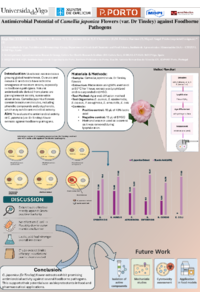
Ezgi Nur YUKSEK-Antimicrobial Potential of Camellia japonica Flowers (var. Dr Tinsley).pdf
Targeting Biofilm-Associated Infections: Antimicrobial and Antibiofilm Effects of Biogenic Zinc Nanoparticles
A Comparative Analysis of the Secondary Metabolites and Antibacterial Properties of a Small Number of Medicinal Plants Available in Dhaka city, Bangladesh