Event submissions
Published
This submission belongs to the session S4. Novel Antimicrobial Agents: Discovery, Design, Synthesis and Action of the event The 4th International Electronic Conference on Antibiotics
Published date
19 May, 2025
Academic Editor
'%3e%3cpath%20d='M12.6657%2010.9104C12.4185%2010.325%2012.0599%209.79327%2011.6097%209.34482C11.1609%208.89508%2010.6293%208.5365%2010.0442%208.28888C10.0389%208.28626%2010.0337%208.28495%2010.0285%208.28233C10.8446%207.69279%2011.3752%206.73249%2011.3752%205.64904C11.3752%203.8542%209.92103%202.39999%208.1262%202.39999C6.33136%202.39999%204.87715%203.8542%204.87715%205.64904C4.87715%206.73249%205.40774%207.69279%206.22393%208.28364C6.21869%208.28626%206.21345%208.28757%206.20821%208.29019C5.62129%208.5378%205.09463%208.89284%204.64265%209.34613C4.1929%209.79493%203.83432%2010.3266%203.58671%2010.9117C3.34345%2011.4845%203.21226%2012.0987%203.20023%2012.7209C3.19988%2012.7349%203.20233%2012.7488%203.20744%2012.7619C3.21255%2012.7749%203.22022%2012.7867%203.22998%2012.7968C3.23975%2012.8068%203.25142%2012.8147%203.26431%2012.8202C3.2772%2012.8256%203.29105%2012.8284%203.30504%2012.8284H4.09109C4.14874%2012.8284%204.19459%2012.7825%204.1959%2012.7262C4.2221%2011.7148%204.62823%2010.7676%205.34617%2010.0497C6.08899%209.30683%207.0755%208.89808%208.1262%208.89808C9.17689%208.89808%2010.1634%209.30683%2010.9062%2010.0497C11.6242%2010.7676%2012.0303%2011.7148%2012.0565%2012.7262C12.0578%2012.7838%2012.1037%2012.8284%2012.1613%2012.8284H12.9474C12.9613%2012.8284%2012.9752%2012.8256%2012.9881%2012.8202C13.001%2012.8147%2013.0126%2012.8068%2013.0224%2012.7968C13.0322%2012.7867%2013.0398%2012.7749%2013.0449%2012.7619C13.0501%2012.7488%2013.0525%2012.7349%2013.0522%2012.7209C13.0391%2012.0947%2012.9094%2011.4855%2012.6657%2010.9104ZM8.1262%207.9024C7.52486%207.9024%206.9589%207.6679%206.53312%207.24211C6.10733%206.81633%205.87283%206.25037%205.87283%205.64904C5.87283%205.0477%206.10733%204.48174%206.53312%204.05596C6.9589%203.63018%207.52486%203.39567%208.1262%203.39567C8.72753%203.39567%209.29349%203.63018%209.71927%204.05596C10.1451%204.48174%2010.3796%205.0477%2010.3796%205.64904C10.3796%206.25037%2010.1451%206.81633%209.71927%207.24211C9.29349%207.6679%208.72753%207.9024%208.1262%207.9024Z'%20fill='%235D1EE1'/%3e%3c/g%3e%3c/svg%3e) Jordi Vila
Jordi VilaCitation
Lyudmila Dimitrova, Milka Mileva, Almira Georgieva, Elina Tzvetanova, Milena Popova, Vassya Bankova, Hristo Najdenski, Effect Of Ethyl Acetate Extracts of the Roots And Aerial Parts of Geum Urbanum L. On The Phenotype Inhibition Of The Pseudomonas Aeruginosa Las/Rhi Quorum Sensing System And Their Antioxidant Activity, in Proceedings of The 4th International Electronic Conference on Antibiotics, 21 May–23 May 2025, MDPI: Basel, Switzerland
Share
Email
Facebook
Twitter
LinkedIn
Effect Of Ethyl Acetate Extracts of the Roots And Aerial Parts of Geum Urbanum L. On The Phenotype Inhibition Of The Pseudomonas Aeruginosa Las/Rhi Quorum Sensing System And Their Antioxidant Activity

Lyudmila Dimitrova 1

Milka Mileva 1
'%3e%3cpath%20d='M12.6647%2010.9104C12.4176%2010.325%2012.0589%209.7933%2011.6088%209.34485C11.16%208.89511%2010.6283%208.53653%2010.0432%208.28891C10.038%208.28629%2010.0327%208.28498%2010.0275%208.28236C10.8437%207.69282%2011.3743%206.73252%2011.3743%205.64907C11.3743%203.85423%209.92005%202.40002%208.12522%202.40002C6.33038%202.40002%204.87618%203.85423%204.87618%205.64907C4.87618%206.73252%205.40677%207.69282%206.22296%208.28367C6.21772%208.28629%206.21248%208.2876%206.20724%208.29022C5.62031%208.53783%205.09365%208.89287%204.64167%209.34616C4.19192%209.79496%203.83334%2010.3266%203.58573%2010.9117C3.34247%2011.4846%203.21128%2012.0987%203.19925%2012.721C3.1989%2012.735%203.20135%2012.7489%203.20646%2012.7619C3.21157%2012.7749%203.21924%2012.7868%203.22901%2012.7968C3.23877%2012.8068%203.25045%2012.8148%203.26334%2012.8202C3.27623%2012.8256%203.29007%2012.8284%203.30406%2012.8284H4.09012C4.14776%2012.8284%204.19362%2012.7825%204.19493%2012.7262C4.22113%2011.7148%204.62726%2010.7676%205.34519%2010.0497C6.08802%209.30686%207.07452%208.89811%208.12522%208.89811C9.17592%208.89811%2010.1624%209.30686%2010.9052%2010.0497C11.6232%2010.7676%2012.0293%2011.7148%2012.0555%2012.7262C12.0568%2012.7839%2012.1027%2012.8284%2012.1603%2012.8284H12.9464C12.9604%2012.8284%2012.9742%2012.8256%2012.9871%2012.8202C13%2012.8148%2013.0117%2012.8068%2013.0214%2012.7968C13.0312%2012.7868%2013.0389%2012.7749%2013.044%2012.7619C13.0491%2012.7489%2013.0515%2012.735%2013.0512%2012.721C13.0381%2012.0947%2012.9084%2011.4856%2012.6647%2010.9104ZM8.12522%207.90243C7.52388%207.90243%206.95792%207.66793%206.53214%207.24215C6.10636%206.81636%205.87185%206.2504%205.87185%205.64907C5.87185%205.04773%206.10636%204.48177%206.53214%204.05599C6.95792%203.63021%207.52388%203.3957%208.12522%203.3957C8.72655%203.3957%209.29252%203.63021%209.7183%204.05599C10.1441%204.48177%2010.3786%205.04773%2010.3786%205.64907C10.3786%206.2504%2010.1441%206.81636%209.7183%207.24215C9.29252%207.66793%208.72655%207.90243%208.12522%207.90243Z'%20fill='%235D1EE1'/%3e%3c/g%3e%3c/svg%3e)
Almira Georgieva 2
Elina Tzvetanova 2

Milena Popova 3

Vassya Bankova 3

Hristo Najdenski 1
1. The Stephan Angeloff Institute of Microbiology, Bulgarian Academy of Sciences, 1113 Sofia, Bulgaria
2. The Stephan Angeloff Institute of Microbiology and Institute of Neurobiology, Bulgarian Academy of Sciences, 1113 Sofia, Bulgaria
3. Institute of Organic Chemistry with Centre of Phytochemistry, Bulgarian Academy of Sciences, 1113 Sofia, Bulgaria
Abstract
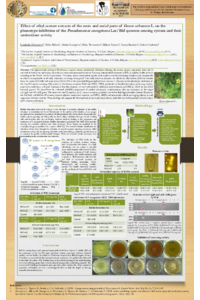
The opportunistic pathogen Pseudomonas aeruginosa causes nosocomial infections affecting the urinary system, respiratory tract, etc. It can lead to bacteremia and sepsis, especially in immunocompromised patients. Growing antimicrobial resistance (AMR) is a global health concern according to the World Health Organization. Therefore, novel antimicrobial agents, such as plant extracts containing complexes of compounds to which it is impossible to develop resistance, are being investigated. This study aimed to compare the effects of ethyl acetate (EtOAc) extracts from the roots (EtOAcR) and aerial parts (EtOAcAP) of the perennial Bulgarian plant Geum urbanum L. (Rosacea) on the phenotype inhibition of the Las/RhI quorum sensing (QS) system in Pseudomonas aeruginosa PA01 and ATCC 27853, specifically on biofilm formation, swarming motility, pyocyanin production, and gene expression. For this purpose, we used sub-minimal inhibition concentrations (sub-MICs), which do not affect bacterial growth. We found that the evaluated sub-MICs suppressed all studied phenotypic manifestations, with no expression of the target lasI/lasR and rhII/rhIR genes. The observed anti-QS capacity of G. urbanum extracts is probably related to their high phenolic content. Moreover, the EtOAcR and EtOAcAP extracts showed effective antioxidant capacity via DPPH, ABTS, and superoxide radical scavenging effects, as well copper ion chelation activity. These findings will support the development of novel phytocomplexes applicable for the biocontrol and prevention of P. aeruginosa infections.
Keywords
Geum urbanum L.
ethyl acetate roots and aerial pats extracts
Pseudomonas aeruginosa
biofilms
pyocyanin production
swarming motility
antioxidant activity
gene expression
quorum sensing
Poster
Effect Of Ethyl Acetate Extracts of the Roots.pdf
Nanotechnology as a promising strategy for controlling oral polymicrobial biofilms
Exploration and Identification of Bioactive Compounds from Antarctic Lichens: Contribution to Bioprospecting of New Antimicrobials