Event submissions
Published
This submission belongs to the session S2. Antibiotics and One Health of the event The 4th International Electronic Conference on Antibiotics
Published date
19 May, 2025
Academic Editor
'%3e%3cpath%20d='M12.6657%2010.9104C12.4185%2010.325%2012.0599%209.79327%2011.6097%209.34482C11.1609%208.89508%2010.6293%208.5365%2010.0442%208.28888C10.0389%208.28626%2010.0337%208.28495%2010.0285%208.28233C10.8446%207.69279%2011.3752%206.73249%2011.3752%205.64904C11.3752%203.8542%209.92103%202.39999%208.1262%202.39999C6.33136%202.39999%204.87715%203.8542%204.87715%205.64904C4.87715%206.73249%205.40774%207.69279%206.22393%208.28364C6.21869%208.28626%206.21345%208.28757%206.20821%208.29019C5.62129%208.5378%205.09463%208.89284%204.64265%209.34613C4.1929%209.79493%203.83432%2010.3266%203.58671%2010.9117C3.34345%2011.4845%203.21226%2012.0987%203.20023%2012.7209C3.19988%2012.7349%203.20233%2012.7488%203.20744%2012.7619C3.21255%2012.7749%203.22022%2012.7867%203.22998%2012.7968C3.23975%2012.8068%203.25142%2012.8147%203.26431%2012.8202C3.2772%2012.8256%203.29105%2012.8284%203.30504%2012.8284H4.09109C4.14874%2012.8284%204.19459%2012.7825%204.1959%2012.7262C4.2221%2011.7148%204.62823%2010.7676%205.34617%2010.0497C6.08899%209.30683%207.0755%208.89808%208.1262%208.89808C9.17689%208.89808%2010.1634%209.30683%2010.9062%2010.0497C11.6242%2010.7676%2012.0303%2011.7148%2012.0565%2012.7262C12.0578%2012.7838%2012.1037%2012.8284%2012.1613%2012.8284H12.9474C12.9613%2012.8284%2012.9752%2012.8256%2012.9881%2012.8202C13.001%2012.8147%2013.0126%2012.8068%2013.0224%2012.7968C13.0322%2012.7867%2013.0398%2012.7749%2013.0449%2012.7619C13.0501%2012.7488%2013.0525%2012.7349%2013.0522%2012.7209C13.0391%2012.0947%2012.9094%2011.4855%2012.6657%2010.9104ZM8.1262%207.9024C7.52486%207.9024%206.9589%207.6679%206.53312%207.24211C6.10733%206.81633%205.87283%206.25037%205.87283%205.64904C5.87283%205.0477%206.10733%204.48174%206.53312%204.05596C6.9589%203.63018%207.52486%203.39567%208.1262%203.39567C8.72753%203.39567%209.29349%203.63018%209.71927%204.05596C10.1451%204.48174%2010.3796%205.0477%2010.3796%205.64904C10.3796%206.25037%2010.1451%206.81633%209.71927%207.24211C9.29349%207.6679%208.72753%207.9024%208.1262%207.9024Z'%20fill='%235D1EE1'/%3e%3c/g%3e%3c/svg%3e) Efstathios Giaouris
Efstathios GiaourisCitation
Aliyu Abdulkadir, Marvelous Oluwashina Ajayi, Halima Abubakar Kusfa, A Survey of Antimicrobial Usage/Consumption in Animal Production: a Cross-Sectional Study of Kaduna Metropolis, Nigeria, in Proceedings of The 4th International Electronic Conference on Antibiotics, 21 May–23 May 2025, MDPI: Basel, Switzerland
Share
Email
Facebook
Twitter
LinkedIn
A Survey of Antimicrobial Usage/Consumption in Animal Production: a Cross-Sectional Study of Kaduna Metropolis, Nigeria
'%3e%3cpath%20d='M12.6647%2010.9104C12.4176%2010.325%2012.0589%209.7933%2011.6088%209.34485C11.16%208.89511%2010.6283%208.53653%2010.0432%208.28891C10.038%208.28629%2010.0327%208.28498%2010.0275%208.28236C10.8437%207.69282%2011.3743%206.73252%2011.3743%205.64907C11.3743%203.85423%209.92005%202.40002%208.12522%202.40002C6.33038%202.40002%204.87618%203.85423%204.87618%205.64907C4.87618%206.73252%205.40677%207.69282%206.22296%208.28367C6.21772%208.28629%206.21248%208.2876%206.20724%208.29022C5.62031%208.53783%205.09365%208.89287%204.64167%209.34616C4.19192%209.79496%203.83334%2010.3266%203.58573%2010.9117C3.34247%2011.4846%203.21128%2012.0987%203.19925%2012.721C3.1989%2012.735%203.20135%2012.7489%203.20646%2012.7619C3.21157%2012.7749%203.21924%2012.7868%203.22901%2012.7968C3.23877%2012.8068%203.25045%2012.8148%203.26334%2012.8202C3.27623%2012.8256%203.29007%2012.8284%203.30406%2012.8284H4.09012C4.14776%2012.8284%204.19362%2012.7825%204.19493%2012.7262C4.22113%2011.7148%204.62726%2010.7676%205.34519%2010.0497C6.08802%209.30686%207.07452%208.89811%208.12522%208.89811C9.17592%208.89811%2010.1624%209.30686%2010.9052%2010.0497C11.6232%2010.7676%2012.0293%2011.7148%2012.0555%2012.7262C12.0568%2012.7839%2012.1027%2012.8284%2012.1603%2012.8284H12.9464C12.9604%2012.8284%2012.9742%2012.8256%2012.9871%2012.8202C13%2012.8148%2013.0117%2012.8068%2013.0214%2012.7968C13.0312%2012.7868%2013.0389%2012.7749%2013.044%2012.7619C13.0491%2012.7489%2013.0515%2012.735%2013.0512%2012.721C13.0381%2012.0947%2012.9084%2011.4856%2012.6647%2010.9104ZM8.12522%207.90243C7.52388%207.90243%206.95792%207.66793%206.53214%207.24215C6.10636%206.81636%205.87185%206.2504%205.87185%205.64907C5.87185%205.04773%206.10636%204.48177%206.53214%204.05599C6.95792%203.63021%207.52388%203.3957%208.12522%203.3957C8.72655%203.3957%209.29252%203.63021%209.7183%204.05599C10.1441%204.48177%2010.3786%205.04773%2010.3786%205.64907C10.3786%206.2504%2010.1441%206.81636%209.7183%207.24215C9.29252%207.66793%208.72655%207.90243%208.12522%207.90243Z'%20fill='%235D1EE1'/%3e%3c/g%3e%3c/svg%3e)
Aliyu Abdulkadir 1
Marvelous Oluwashina Ajayi 1
Halima Abubakar Kusfa 1
1. Public Health and Preventive Medicine, Ahmadu Bello University, Zaria, Nigeria
Abstract
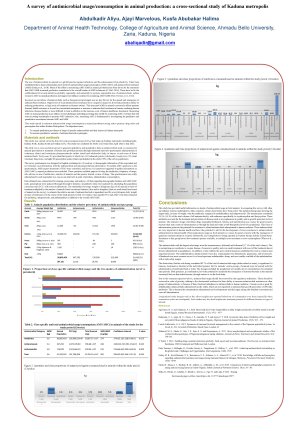
BACKGROUND: The use of antimicrobials in animals is a global practice against infections and for the enhancement of productivity. This study was aimed at monitoring antimicrobial usage/consumption (AMU/AMC) in animal production in Kaduna metropolis. Measuring AMU in animal production can provide useful data for monitoring AMU over time, which will assist in setting benchmarks to promote antimicrobial resistance (AMR) reduction.
METHOD: This study involved the daily collation and validation of active primary drug sales and prescription data from thirty-two veterinary pharmaceutical outlets and clinics out of forty-one (41) pre-identified points within Kaduna metropolis (78%) over a 12-week period.
RESULTS: Classes and types of antimicrobials that were identified included macrolides, quinoxalines, polypeptides, streptogramins, glycolipids, oligosaccharides, phosphonic acids, and polymeric compounds. In total, 83.7% of the identified antimicrobials were in the forms of oral medication, and most were registered antibiotics (52.8%). Parenteral and topical forms were also identified, with 94% also being antibiotics. The estimated AMU/AMC was 282mg/kg population correction unit (PCU). Poultry were the most significant population, constituting 99% (31,502,004) of the study population. The class-specific AMU/AMC was antibiotics, with 274mg/kg PCU (with the terramycines constituting 24.1%). The antiprotozoal AMU/AMC was 418mg/kg PCU, of which triazenetriones (17.1%) were mainly applied in the treatment of coccidia infections. The anthelminthic AMU/AMC was the highest at 576mg/kg PCU, with albendazole, piperazine, and levamisole being the most commonly used. These constituted 95.8% of the volume of anthelminthics and 16.5% of the volume of antimicrobials that were used in animals in the study. Oxytetracycline had the highest sale/usage for a single active agent at 9.6% of the volume.
CONCLUSION: This study has provided useful and practical information on the trends in antimicrobial usage in animals, with poultry being the most important animal population involved in AMU/AMC and oxytetracycline being the most abused antibiotic in animal production. Antimicrobial stewardship (AMS) should be targeted at poultry populations, with an emphasis on reducing antibiotic usage/consumption.
Keywords
Animal
production
antimicrobial
usage
consumption
stewardship
one health
Poster
Antibiotics eConference Poster Presentation.pdf
Catalytic Production of Erythromycin Against COVID-19
Prescribing Patterns and the Pharmacoeconomic Evaluation Of Antibiotics in the Pediatric Population Of A Tertiary Care Teaching Hospital—A Prospective, Observational Study