Event submissions
Published
This submission belongs to the session S2. Antibiotics and One Health of the event The 4th International Electronic Conference on Antibiotics
Published date
19 May, 2025
Academic Editor
'%3e%3cpath%20d='M12.6657%2010.9104C12.4185%2010.325%2012.0599%209.79327%2011.6097%209.34482C11.1609%208.89508%2010.6293%208.5365%2010.0442%208.28888C10.0389%208.28626%2010.0337%208.28495%2010.0285%208.28233C10.8446%207.69279%2011.3752%206.73249%2011.3752%205.64904C11.3752%203.8542%209.92103%202.39999%208.1262%202.39999C6.33136%202.39999%204.87715%203.8542%204.87715%205.64904C4.87715%206.73249%205.40774%207.69279%206.22393%208.28364C6.21869%208.28626%206.21345%208.28757%206.20821%208.29019C5.62129%208.5378%205.09463%208.89284%204.64265%209.34613C4.1929%209.79493%203.83432%2010.3266%203.58671%2010.9117C3.34345%2011.4845%203.21226%2012.0987%203.20023%2012.7209C3.19988%2012.7349%203.20233%2012.7488%203.20744%2012.7619C3.21255%2012.7749%203.22022%2012.7867%203.22998%2012.7968C3.23975%2012.8068%203.25142%2012.8147%203.26431%2012.8202C3.2772%2012.8256%203.29105%2012.8284%203.30504%2012.8284H4.09109C4.14874%2012.8284%204.19459%2012.7825%204.1959%2012.7262C4.2221%2011.7148%204.62823%2010.7676%205.34617%2010.0497C6.08899%209.30683%207.0755%208.89808%208.1262%208.89808C9.17689%208.89808%2010.1634%209.30683%2010.9062%2010.0497C11.6242%2010.7676%2012.0303%2011.7148%2012.0565%2012.7262C12.0578%2012.7838%2012.1037%2012.8284%2012.1613%2012.8284H12.9474C12.9613%2012.8284%2012.9752%2012.8256%2012.9881%2012.8202C13.001%2012.8147%2013.0126%2012.8068%2013.0224%2012.7968C13.0322%2012.7867%2013.0398%2012.7749%2013.0449%2012.7619C13.0501%2012.7488%2013.0525%2012.7349%2013.0522%2012.7209C13.0391%2012.0947%2012.9094%2011.4855%2012.6657%2010.9104ZM8.1262%207.9024C7.52486%207.9024%206.9589%207.6679%206.53312%207.24211C6.10733%206.81633%205.87283%206.25037%205.87283%205.64904C5.87283%205.0477%206.10733%204.48174%206.53312%204.05596C6.9589%203.63018%207.52486%203.39567%208.1262%203.39567C8.72753%203.39567%209.29349%203.63018%209.71927%204.05596C10.1451%204.48174%2010.3796%205.0477%2010.3796%205.64904C10.3796%206.25037%2010.1451%206.81633%209.71927%207.24211C9.29349%207.6679%208.72753%207.9024%208.1262%207.9024Z'%20fill='%235D1EE1'/%3e%3c/g%3e%3c/svg%3e) Efstathios Giaouris
Efstathios GiaourisCitation
Fataha Sultana, Jarin Tabassum, Sohidul Islam, Ishrat Jabeen, Sabbir Rahman Shuvo, Genetic Insights into Acinetobacter bereziniae IJ5: A Comparative Genomics Perspective, in Proceedings of The 4th International Electronic Conference on Antibiotics, 21 May–23 May 2025, MDPI: Basel, Switzerland
Share
Email
Facebook
Twitter
LinkedIn
Genetic Insights into Acinetobacter bereziniae IJ5: A Comparative Genomics Perspective
'%3e%3cpath%20d='M12.6647%2010.9104C12.4176%2010.325%2012.0589%209.7933%2011.6088%209.34485C11.16%208.89511%2010.6283%208.53653%2010.0432%208.28891C10.038%208.28629%2010.0327%208.28498%2010.0275%208.28236C10.8437%207.69282%2011.3743%206.73252%2011.3743%205.64907C11.3743%203.85423%209.92005%202.40002%208.12522%202.40002C6.33038%202.40002%204.87618%203.85423%204.87618%205.64907C4.87618%206.73252%205.40677%207.69282%206.22296%208.28367C6.21772%208.28629%206.21248%208.2876%206.20724%208.29022C5.62031%208.53783%205.09365%208.89287%204.64167%209.34616C4.19192%209.79496%203.83334%2010.3266%203.58573%2010.9117C3.34247%2011.4846%203.21128%2012.0987%203.19925%2012.721C3.1989%2012.735%203.20135%2012.7489%203.20646%2012.7619C3.21157%2012.7749%203.21924%2012.7868%203.22901%2012.7968C3.23877%2012.8068%203.25045%2012.8148%203.26334%2012.8202C3.27623%2012.8256%203.29007%2012.8284%203.30406%2012.8284H4.09012C4.14776%2012.8284%204.19362%2012.7825%204.19493%2012.7262C4.22113%2011.7148%204.62726%2010.7676%205.34519%2010.0497C6.08802%209.30686%207.07452%208.89811%208.12522%208.89811C9.17592%208.89811%2010.1624%209.30686%2010.9052%2010.0497C11.6232%2010.7676%2012.0293%2011.7148%2012.0555%2012.7262C12.0568%2012.7839%2012.1027%2012.8284%2012.1603%2012.8284H12.9464C12.9604%2012.8284%2012.9742%2012.8256%2012.9871%2012.8202C13%2012.8148%2013.0117%2012.8068%2013.0214%2012.7968C13.0312%2012.7868%2013.0389%2012.7749%2013.044%2012.7619C13.0491%2012.7489%2013.0515%2012.735%2013.0512%2012.721C13.0381%2012.0947%2012.9084%2011.4856%2012.6647%2010.9104ZM8.12522%207.90243C7.52388%207.90243%206.95792%207.66793%206.53214%207.24215C6.10636%206.81636%205.87185%206.2504%205.87185%205.64907C5.87185%205.04773%206.10636%204.48177%206.53214%204.05599C6.95792%203.63021%207.52388%203.3957%208.12522%203.3957C8.72655%203.3957%209.29252%203.63021%209.7183%204.05599C10.1441%204.48177%2010.3786%205.04773%2010.3786%205.64907C10.3786%206.2504%2010.1441%206.81636%209.7183%207.24215C9.29252%207.66793%208.72655%207.90243%208.12522%207.90243Z'%20fill='%235D1EE1'/%3e%3c/g%3e%3c/svg%3e)
Fataha Sultana 1
Jarin Tabassum 1
Sohidul Islam 1
Ishrat Jabeen 1
Sabbir Rahman Shuvo 1
1. North South University, Dhaka 1229, Bangladesh
Abstract
Abstract
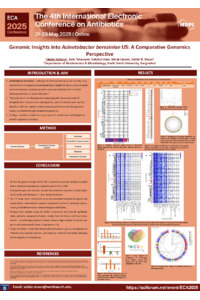
Introduction : Acinetobacter bereziniae IJ5 is a Gram-negative bacterium notorious for multidrug resistance and poses a significant risk for nosocomial infections. This study focuses on the genomic characterization of A. bereziniae strain IJ5, recovered from drinking water in Dhaka, Bangladesh. Through comparative genome analysis with other global strains, we determine its pathogenicity, virulence, and adaptation strategies.
Methods: The genome of A. bereziniae was sequenced using Illumina MiniSeq, followed by assembly with Shovill on Galaxy and annotation through RAST and PGAP in NCBI. The bioinformatics analyses carried out revealed antibiotic resistance genes, virulome, toxin–antitoxin systems, secondary metabolites, and prophage sequences, with the goal of identifying the factors that contribute to its pathogenicity.
Result : A unique combination of MDR genes such as qacG, adeF, OXA-355, and vanG was identified, coupled with diverse toxin–antitoxin systems consisting of RelE/RelB, ParE/ParD, and HigB/HigA, underscoring the high survival capability of IJ5. The genome of A.bereziniae IJ5 has a GC content of 38% and a total size of 4.4 Mb. The presence of distinct metabolic pathways, such as Ni-siderophores, RiPP-like compounds, and arylpolyenes, contributes to the resilience of IJ5 in clinical environments. IJ5’s pathogenicity score of 77.2% indicates a strong potential to infect humans, enhanced by regulatory
elements. IJ5 is closely related to the AB839 (Taiwan) and FFMG-36-12-21 (Tanzania) strains of A. bereziniae, as they share a common ancestor; additionally no other strains cluster with IJ5, portraying its unique sub-lineage.
Conclusion: The genomic analysis of A. bereziniae reveals a distinctive mixture of MDR genes and toxin–antitoxin systems, showing an enhanced adaptability in clinical settings. A high pathogenicity score of 77.2% indicates strong infection potential, likely reinforced by regulatory elements. Comparative analysis further shows the genomic plasticity and persistence of IJ5, highlighting the necessity for continuous surveillance and research to develop targeted infection control and treatment strategies within Bangladeshi healthcare facilities.
Keywords
Acinetobacter bereziniae
pathogenicity
whole-genome sequencing
Poster
ECA POSTER.pdf
Antibiotic resistance of Staphylococcus aureus isolated from raw beef sold in meat processing plants and markets
Comparative study on the Efficacy and safety of Gemifloxacin Versus Amoxicillin/Clavulanate in the management of Chronic Bronchitis