Event submissions
Published
This submission belongs to the session S4. Novel Antimicrobial Agents: Discovery, Design, Synthesis and Action of the event The 4th International Electronic Conference on Antibiotics
Published date
19 May, 2025
Academic Editor
'%3e%3cpath%20d='M12.6657%2010.9104C12.4185%2010.325%2012.0599%209.79327%2011.6097%209.34482C11.1609%208.89508%2010.6293%208.5365%2010.0442%208.28888C10.0389%208.28626%2010.0337%208.28495%2010.0285%208.28233C10.8446%207.69279%2011.3752%206.73249%2011.3752%205.64904C11.3752%203.8542%209.92103%202.39999%208.1262%202.39999C6.33136%202.39999%204.87715%203.8542%204.87715%205.64904C4.87715%206.73249%205.40774%207.69279%206.22393%208.28364C6.21869%208.28626%206.21345%208.28757%206.20821%208.29019C5.62129%208.5378%205.09463%208.89284%204.64265%209.34613C4.1929%209.79493%203.83432%2010.3266%203.58671%2010.9117C3.34345%2011.4845%203.21226%2012.0987%203.20023%2012.7209C3.19988%2012.7349%203.20233%2012.7488%203.20744%2012.7619C3.21255%2012.7749%203.22022%2012.7867%203.22998%2012.7968C3.23975%2012.8068%203.25142%2012.8147%203.26431%2012.8202C3.2772%2012.8256%203.29105%2012.8284%203.30504%2012.8284H4.09109C4.14874%2012.8284%204.19459%2012.7825%204.1959%2012.7262C4.2221%2011.7148%204.62823%2010.7676%205.34617%2010.0497C6.08899%209.30683%207.0755%208.89808%208.1262%208.89808C9.17689%208.89808%2010.1634%209.30683%2010.9062%2010.0497C11.6242%2010.7676%2012.0303%2011.7148%2012.0565%2012.7262C12.0578%2012.7838%2012.1037%2012.8284%2012.1613%2012.8284H12.9474C12.9613%2012.8284%2012.9752%2012.8256%2012.9881%2012.8202C13.001%2012.8147%2013.0126%2012.8068%2013.0224%2012.7968C13.0322%2012.7867%2013.0398%2012.7749%2013.0449%2012.7619C13.0501%2012.7488%2013.0525%2012.7349%2013.0522%2012.7209C13.0391%2012.0947%2012.9094%2011.4855%2012.6657%2010.9104ZM8.1262%207.9024C7.52486%207.9024%206.9589%207.6679%206.53312%207.24211C6.10733%206.81633%205.87283%206.25037%205.87283%205.64904C5.87283%205.0477%206.10733%204.48174%206.53312%204.05596C6.9589%203.63018%207.52486%203.39567%208.1262%203.39567C8.72753%203.39567%209.29349%203.63018%209.71927%204.05596C10.1451%204.48174%2010.3796%205.0477%2010.3796%205.64904C10.3796%206.25037%2010.1451%206.81633%209.71927%207.24211C9.29349%207.6679%208.72753%207.9024%208.1262%207.9024Z'%20fill='%235D1EE1'/%3e%3c/g%3e%3c/svg%3e) Jordi Vila
Jordi VilaCitation
Laura Cerezo Collado, Víctor Garcés, Pablo Alarcón-Guijo, José Manuel Delgado-López, Jose Manuel Dominguez-Vera, Jose Gutiérrez-Fernández, TARGETING CARBAPENEM-RESISTANT INFECTIONS THROUGH PROBIOTIC-BASED LIVING MATERIALS, in Proceedings of The 4th International Electronic Conference on Antibiotics, 21 May–23 May 2025, MDPI: Basel, Switzerland
Share
Email
Facebook
Twitter
LinkedIn
TARGETING CARBAPENEM-RESISTANT INFECTIONS THROUGH PROBIOTIC-BASED LIVING MATERIALS
'%3e%3cpath%20d='M12.6647%2010.9104C12.4176%2010.325%2012.0589%209.7933%2011.6088%209.34485C11.16%208.89511%2010.6283%208.53653%2010.0432%208.28891C10.038%208.28629%2010.0327%208.28498%2010.0275%208.28236C10.8437%207.69282%2011.3743%206.73252%2011.3743%205.64907C11.3743%203.85423%209.92005%202.40002%208.12522%202.40002C6.33038%202.40002%204.87618%203.85423%204.87618%205.64907C4.87618%206.73252%205.40677%207.69282%206.22296%208.28367C6.21772%208.28629%206.21248%208.2876%206.20724%208.29022C5.62031%208.53783%205.09365%208.89287%204.64167%209.34616C4.19192%209.79496%203.83334%2010.3266%203.58573%2010.9117C3.34247%2011.4846%203.21128%2012.0987%203.19925%2012.721C3.1989%2012.735%203.20135%2012.7489%203.20646%2012.7619C3.21157%2012.7749%203.21924%2012.7868%203.22901%2012.7968C3.23877%2012.8068%203.25045%2012.8148%203.26334%2012.8202C3.27623%2012.8256%203.29007%2012.8284%203.30406%2012.8284H4.09012C4.14776%2012.8284%204.19362%2012.7825%204.19493%2012.7262C4.22113%2011.7148%204.62726%2010.7676%205.34519%2010.0497C6.08802%209.30686%207.07452%208.89811%208.12522%208.89811C9.17592%208.89811%2010.1624%209.30686%2010.9052%2010.0497C11.6232%2010.7676%2012.0293%2011.7148%2012.0555%2012.7262C12.0568%2012.7839%2012.1027%2012.8284%2012.1603%2012.8284H12.9464C12.9604%2012.8284%2012.9742%2012.8256%2012.9871%2012.8202C13%2012.8148%2013.0117%2012.8068%2013.0214%2012.7968C13.0312%2012.7868%2013.0389%2012.7749%2013.044%2012.7619C13.0491%2012.7489%2013.0515%2012.735%2013.0512%2012.721C13.0381%2012.0947%2012.9084%2011.4856%2012.6647%2010.9104ZM8.12522%207.90243C7.52388%207.90243%206.95792%207.66793%206.53214%207.24215C6.10636%206.81636%205.87185%206.2504%205.87185%205.64907C5.87185%205.04773%206.10636%204.48177%206.53214%204.05599C6.95792%203.63021%207.52388%203.3957%208.12522%203.3957C8.72655%203.3957%209.29252%203.63021%209.7183%204.05599C10.1441%204.48177%2010.3786%205.04773%2010.3786%205.64907C10.3786%206.2504%2010.1441%206.81636%209.7183%207.24215C9.29252%207.66793%208.72655%207.90243%208.12522%207.90243Z'%20fill='%235D1EE1'/%3e%3c/g%3e%3c/svg%3e)
Laura Cerezo Collado 1
Víctor Garcés 1
Pablo Alarcón-Guijo 1
José Manuel Delgado-López 1
Jose Manuel Dominguez-Vera 1

Jose Gutiérrez-Fernández 2
1. Department of Inorganic Chemistry, University of Granada, Faculty of Sciences, Avda. Fuentenueva s/n, 18071 Granada, Spain
2. Department of Microbiology, Virgen de las Nieves University Hospital, 18014 Granada, Spain.
Abstract
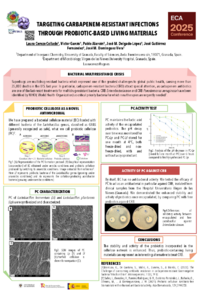
The rapid rise of antibiotic-resistant bacteria has emerged as one of the most urgent and critical threats to global public health. Among these, carbapenem-resistant bacteria (CRB) pose a particular challenge, as carbapenem antibiotics are regarded as the last line of defense against multidrug-resistant infections [1]. This study evaluates the antimicrobial properties of probiotic cellulose (PC), a material made of dense cellulose nanofibers colonized by Lactobacillus species, which are classified as GRAS (generally recognized as safe). This method overcomes the limitation of bacterial cellulose produced by Komagataeibacter xylinus, which lacks intrinsic antibacterial activity [2]. We tested various PC samples, each loaded with Lactobacillus fermentum (Lf), Lactobacillus plantarum (Lp), or a combination of both (Lp+Lf), against CRB strains isolated from clinical samples at the Hospital Virgen de las Nieves (Granada). Agar diffusion inhibition assays were performed in a medium favorable for pathogen growth to assess efficacy. The results revealed that all PC samples exhibited inhibition zones against the tested CRB strains. The antimicrobial activity of PC is attributed to the encapsulation of probiotics within the cellulose matrix, as free Lactobacillus species (without bacterial cellulose) showed no inhibitory effect on the pathogenic strains.
Acknowledgments. The results were funded by the research project "PROBCEL - Probiotic cellulose. A new material for the treatment of antibiotic-resistant bacterial infections", reference PDC2022-133234-I00. The project was funded by MCIN/AEI /10.13039/501100011033 and by the European Union Next GenerationEU/ PRTR.
[1] Mancuso, G.; De Gaetano, S.; Midiri, A.; Zummo, S.; Biondo, C. The Challenge of overcoming antibiotic resistance in carbapenem-resistant Gram-negative bacteria: “Attack on Titan”. Microorganisms 2023, 11(8), 1912.
[2] Sabio, L.; González, A.; Ramírez-Rodríguez, G. B.; Gutiérrez-Fernández, J.; Bañuelo, O.; Olivares, M.; Dominguez-Vera, J.M. Probiotic cellulose: Antibiotic-free biomaterials with enhanced antibacterial activity. Acta Biomaterialia 2021,124, 244-253.
Keywords
Probiotics
Antibiotics
Bacterial resistance
Cellulose
Living materials
Poster
POSTER ECA_LauraCerezo 2025.pdf
Corrugated Biopolymeric Grafts: A Multifunctional Approach to Vascular Reconstruction and Haemodynamic Optimization
ASSESSING THE IMPACT OF DECANOYL-RVKR-CHLOROMETHYL KETONE ON CRYPTOCOCCUS NEOFORMANS CELLS