Event submissions
Published
This submission belongs to the session S4. Novel Antimicrobial Agents: Discovery, Design, Synthesis and Action of the event The 4th International Electronic Conference on Antibiotics
Published date
19 May, 2025
Academic Editor
'%3e%3cpath%20d='M12.6657%2010.9104C12.4185%2010.325%2012.0599%209.79327%2011.6097%209.34482C11.1609%208.89508%2010.6293%208.5365%2010.0442%208.28888C10.0389%208.28626%2010.0337%208.28495%2010.0285%208.28233C10.8446%207.69279%2011.3752%206.73249%2011.3752%205.64904C11.3752%203.8542%209.92103%202.39999%208.1262%202.39999C6.33136%202.39999%204.87715%203.8542%204.87715%205.64904C4.87715%206.73249%205.40774%207.69279%206.22393%208.28364C6.21869%208.28626%206.21345%208.28757%206.20821%208.29019C5.62129%208.5378%205.09463%208.89284%204.64265%209.34613C4.1929%209.79493%203.83432%2010.3266%203.58671%2010.9117C3.34345%2011.4845%203.21226%2012.0987%203.20023%2012.7209C3.19988%2012.7349%203.20233%2012.7488%203.20744%2012.7619C3.21255%2012.7749%203.22022%2012.7867%203.22998%2012.7968C3.23975%2012.8068%203.25142%2012.8147%203.26431%2012.8202C3.2772%2012.8256%203.29105%2012.8284%203.30504%2012.8284H4.09109C4.14874%2012.8284%204.19459%2012.7825%204.1959%2012.7262C4.2221%2011.7148%204.62823%2010.7676%205.34617%2010.0497C6.08899%209.30683%207.0755%208.89808%208.1262%208.89808C9.17689%208.89808%2010.1634%209.30683%2010.9062%2010.0497C11.6242%2010.7676%2012.0303%2011.7148%2012.0565%2012.7262C12.0578%2012.7838%2012.1037%2012.8284%2012.1613%2012.8284H12.9474C12.9613%2012.8284%2012.9752%2012.8256%2012.9881%2012.8202C13.001%2012.8147%2013.0126%2012.8068%2013.0224%2012.7968C13.0322%2012.7867%2013.0398%2012.7749%2013.0449%2012.7619C13.0501%2012.7488%2013.0525%2012.7349%2013.0522%2012.7209C13.0391%2012.0947%2012.9094%2011.4855%2012.6657%2010.9104ZM8.1262%207.9024C7.52486%207.9024%206.9589%207.6679%206.53312%207.24211C6.10733%206.81633%205.87283%206.25037%205.87283%205.64904C5.87283%205.0477%206.10733%204.48174%206.53312%204.05596C6.9589%203.63018%207.52486%203.39567%208.1262%203.39567C8.72753%203.39567%209.29349%203.63018%209.71927%204.05596C10.1451%204.48174%2010.3796%205.0477%2010.3796%205.64904C10.3796%206.25037%2010.1451%206.81633%209.71927%207.24211C9.29349%207.6679%208.72753%207.9024%208.1262%207.9024Z'%20fill='%235D1EE1'/%3e%3c/g%3e%3c/svg%3e) Jordi Vila
Jordi VilaCitation
Colleen Kay-lee Mc Quire, Maphori Maliehe, Nozethu Mjokane, Olihile Sebolai, ASSESSING THE IMPACT OF DECANOYL-RVKR-CHLOROMETHYL KETONE ON CRYPTOCOCCUS NEOFORMANS CELLS, in Proceedings of The 4th International Electronic Conference on Antibiotics, 21 May–23 May 2025, MDPI: Basel, Switzerland
Share
Email
Facebook
Twitter
LinkedIn
ASSESSING THE IMPACT OF DECANOYL-RVKR-CHLOROMETHYL KETONE ON CRYPTOCOCCUS NEOFORMANS CELLS
'%3e%3cpath%20d='M12.6647%2010.9104C12.4176%2010.325%2012.0589%209.7933%2011.6088%209.34485C11.16%208.89511%2010.6283%208.53653%2010.0432%208.28891C10.038%208.28629%2010.0327%208.28498%2010.0275%208.28236C10.8437%207.69282%2011.3743%206.73252%2011.3743%205.64907C11.3743%203.85423%209.92005%202.40002%208.12522%202.40002C6.33038%202.40002%204.87618%203.85423%204.87618%205.64907C4.87618%206.73252%205.40677%207.69282%206.22296%208.28367C6.21772%208.28629%206.21248%208.2876%206.20724%208.29022C5.62031%208.53783%205.09365%208.89287%204.64167%209.34616C4.19192%209.79496%203.83334%2010.3266%203.58573%2010.9117C3.34247%2011.4846%203.21128%2012.0987%203.19925%2012.721C3.1989%2012.735%203.20135%2012.7489%203.20646%2012.7619C3.21157%2012.7749%203.21924%2012.7868%203.22901%2012.7968C3.23877%2012.8068%203.25045%2012.8148%203.26334%2012.8202C3.27623%2012.8256%203.29007%2012.8284%203.30406%2012.8284H4.09012C4.14776%2012.8284%204.19362%2012.7825%204.19493%2012.7262C4.22113%2011.7148%204.62726%2010.7676%205.34519%2010.0497C6.08802%209.30686%207.07452%208.89811%208.12522%208.89811C9.17592%208.89811%2010.1624%209.30686%2010.9052%2010.0497C11.6232%2010.7676%2012.0293%2011.7148%2012.0555%2012.7262C12.0568%2012.7839%2012.1027%2012.8284%2012.1603%2012.8284H12.9464C12.9604%2012.8284%2012.9742%2012.8256%2012.9871%2012.8202C13%2012.8148%2013.0117%2012.8068%2013.0214%2012.7968C13.0312%2012.7868%2013.0389%2012.7749%2013.044%2012.7619C13.0491%2012.7489%2013.0515%2012.735%2013.0512%2012.721C13.0381%2012.0947%2012.9084%2011.4856%2012.6647%2010.9104ZM8.12522%207.90243C7.52388%207.90243%206.95792%207.66793%206.53214%207.24215C6.10636%206.81636%205.87185%206.2504%205.87185%205.64907C5.87185%205.04773%206.10636%204.48177%206.53214%204.05599C6.95792%203.63021%207.52388%203.3957%208.12522%203.3957C8.72655%203.3957%209.29252%203.63021%209.7183%204.05599C10.1441%204.48177%2010.3786%205.04773%2010.3786%205.64907C10.3786%206.2504%2010.1441%206.81636%209.7183%207.24215C9.29252%207.66793%208.72655%207.90243%208.12522%207.90243Z'%20fill='%235D1EE1'/%3e%3c/g%3e%3c/svg%3e)
Colleen Kay-lee Mc Quire 1
Maphori Maliehe 1
Nozethu Mjokane 1
Olihile Sebolai 1
1. Department of Microbiology and Biochemistry, University of the Free State, Bloemfontein, 9301 South Africa
Abstract
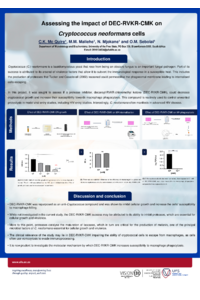
Cryptococcus neoformans is a basidiomycetous yeast that rose from being an obscure fungus to an important fungal pathogen. Part of its success is attributed to its arsenal of virulence factors that allow it to subvert the immunological response in a susceptible host, including the production of proteases that can permeabilise the phagosomal membrane, leading to internalised cells escaping. This project sought to assess if a protease inhibitor, decanoyl-RVKR-chloromethyl ketone (DEC-RVKR-CMK), could decrease cryptococcal growth and increase their susceptibility towards macrophage phagocytosis. This compound is used to control unwanted proteolysis in model viral entry studies, including HIV entry studies. The in vitro susceptibility of cryptococcal cells was assessed by measuring the optical density of the cells following exposure to different DEC-RVKR-CMK concentrations. Additionally, the DEC-RVKR-CMK-treated and non-treated cells were co-cultured with macrophages to assess their susceptibility to macrophage phagocytosis. The pHrodo stain was used to assess the internalisation of cryptococcal cells by macrophages. The macrophages were lysed to liberate the internalised cryptococcal cells. A 10-fold increase in DEC-RVKR-CMK concentration led to the growth of cryptococcal cells being inhibited in a dose-dependent manner. In this study, 0.1 mM was defined as the minimum inhibition concentration and led to over 75% growth inhibition. There was no difference in the efficiency of macrophages to internalised DEC-RVKR-CMK-treated and non-treated cells. However, no colonies of DEC-RVKR-CMK-treated cells could be recovered on mycological agar, while the non-treated cells yielded colonies on the agar. The in vitro preliminary data obtained in this study suggest that DEC-RVKR-CMK may be ideal for controlling cryptococcal growth. The clinical relevance of the study may lie in impairing the ability of cryptococcal cells to escape from macrophages, avoiding immunoprocessing. It is suggested to investigate if this quality can be observed in other C. neoformans strains and elucidate the molecular mechanism underpinning the reported observations.
Keywords
Cryptococcus neoformans
Decanoyl-RVKR-chloromethyl ketone (DEC-RVKR-CMK)
Internalisation
Macrophage
Phagocytosis
Proteases.
Poster
Sciforum poster Colleen.pdf
TARGETING CARBAPENEM-RESISTANT INFECTIONS THROUGH PROBIOTIC-BASED LIVING MATERIALS
A High Presence of CTX-M-2-Producing Escherichia coli in Chicken Meat Obtained from Butcher Shops in La Plata City, Argentina.