Event submissions
Published
This submission belongs to the session S4. Novel Antimicrobial Agents: Discovery, Design, Synthesis and Action of the event The 4th International Electronic Conference on Antibiotics
Published date
19 May, 2025
Academic Editor
'%3e%3cpath%20d='M12.6657%2010.9104C12.4185%2010.325%2012.0599%209.79327%2011.6097%209.34482C11.1609%208.89508%2010.6293%208.5365%2010.0442%208.28888C10.0389%208.28626%2010.0337%208.28495%2010.0285%208.28233C10.8446%207.69279%2011.3752%206.73249%2011.3752%205.64904C11.3752%203.8542%209.92103%202.39999%208.1262%202.39999C6.33136%202.39999%204.87715%203.8542%204.87715%205.64904C4.87715%206.73249%205.40774%207.69279%206.22393%208.28364C6.21869%208.28626%206.21345%208.28757%206.20821%208.29019C5.62129%208.5378%205.09463%208.89284%204.64265%209.34613C4.1929%209.79493%203.83432%2010.3266%203.58671%2010.9117C3.34345%2011.4845%203.21226%2012.0987%203.20023%2012.7209C3.19988%2012.7349%203.20233%2012.7488%203.20744%2012.7619C3.21255%2012.7749%203.22022%2012.7867%203.22998%2012.7968C3.23975%2012.8068%203.25142%2012.8147%203.26431%2012.8202C3.2772%2012.8256%203.29105%2012.8284%203.30504%2012.8284H4.09109C4.14874%2012.8284%204.19459%2012.7825%204.1959%2012.7262C4.2221%2011.7148%204.62823%2010.7676%205.34617%2010.0497C6.08899%209.30683%207.0755%208.89808%208.1262%208.89808C9.17689%208.89808%2010.1634%209.30683%2010.9062%2010.0497C11.6242%2010.7676%2012.0303%2011.7148%2012.0565%2012.7262C12.0578%2012.7838%2012.1037%2012.8284%2012.1613%2012.8284H12.9474C12.9613%2012.8284%2012.9752%2012.8256%2012.9881%2012.8202C13.001%2012.8147%2013.0126%2012.8068%2013.0224%2012.7968C13.0322%2012.7867%2013.0398%2012.7749%2013.0449%2012.7619C13.0501%2012.7488%2013.0525%2012.7349%2013.0522%2012.7209C13.0391%2012.0947%2012.9094%2011.4855%2012.6657%2010.9104ZM8.1262%207.9024C7.52486%207.9024%206.9589%207.6679%206.53312%207.24211C6.10733%206.81633%205.87283%206.25037%205.87283%205.64904C5.87283%205.0477%206.10733%204.48174%206.53312%204.05596C6.9589%203.63018%207.52486%203.39567%208.1262%203.39567C8.72753%203.39567%209.29349%203.63018%209.71927%204.05596C10.1451%204.48174%2010.3796%205.0477%2010.3796%205.64904C10.3796%206.25037%2010.1451%206.81633%209.71927%207.24211C9.29349%207.6679%208.72753%207.9024%208.1262%207.9024Z'%20fill='%235D1EE1'/%3e%3c/g%3e%3c/svg%3e) Jordi Vila
Jordi VilaCitation
Valeria Sergeevna Lysakova, Olga Nikolaevna Sineva, Elena Borisovna Isakova, Larissa Mikhailovna Krasnopolskaya, Screening of basidiomycetes submerged culture extracts with high antibacterial activity, in Proceedings of The 4th International Electronic Conference on Antibiotics, 21 May–23 May 2025, MDPI: Basel, Switzerland
Share
Email
Facebook
Twitter
LinkedIn
Screening of basidiomycetes submerged culture extracts with high antibacterial activity
'%3e%3cpath%20d='M12.6647%2010.9104C12.4176%2010.325%2012.0589%209.7933%2011.6088%209.34485C11.16%208.89511%2010.6283%208.53653%2010.0432%208.28891C10.038%208.28629%2010.0327%208.28498%2010.0275%208.28236C10.8437%207.69282%2011.3743%206.73252%2011.3743%205.64907C11.3743%203.85423%209.92005%202.40002%208.12522%202.40002C6.33038%202.40002%204.87618%203.85423%204.87618%205.64907C4.87618%206.73252%205.40677%207.69282%206.22296%208.28367C6.21772%208.28629%206.21248%208.2876%206.20724%208.29022C5.62031%208.53783%205.09365%208.89287%204.64167%209.34616C4.19192%209.79496%203.83334%2010.3266%203.58573%2010.9117C3.34247%2011.4846%203.21128%2012.0987%203.19925%2012.721C3.1989%2012.735%203.20135%2012.7489%203.20646%2012.7619C3.21157%2012.7749%203.21924%2012.7868%203.22901%2012.7968C3.23877%2012.8068%203.25045%2012.8148%203.26334%2012.8202C3.27623%2012.8256%203.29007%2012.8284%203.30406%2012.8284H4.09012C4.14776%2012.8284%204.19362%2012.7825%204.19493%2012.7262C4.22113%2011.7148%204.62726%2010.7676%205.34519%2010.0497C6.08802%209.30686%207.07452%208.89811%208.12522%208.89811C9.17592%208.89811%2010.1624%209.30686%2010.9052%2010.0497C11.6232%2010.7676%2012.0293%2011.7148%2012.0555%2012.7262C12.0568%2012.7839%2012.1027%2012.8284%2012.1603%2012.8284H12.9464C12.9604%2012.8284%2012.9742%2012.8256%2012.9871%2012.8202C13%2012.8148%2013.0117%2012.8068%2013.0214%2012.7968C13.0312%2012.7868%2013.0389%2012.7749%2013.044%2012.7619C13.0491%2012.7489%2013.0515%2012.735%2013.0512%2012.721C13.0381%2012.0947%2012.9084%2011.4856%2012.6647%2010.9104ZM8.12522%207.90243C7.52388%207.90243%206.95792%207.66793%206.53214%207.24215C6.10636%206.81636%205.87185%206.2504%205.87185%205.64907C5.87185%205.04773%206.10636%204.48177%206.53214%204.05599C6.95792%203.63021%207.52388%203.3957%208.12522%203.3957C8.72655%203.3957%209.29252%203.63021%209.7183%204.05599C10.1441%204.48177%2010.3786%205.04773%2010.3786%205.64907C10.3786%206.2504%2010.1441%206.81636%209.7183%207.24215C9.29252%207.66793%208.72655%207.90243%208.12522%207.90243Z'%20fill='%235D1EE1'/%3e%3c/g%3e%3c/svg%3e)
Valeria Sergeevna Lysakova 1
Olga Nikolaevna Sineva 1
Elena Borisovna Isakova 1
Larissa Mikhailovna Krasnopolskaya 1
1. FSBI Gause Institute of New Antibiotics, Bol'shaya Pirogovskaya Str., 11, 119021 Moscow, Russia
Abstract
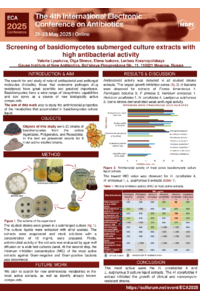
Introduction: The search for and study of natural antibacterial and antifungal molecules (including those that overcome pathogen drug resistance) have great scientific and practical importance. Basidiomycetes have a wide range of biosynthetic capabilities and can serve as a source of new biologically active compounds.
The aim of this work was to study the antimicrobial properties of the metabolites that accumulated in basidiomycetes culture liquid.
Methods. The objects of this study were 20 strains of basidiomycetes from the orders Agaricales, Polyporales, and Russulales. The studied strains were grown in a submerged culture. The culture liquids were extracted using ethyl acetate. The extracts were evaporated, and stock solutions with a concentration of 10 mg/mL were prepared. At first, the antimicrobial activity of the extracts was evaluated through agar well diffusion on a wide test culture panel. At the second step, the minimum inhibitory concentration (MIC) of the most active extracts against Gram-negative and Gram-positive bacteria was determined.
Results: Antibacterial activity was detected in all of the strain extracts studied. The largest growth inhibition zones of bacteria were observed for the extracts of Fomes fomentarius 1; Fomitopsis betulina 3; F. pinicola 2, Hericium coralloides 4, and Laetiporus sulphureus 3. Strains F. betulina 3 and H. coralloides 4 demonstrated weak antifungal activity against Aspergillus niger ATCC 16404.
The lowest MIC values were observed for 80 µg/mL of H. coralloides 4 extract against Staphylococcus aureus 25923 ATCC; 160 µg/mL of the former against the clinical strains S. epidermidis 533 and S. haemoliticus 585; and 320 µg/mL of the former against the vancomycin A-resistant strain Enterococcus faecium 569. The MIC of the L. sulphureus 3 extract was 320 µg/mL against S. aureus 25923 ATCC, S. epidermidis 533, and S. haemoliticus 585.
Conclusion: The most active were the H. coralloides 4 and L. sulphureus 3 culture liquid extracts. The H. coralloides 4 extract inhibited the growth of clinical and vancomycin-resistant strains.
Keywords
Basidiomycetes
extracts
antibacterial activity
Poster
PosterECA.pdf
A High Presence of CTX-M-2-Producing Escherichia coli in Chicken Meat Obtained from Butcher Shops in La Plata City, Argentina.
Avian Pathogenic Escherichia Coli Biofilm Formation Ability At Different Temperatures (37°C And 42°C)