Event submissions
Published
This submission belongs to the session S4. Novel Antimicrobial Agents: Discovery, Design, Synthesis and Action of the event The 4th International Electronic Conference on Antibiotics
Published date
19 May, 2025
Academic Editor
'%3e%3cpath%20d='M12.6657%2010.9104C12.4185%2010.325%2012.0599%209.79327%2011.6097%209.34482C11.1609%208.89508%2010.6293%208.5365%2010.0442%208.28888C10.0389%208.28626%2010.0337%208.28495%2010.0285%208.28233C10.8446%207.69279%2011.3752%206.73249%2011.3752%205.64904C11.3752%203.8542%209.92103%202.39999%208.1262%202.39999C6.33136%202.39999%204.87715%203.8542%204.87715%205.64904C4.87715%206.73249%205.40774%207.69279%206.22393%208.28364C6.21869%208.28626%206.21345%208.28757%206.20821%208.29019C5.62129%208.5378%205.09463%208.89284%204.64265%209.34613C4.1929%209.79493%203.83432%2010.3266%203.58671%2010.9117C3.34345%2011.4845%203.21226%2012.0987%203.20023%2012.7209C3.19988%2012.7349%203.20233%2012.7488%203.20744%2012.7619C3.21255%2012.7749%203.22022%2012.7867%203.22998%2012.7968C3.23975%2012.8068%203.25142%2012.8147%203.26431%2012.8202C3.2772%2012.8256%203.29105%2012.8284%203.30504%2012.8284H4.09109C4.14874%2012.8284%204.19459%2012.7825%204.1959%2012.7262C4.2221%2011.7148%204.62823%2010.7676%205.34617%2010.0497C6.08899%209.30683%207.0755%208.89808%208.1262%208.89808C9.17689%208.89808%2010.1634%209.30683%2010.9062%2010.0497C11.6242%2010.7676%2012.0303%2011.7148%2012.0565%2012.7262C12.0578%2012.7838%2012.1037%2012.8284%2012.1613%2012.8284H12.9474C12.9613%2012.8284%2012.9752%2012.8256%2012.9881%2012.8202C13.001%2012.8147%2013.0126%2012.8068%2013.0224%2012.7968C13.0322%2012.7867%2013.0398%2012.7749%2013.0449%2012.7619C13.0501%2012.7488%2013.0525%2012.7349%2013.0522%2012.7209C13.0391%2012.0947%2012.9094%2011.4855%2012.6657%2010.9104ZM8.1262%207.9024C7.52486%207.9024%206.9589%207.6679%206.53312%207.24211C6.10733%206.81633%205.87283%206.25037%205.87283%205.64904C5.87283%205.0477%206.10733%204.48174%206.53312%204.05596C6.9589%203.63018%207.52486%203.39567%208.1262%203.39567C8.72753%203.39567%209.29349%203.63018%209.71927%204.05596C10.1451%204.48174%2010.3796%205.0477%2010.3796%205.64904C10.3796%206.25037%2010.1451%206.81633%209.71927%207.24211C9.29349%207.6679%208.72753%207.9024%208.1262%207.9024Z'%20fill='%235D1EE1'/%3e%3c/g%3e%3c/svg%3e) Jordi Vila
Jordi VilaCitation
Monni Paulina Rapeso, Carolina Pohl, Olihile Sebolai, CRYPTOCOCCAL MENINGITIS, WHAT IT IS, AND TREATMENT ISSUES RELATED TO ITS MANAGEMENT, in Proceedings of The 4th International Electronic Conference on Antibiotics, 21 May–23 May 2025, MDPI: Basel, Switzerland
Share
Email
Facebook
Twitter
LinkedIn
CRYPTOCOCCAL MENINGITIS, WHAT IT IS, AND TREATMENT ISSUES RELATED TO ITS MANAGEMENT
'%3e%3cpath%20d='M12.6647%2010.9104C12.4176%2010.325%2012.0589%209.7933%2011.6088%209.34485C11.16%208.89511%2010.6283%208.53653%2010.0432%208.28891C10.038%208.28629%2010.0327%208.28498%2010.0275%208.28236C10.8437%207.69282%2011.3743%206.73252%2011.3743%205.64907C11.3743%203.85423%209.92005%202.40002%208.12522%202.40002C6.33038%202.40002%204.87618%203.85423%204.87618%205.64907C4.87618%206.73252%205.40677%207.69282%206.22296%208.28367C6.21772%208.28629%206.21248%208.2876%206.20724%208.29022C5.62031%208.53783%205.09365%208.89287%204.64167%209.34616C4.19192%209.79496%203.83334%2010.3266%203.58573%2010.9117C3.34247%2011.4846%203.21128%2012.0987%203.19925%2012.721C3.1989%2012.735%203.20135%2012.7489%203.20646%2012.7619C3.21157%2012.7749%203.21924%2012.7868%203.22901%2012.7968C3.23877%2012.8068%203.25045%2012.8148%203.26334%2012.8202C3.27623%2012.8256%203.29007%2012.8284%203.30406%2012.8284H4.09012C4.14776%2012.8284%204.19362%2012.7825%204.19493%2012.7262C4.22113%2011.7148%204.62726%2010.7676%205.34519%2010.0497C6.08802%209.30686%207.07452%208.89811%208.12522%208.89811C9.17592%208.89811%2010.1624%209.30686%2010.9052%2010.0497C11.6232%2010.7676%2012.0293%2011.7148%2012.0555%2012.7262C12.0568%2012.7839%2012.1027%2012.8284%2012.1603%2012.8284H12.9464C12.9604%2012.8284%2012.9742%2012.8256%2012.9871%2012.8202C13%2012.8148%2013.0117%2012.8068%2013.0214%2012.7968C13.0312%2012.7868%2013.0389%2012.7749%2013.044%2012.7619C13.0491%2012.7489%2013.0515%2012.735%2013.0512%2012.721C13.0381%2012.0947%2012.9084%2011.4856%2012.6647%2010.9104ZM8.12522%207.90243C7.52388%207.90243%206.95792%207.66793%206.53214%207.24215C6.10636%206.81636%205.87185%206.2504%205.87185%205.64907C5.87185%205.04773%206.10636%204.48177%206.53214%204.05599C6.95792%203.63021%207.52388%203.3957%208.12522%203.3957C8.72655%203.3957%209.29252%203.63021%209.7183%204.05599C10.1441%204.48177%2010.3786%205.04773%2010.3786%205.64907C10.3786%206.2504%2010.1441%206.81636%209.7183%207.24215C9.29252%207.66793%208.72655%207.90243%208.12522%207.90243Z'%20fill='%235D1EE1'/%3e%3c/g%3e%3c/svg%3e)
Monni Paulina Rapeso 1

Carolina Pohl 1
Olihile Sebolai 1
1. Department of Microbiology and Biochemistry, University of the Free State, Bloemfontein, 9301 South Africa
Abstract
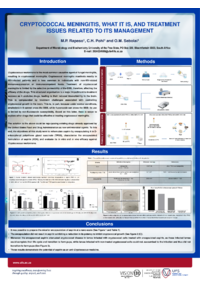
Introduction: Cryptococcus (C.) neoformans is a pathogen capable of breaching the blood–brain barrier (BBB) and localising in the brain, presenting challenges for treatment. This is, in part, because amphotericin B cannot cross the BBB, and while fluconazole can cross the BBB, its use is limited by non-fluconazole susceptibility. This study aimed to reformulate aspirin by encapsulating it into D-α-tocopheryl polyethylene glycol succinate (TPGS), to characterise the formulation, and to evaluate its in vitro efficacy against C. neoformans.
Methods: Aspirin was encapsulated into TPGS using a colloidal dispersion method. The aspirin–TPGS micelles were characterised using Fourier transform infrared spectroscopy (FTIR) and a Zeta particle analyser. The EUCAST protocol was used to assess the cryptococcal growth susceptibility to aspirin–TPGS at 0, 1, 2, and 4 mM concentrations. For a comparative analysis, cells were also treated with standard aspirin, TPGS, fluconazole, and amphotericin B at the same concentrations.
Results: The FTIR spectra analysis confirmed the successful encapsulation of aspirin into TPGS. The aspirin–TPGS nanoparticles were 10.97 nm in size with a polydispersity index of 0.175 and a zeta potential of 3.668. Aspirin in TPGS was found to be more potent than standard aspirin powder at 1, 2, and 4 mM, which may have been due to increased lipophilicity that facilitated cellular entry. The aspirin–TPGS formulation was more effective than fluconazole at 1, 2, and 4 mM based on the calculated p values and showed a similar efficacy to that of amphotericin B. The results showed that aspirin–TPGS significantly reduced the cryptococcal growth after 48 hours compared to that in the untreated controls.
Conclusion: These findings indicate that aspirin–TPGS micelles exhibit a potent inhibitory effect on C. neoformans, offering potential as a treatment for cryptococcal infections. Further studies will investigate aspirin–TPGS’s ability to traverse the BBB using an in vitro model of hCMEC/D3 cells, enhancing our understanding of its therapeutic potential in complex biological systems.
Keywords
Aspirin
Cryptococcus (C.) neoformans
Drug reformulation
Micellar encapsulation
D-α-tocopheryl polyethylene glycol succinate (TPGS).
Poster
Rapeso_ECA Poster.pdf
Avian Pathogenic Escherichia Coli Biofilm Formation Ability At Different Temperatures (37°C And 42°C)
In Silico Design and Docking of Novel Benzimidazole Derivatives as Inhibitors Targeting AcrB Efflux Pump and NDM-1 Carbapenemase: Strategies to Combat Antibiotic Resistance