Event submissions
Published
This submission belongs to the session S4. Novel Antimicrobial Agents: Discovery, Design, Synthesis and Action of the event The 4th International Electronic Conference on Antibiotics
Published date
19 May, 2025
Academic Editor
'%3e%3cpath%20d='M12.6657%2010.9104C12.4185%2010.325%2012.0599%209.79327%2011.6097%209.34482C11.1609%208.89508%2010.6293%208.5365%2010.0442%208.28888C10.0389%208.28626%2010.0337%208.28495%2010.0285%208.28233C10.8446%207.69279%2011.3752%206.73249%2011.3752%205.64904C11.3752%203.8542%209.92103%202.39999%208.1262%202.39999C6.33136%202.39999%204.87715%203.8542%204.87715%205.64904C4.87715%206.73249%205.40774%207.69279%206.22393%208.28364C6.21869%208.28626%206.21345%208.28757%206.20821%208.29019C5.62129%208.5378%205.09463%208.89284%204.64265%209.34613C4.1929%209.79493%203.83432%2010.3266%203.58671%2010.9117C3.34345%2011.4845%203.21226%2012.0987%203.20023%2012.7209C3.19988%2012.7349%203.20233%2012.7488%203.20744%2012.7619C3.21255%2012.7749%203.22022%2012.7867%203.22998%2012.7968C3.23975%2012.8068%203.25142%2012.8147%203.26431%2012.8202C3.2772%2012.8256%203.29105%2012.8284%203.30504%2012.8284H4.09109C4.14874%2012.8284%204.19459%2012.7825%204.1959%2012.7262C4.2221%2011.7148%204.62823%2010.7676%205.34617%2010.0497C6.08899%209.30683%207.0755%208.89808%208.1262%208.89808C9.17689%208.89808%2010.1634%209.30683%2010.9062%2010.0497C11.6242%2010.7676%2012.0303%2011.7148%2012.0565%2012.7262C12.0578%2012.7838%2012.1037%2012.8284%2012.1613%2012.8284H12.9474C12.9613%2012.8284%2012.9752%2012.8256%2012.9881%2012.8202C13.001%2012.8147%2013.0126%2012.8068%2013.0224%2012.7968C13.0322%2012.7867%2013.0398%2012.7749%2013.0449%2012.7619C13.0501%2012.7488%2013.0525%2012.7349%2013.0522%2012.7209C13.0391%2012.0947%2012.9094%2011.4855%2012.6657%2010.9104ZM8.1262%207.9024C7.52486%207.9024%206.9589%207.6679%206.53312%207.24211C6.10733%206.81633%205.87283%206.25037%205.87283%205.64904C5.87283%205.0477%206.10733%204.48174%206.53312%204.05596C6.9589%203.63018%207.52486%203.39567%208.1262%203.39567C8.72753%203.39567%209.29349%203.63018%209.71927%204.05596C10.1451%204.48174%2010.3796%205.0477%2010.3796%205.64904C10.3796%206.25037%2010.1451%206.81633%209.71927%207.24211C9.29349%207.6679%208.72753%207.9024%208.1262%207.9024Z'%20fill='%235D1EE1'/%3e%3c/g%3e%3c/svg%3e) Marc Maresca
Marc MarescaCitation
Yusuf Jimoh, Ummulkhair Sani, Abdullahi Ahmad, In Silico Design and Docking of Novel Benzimidazole Derivatives as Inhibitors Targeting AcrB Efflux Pump and NDM-1 Carbapenemase: Strategies to Combat Antibiotic Resistance, in Proceedings of The 4th International Electronic Conference on Antibiotics, 21 May–23 May 2025, MDPI: Basel, Switzerland
Share
Email
Facebook
Twitter
LinkedIn
In Silico Design and Docking of Novel Benzimidazole Derivatives as Inhibitors Targeting AcrB Efflux Pump and NDM-1 Carbapenemase: Strategies to Combat Antibiotic Resistance
'%3e%3cpath%20d='M12.6647%2010.9104C12.4176%2010.325%2012.0589%209.7933%2011.6088%209.34485C11.16%208.89511%2010.6283%208.53653%2010.0432%208.28891C10.038%208.28629%2010.0327%208.28498%2010.0275%208.28236C10.8437%207.69282%2011.3743%206.73252%2011.3743%205.64907C11.3743%203.85423%209.92005%202.40002%208.12522%202.40002C6.33038%202.40002%204.87618%203.85423%204.87618%205.64907C4.87618%206.73252%205.40677%207.69282%206.22296%208.28367C6.21772%208.28629%206.21248%208.2876%206.20724%208.29022C5.62031%208.53783%205.09365%208.89287%204.64167%209.34616C4.19192%209.79496%203.83334%2010.3266%203.58573%2010.9117C3.34247%2011.4846%203.21128%2012.0987%203.19925%2012.721C3.1989%2012.735%203.20135%2012.7489%203.20646%2012.7619C3.21157%2012.7749%203.21924%2012.7868%203.22901%2012.7968C3.23877%2012.8068%203.25045%2012.8148%203.26334%2012.8202C3.27623%2012.8256%203.29007%2012.8284%203.30406%2012.8284H4.09012C4.14776%2012.8284%204.19362%2012.7825%204.19493%2012.7262C4.22113%2011.7148%204.62726%2010.7676%205.34519%2010.0497C6.08802%209.30686%207.07452%208.89811%208.12522%208.89811C9.17592%208.89811%2010.1624%209.30686%2010.9052%2010.0497C11.6232%2010.7676%2012.0293%2011.7148%2012.0555%2012.7262C12.0568%2012.7839%2012.1027%2012.8284%2012.1603%2012.8284H12.9464C12.9604%2012.8284%2012.9742%2012.8256%2012.9871%2012.8202C13%2012.8148%2013.0117%2012.8068%2013.0214%2012.7968C13.0312%2012.7868%2013.0389%2012.7749%2013.044%2012.7619C13.0491%2012.7489%2013.0515%2012.735%2013.0512%2012.721C13.0381%2012.0947%2012.9084%2011.4856%2012.6647%2010.9104ZM8.12522%207.90243C7.52388%207.90243%206.95792%207.66793%206.53214%207.24215C6.10636%206.81636%205.87185%206.2504%205.87185%205.64907C5.87185%205.04773%206.10636%204.48177%206.53214%204.05599C6.95792%203.63021%207.52388%203.3957%208.12522%203.3957C8.72655%203.3957%209.29252%203.63021%209.7183%204.05599C10.1441%204.48177%2010.3786%205.04773%2010.3786%205.64907C10.3786%206.2504%2010.1441%206.81636%209.7183%207.24215C9.29252%207.66793%208.72655%207.90243%208.12522%207.90243Z'%20fill='%235D1EE1'/%3e%3c/g%3e%3c/svg%3e)
Yusuf Jimoh 1
Ummulkhair Sani 1
Abdullahi Ahmad 1
1. Department of Pharmaceutical and Medicinal Chemistry, Ahmadu Bello University, Zaria 810107, Nigeria
Abstract
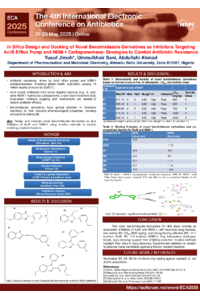
Antibiotic resistance poses a significant global health threat, necessitating the development of novel strategies to combat resistant bacterial strains. This study employs in silico design and molecular docking techniques to develop novel benzimidazole derivatives targeting the AcrB efflux pump and NDM-1 carbapenemase, two critical mechanisms of antibiotic resistance. Using a suite of computational tools including Chemdraw, Spartan14, Chimera, Autodock Vina, and Biovia Discovery Studio, we designed and analyzed five benzimidazole derivatives (B1-B5). Biovia Discovery Studio was specifically utilized for the visualization and analysis of molecular interactions, providing crucial insights into the binding modes and types of interactions involved. The compounds were evaluated for drug-likeness using ADMETLab2.0 and toxicity using Protox3. The results show that all compounds comply with Lipinski's rule of five and exhibit high GI absorption, indicating favorable pharmacokinetic properties. Toxicity analysis revealed low to moderate toxicity, with compound B4 showing the most favorable safety profile. Molecular docking studies, complemented by interaction visualizations, demonstrated strong binding affinities to both target proteins, with some compounds outperforming native ligands. Notably, compounds B5 and B1 showed the strongest interactions with NDM-1 Carbapenemase, while B3 and B4 exhibited comparable or better binding to the AcrB Efflux Pump than the native ligand. The visualization of these interactions revealed key binding features, including hydrogen bonds and hydrophobic interactions, providing a molecular basis for the observed affinities. These findings suggest the potential of these benzimidazole derivatives as dual-action inhibitors, simultaneously targeting two critical resistance mechanisms. This study highlights the significance of in silico methods and interaction visualization in drug discovery, and presents promising candidates for further development in combating antibiotic resistance.
Keywords
Antibiotic Resistance
AcrB Efflux Pump Inhibitors
Benzimidazole Derivatives
Dual-Target Inhibition
In Silico Drug Design
NDM-1 Carbapenemase Inhibitors
Poster
Poster.pdf
CRYPTOCOCCAL MENINGITIS, WHAT IT IS, AND TREATMENT ISSUES RELATED TO ITS MANAGEMENT
Antibiotic Prescription In Food-Producing Animals—A Focus Group Study To Assess Portuguese Veterinarians’ Knowledge And Attitudes