Event submissions
Published
This submission belongs to the session S4. Novel Antimicrobial Agents: Discovery, Design, Synthesis and Action of the event The 4th International Electronic Conference on Antibiotics
Published date
19 May, 2025
Academic Editor
'%3e%3cpath%20d='M12.6657%2010.9104C12.4185%2010.325%2012.0599%209.79327%2011.6097%209.34482C11.1609%208.89508%2010.6293%208.5365%2010.0442%208.28888C10.0389%208.28626%2010.0337%208.28495%2010.0285%208.28233C10.8446%207.69279%2011.3752%206.73249%2011.3752%205.64904C11.3752%203.8542%209.92103%202.39999%208.1262%202.39999C6.33136%202.39999%204.87715%203.8542%204.87715%205.64904C4.87715%206.73249%205.40774%207.69279%206.22393%208.28364C6.21869%208.28626%206.21345%208.28757%206.20821%208.29019C5.62129%208.5378%205.09463%208.89284%204.64265%209.34613C4.1929%209.79493%203.83432%2010.3266%203.58671%2010.9117C3.34345%2011.4845%203.21226%2012.0987%203.20023%2012.7209C3.19988%2012.7349%203.20233%2012.7488%203.20744%2012.7619C3.21255%2012.7749%203.22022%2012.7867%203.22998%2012.7968C3.23975%2012.8068%203.25142%2012.8147%203.26431%2012.8202C3.2772%2012.8256%203.29105%2012.8284%203.30504%2012.8284H4.09109C4.14874%2012.8284%204.19459%2012.7825%204.1959%2012.7262C4.2221%2011.7148%204.62823%2010.7676%205.34617%2010.0497C6.08899%209.30683%207.0755%208.89808%208.1262%208.89808C9.17689%208.89808%2010.1634%209.30683%2010.9062%2010.0497C11.6242%2010.7676%2012.0303%2011.7148%2012.0565%2012.7262C12.0578%2012.7838%2012.1037%2012.8284%2012.1613%2012.8284H12.9474C12.9613%2012.8284%2012.9752%2012.8256%2012.9881%2012.8202C13.001%2012.8147%2013.0126%2012.8068%2013.0224%2012.7968C13.0322%2012.7867%2013.0398%2012.7749%2013.0449%2012.7619C13.0501%2012.7488%2013.0525%2012.7349%2013.0522%2012.7209C13.0391%2012.0947%2012.9094%2011.4855%2012.6657%2010.9104ZM8.1262%207.9024C7.52486%207.9024%206.9589%207.6679%206.53312%207.24211C6.10733%206.81633%205.87283%206.25037%205.87283%205.64904C5.87283%205.0477%206.10733%204.48174%206.53312%204.05596C6.9589%203.63018%207.52486%203.39567%208.1262%203.39567C8.72753%203.39567%209.29349%203.63018%209.71927%204.05596C10.1451%204.48174%2010.3796%205.0477%2010.3796%205.64904C10.3796%206.25037%2010.1451%206.81633%209.71927%207.24211C9.29349%207.6679%208.72753%207.9024%208.1262%207.9024Z'%20fill='%235D1EE1'/%3e%3c/g%3e%3c/svg%3e) Jordi Vila
Jordi VilaCitation
Maria Tosounidou, Vicky Nicolaidou, Yiannis Sarigiannis, Tolis Panayi, Exploring Snake Venoms For Novel Antimicrobial Agents, in Proceedings of The 4th International Electronic Conference on Antibiotics, 21 May–23 May 2025, MDPI: Basel, Switzerland
Share
Email
Facebook
Twitter
LinkedIn
Exploring Snake Venoms For Novel Antimicrobial Agents
'%3e%3cpath%20d='M12.6647%2010.9104C12.4176%2010.325%2012.0589%209.7933%2011.6088%209.34485C11.16%208.89511%2010.6283%208.53653%2010.0432%208.28891C10.038%208.28629%2010.0327%208.28498%2010.0275%208.28236C10.8437%207.69282%2011.3743%206.73252%2011.3743%205.64907C11.3743%203.85423%209.92005%202.40002%208.12522%202.40002C6.33038%202.40002%204.87618%203.85423%204.87618%205.64907C4.87618%206.73252%205.40677%207.69282%206.22296%208.28367C6.21772%208.28629%206.21248%208.2876%206.20724%208.29022C5.62031%208.53783%205.09365%208.89287%204.64167%209.34616C4.19192%209.79496%203.83334%2010.3266%203.58573%2010.9117C3.34247%2011.4846%203.21128%2012.0987%203.19925%2012.721C3.1989%2012.735%203.20135%2012.7489%203.20646%2012.7619C3.21157%2012.7749%203.21924%2012.7868%203.22901%2012.7968C3.23877%2012.8068%203.25045%2012.8148%203.26334%2012.8202C3.27623%2012.8256%203.29007%2012.8284%203.30406%2012.8284H4.09012C4.14776%2012.8284%204.19362%2012.7825%204.19493%2012.7262C4.22113%2011.7148%204.62726%2010.7676%205.34519%2010.0497C6.08802%209.30686%207.07452%208.89811%208.12522%208.89811C9.17592%208.89811%2010.1624%209.30686%2010.9052%2010.0497C11.6232%2010.7676%2012.0293%2011.7148%2012.0555%2012.7262C12.0568%2012.7839%2012.1027%2012.8284%2012.1603%2012.8284H12.9464C12.9604%2012.8284%2012.9742%2012.8256%2012.9871%2012.8202C13%2012.8148%2013.0117%2012.8068%2013.0214%2012.7968C13.0312%2012.7868%2013.0389%2012.7749%2013.044%2012.7619C13.0491%2012.7489%2013.0515%2012.735%2013.0512%2012.721C13.0381%2012.0947%2012.9084%2011.4856%2012.6647%2010.9104ZM8.12522%207.90243C7.52388%207.90243%206.95792%207.66793%206.53214%207.24215C6.10636%206.81636%205.87185%206.2504%205.87185%205.64907C5.87185%205.04773%206.10636%204.48177%206.53214%204.05599C6.95792%203.63021%207.52388%203.3957%208.12522%203.3957C8.72655%203.3957%209.29252%203.63021%209.7183%204.05599C10.1441%204.48177%2010.3786%205.04773%2010.3786%205.64907C10.3786%206.2504%2010.1441%206.81636%209.7183%207.24215C9.29252%207.66793%208.72655%207.90243%208.12522%207.90243Z'%20fill='%235D1EE1'/%3e%3c/g%3e%3c/svg%3e)
Maria Tosounidou 1

Vicky Nicolaidou 2

Yiannis Sarigiannis 1
Tolis Panayi 1,2
1. Department of Health Sciences, School of Life and Health Sciences, University of Nicosia, 2417 Nicosia, Cyprus
2. Department of Life Sciences, School of Life and Health Sciences, University of Nicosia, 2417 Nicosia, Cyprus
Abstract
The increasing prevalence of antibiotic resistance is a major global healthcare concern,
leading to higher mortality rates and rising treatment costs. This crisis is largely attributed
to the excessive and improper use of antibiotics, which accelerates bacterial resistance.
With diminishing pharmaceutical investment in novel antibiotics, there is an urgent need
to explore alternative antimicrobial therapies. Snake venoms represent a promising
avenue due to their complex protein compositions, which include phospholipases A₂
(PLA₂s), L-amino acid oxidases (LAAOs), cathelicidins (CAMPs), and other protein toxins
with antibacterial properties.
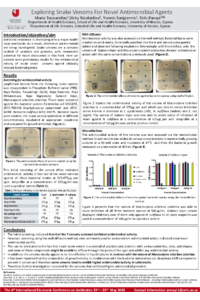
In this study, we evaluated the antimicrobial activity of crude venoms from seven snake
species against three bacterial strains—Escherichia coli, Staphylococcus epidermidis,
and Neisseria subflava—using spot assays, the well diffusion method, and microdilution
assays to determine antimicrobial activity and minimum inhibitory concentrations (MICs)
in both solid and liquid media.
On solid media, complete inhibition of E. coli, S. epidermidis, and N. subflava was
observed with Macrovipera lebetina lebetina venom at 375 μg/50 μL and Bitis gabonica
(Gaboon viper) venom at 675 μg/50 μL. Additionally, Naja nigricincta venom exhibited
complete inhibition of N. subflava at 325 μg/50 μL. In liquid media, complete inhibition
of all three bacterial strains occurred with M. lebetina lebetina venom at 500 μg/mL, while
B. gabonica venom inhibited N. subflava at 1350 μg/mL.
These findings highlight the potential of snake venoms as novel antimicrobial agents.
However, further research is necessary to assess their clinical applicability and safety.
Continued investigation into venom-derived compounds may pave the way for innovative
therapeutic strategies to combat antibiotic-resistant bacterial infections.
Keywords
venom
snake venom
antimicrobials
theraputics
Poster
4th international conference antibiotics_Exploring Snake Venoms.pdf
Antibiotic susceptibility testing of Escherichia coli and coliform isolates detected in samples of drinking water from central Greece
Characterisation Of Resistant Enteric Bacteria Isolated From Poultry Faeces and Meat In Portugal—Is There A Risk To Public Health?