Event submissions
Published
This submission belongs to the session S2. Antibiotics and One Health of the event The 4th International Electronic Conference on Antibiotics
Published date
19 May, 2025
Academic Editor
'%3e%3cpath%20d='M12.6657%2010.9104C12.4185%2010.325%2012.0599%209.79327%2011.6097%209.34482C11.1609%208.89508%2010.6293%208.5365%2010.0442%208.28888C10.0389%208.28626%2010.0337%208.28495%2010.0285%208.28233C10.8446%207.69279%2011.3752%206.73249%2011.3752%205.64904C11.3752%203.8542%209.92103%202.39999%208.1262%202.39999C6.33136%202.39999%204.87715%203.8542%204.87715%205.64904C4.87715%206.73249%205.40774%207.69279%206.22393%208.28364C6.21869%208.28626%206.21345%208.28757%206.20821%208.29019C5.62129%208.5378%205.09463%208.89284%204.64265%209.34613C4.1929%209.79493%203.83432%2010.3266%203.58671%2010.9117C3.34345%2011.4845%203.21226%2012.0987%203.20023%2012.7209C3.19988%2012.7349%203.20233%2012.7488%203.20744%2012.7619C3.21255%2012.7749%203.22022%2012.7867%203.22998%2012.7968C3.23975%2012.8068%203.25142%2012.8147%203.26431%2012.8202C3.2772%2012.8256%203.29105%2012.8284%203.30504%2012.8284H4.09109C4.14874%2012.8284%204.19459%2012.7825%204.1959%2012.7262C4.2221%2011.7148%204.62823%2010.7676%205.34617%2010.0497C6.08899%209.30683%207.0755%208.89808%208.1262%208.89808C9.17689%208.89808%2010.1634%209.30683%2010.9062%2010.0497C11.6242%2010.7676%2012.0303%2011.7148%2012.0565%2012.7262C12.0578%2012.7838%2012.1037%2012.8284%2012.1613%2012.8284H12.9474C12.9613%2012.8284%2012.9752%2012.8256%2012.9881%2012.8202C13.001%2012.8147%2013.0126%2012.8068%2013.0224%2012.7968C13.0322%2012.7867%2013.0398%2012.7749%2013.0449%2012.7619C13.0501%2012.7488%2013.0525%2012.7349%2013.0522%2012.7209C13.0391%2012.0947%2012.9094%2011.4855%2012.6657%2010.9104ZM8.1262%207.9024C7.52486%207.9024%206.9589%207.6679%206.53312%207.24211C6.10733%206.81633%205.87283%206.25037%205.87283%205.64904C5.87283%205.0477%206.10733%204.48174%206.53312%204.05596C6.9589%203.63018%207.52486%203.39567%208.1262%203.39567C8.72753%203.39567%209.29349%203.63018%209.71927%204.05596C10.1451%204.48174%2010.3796%205.0477%2010.3796%205.64904C10.3796%206.25037%2010.1451%206.81633%209.71927%207.24211C9.29349%207.6679%208.72753%207.9024%208.1262%207.9024Z'%20fill='%235D1EE1'/%3e%3c/g%3e%3c/svg%3e) Efstathios Giaouris
Efstathios GiaourisCitation
Mariana Borges, Margarida Martins, Alexandra Nunes, Sónia Ramos, Isabel Santos, Mariana Camoesas Silva, Adriana Belas, Ana Lima, Laurentina Pedroso, João Paulo Gomes, Leonor Silveira, Angela Pista, Characterisation Of Resistant Enteric Bacteria Isolated From Poultry Faeces and Meat In Portugal—Is There A Risk To Public Health?, in Proceedings of The 4th International Electronic Conference on Antibiotics, 21 May–23 May 2025, MDPI: Basel, Switzerland
Share
Email
Facebook
Twitter
LinkedIn
Characterisation Of Resistant Enteric Bacteria Isolated From Poultry Faeces and Meat In Portugal—Is There A Risk To Public Health?
'%3e%3cpath%20d='M12.6647%2010.9104C12.4176%2010.325%2012.0589%209.7933%2011.6088%209.34485C11.16%208.89511%2010.6283%208.53653%2010.0432%208.28891C10.038%208.28629%2010.0327%208.28498%2010.0275%208.28236C10.8437%207.69282%2011.3743%206.73252%2011.3743%205.64907C11.3743%203.85423%209.92005%202.40002%208.12522%202.40002C6.33038%202.40002%204.87618%203.85423%204.87618%205.64907C4.87618%206.73252%205.40677%207.69282%206.22296%208.28367C6.21772%208.28629%206.21248%208.2876%206.20724%208.29022C5.62031%208.53783%205.09365%208.89287%204.64167%209.34616C4.19192%209.79496%203.83334%2010.3266%203.58573%2010.9117C3.34247%2011.4846%203.21128%2012.0987%203.19925%2012.721C3.1989%2012.735%203.20135%2012.7489%203.20646%2012.7619C3.21157%2012.7749%203.21924%2012.7868%203.22901%2012.7968C3.23877%2012.8068%203.25045%2012.8148%203.26334%2012.8202C3.27623%2012.8256%203.29007%2012.8284%203.30406%2012.8284H4.09012C4.14776%2012.8284%204.19362%2012.7825%204.19493%2012.7262C4.22113%2011.7148%204.62726%2010.7676%205.34519%2010.0497C6.08802%209.30686%207.07452%208.89811%208.12522%208.89811C9.17592%208.89811%2010.1624%209.30686%2010.9052%2010.0497C11.6232%2010.7676%2012.0293%2011.7148%2012.0555%2012.7262C12.0568%2012.7839%2012.1027%2012.8284%2012.1603%2012.8284H12.9464C12.9604%2012.8284%2012.9742%2012.8256%2012.9871%2012.8202C13%2012.8148%2013.0117%2012.8068%2013.0214%2012.7968C13.0312%2012.7868%2013.0389%2012.7749%2013.044%2012.7619C13.0491%2012.7489%2013.0515%2012.735%2013.0512%2012.721C13.0381%2012.0947%2012.9084%2011.4856%2012.6647%2010.9104ZM8.12522%207.90243C7.52388%207.90243%206.95792%207.66793%206.53214%207.24215C6.10636%206.81636%205.87185%206.2504%205.87185%205.64907C5.87185%205.04773%206.10636%204.48177%206.53214%204.05599C6.95792%203.63021%207.52388%203.3957%208.12522%203.3957C8.72655%203.3957%209.29252%203.63021%209.7183%204.05599C10.1441%204.48177%2010.3786%205.04773%2010.3786%205.64907C10.3786%206.2504%2010.1441%206.81636%209.7183%207.24215C9.29252%207.66793%208.72655%207.90243%208.12522%207.90243Z'%20fill='%235D1EE1'/%3e%3c/g%3e%3c/svg%3e)
Mariana Borges 1
Margarida Martins 1
Alexandra Nunes 2,3,4
Sónia Ramos 3,4
Isabel Santos 3,4
Mariana Camoesas Silva 3,4
Adriana Belas 3,4
Ana Lima 3,4
Laurentina Pedroso 3,4

João Paulo Gomes 2,3,4
Leonor Silveira 1
Angela Pista 1
1. National Reference Laboratory for Gastrointestinal Infections, Department of Infectious Diseases, National Institute of Health Doutor Ricardo Jorge, Lisbon, Portugal
2. Genomics and Bioinformatics Unit, Department of Infectious Diseases, National Institute of Health Doutor Ricardo Jorge, Lisbon, Portugal
3. Veterinary and Animal Research Centre (CECAV), Faculty of Veterinary Medicine, Lusófona University, Lisbon University Centre, Lisbon, Portugal
4. I-MVET, Research in Veterinary Medicine, Faculty of Veterinary Medicine, Lusófona University, Lisbon University Centre, Lisbon, Portugal
Abstract
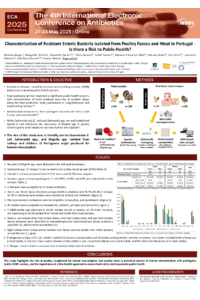
Introduction: Foodborne diseases associated with resistant and multidrug-resistant (MDR) bacteria represent a significant public health concern, with food-producing animals being a major source of these infections. The aim of this study was to identify and to characterise E. coli, Salmonella spp., and Shigella spp. isolated from turkeys and chickens of Portuguese origin produced for human consumption.
Methods: Between 2023 and 2024, 201 faecal samples (108 turkeys; 93 chickens), collected in various slaughterhouses, and 66 raw meat samples (33 each of turkeys and chickens), purchased in different retail stores, were analysed. Isolation was performed in selective and non-selective media. All isolates underwent to antimicrobial susceptibility testing and whole-genome sequencing.
Results: No cases of Shigella spp. were detected and Salmonella spp. (S. Newport) was isolated from one turkey faecal sample (0.9%). E. coli was detected in 97.5% of faeces (100% in turkeys; 94.6% in chickens) and in 92.4% of meat samples (90.9% in turkeys; 93.9% in chickens).
Virulence genes of enteropathogenic E. coli (EPEC), extraintestinal pathogenic E. coli (ExPEC) and avian pathogenic E. coli (APEC) were identified in both animals. S. Newport was susceptible to all tested antibiotics. For E. coli, 78.1% faecal (74.1% in turkeys; 83.0% in chickens) and 78.7% (90.0% in turkeys; 67.7% in chickens) meat isolates were resistant to at least one antibiotic. The most common resistances were to ampicillin, tetracycline, and ciprofloxacin, and all isolates were susceptible to meropenem, cefoxitin and temocillin. A MDR profile was observed in 58.6% isolates (56.5% in turkeys; 61.7% from chickens), corresponding to 59.1% isolates from faeces and 56.8% from meat samples. Seven E. coli isolates (five from turkeys and two from chickens) were identified as extended-spectrum beta-lactamase (ESBL) producers (blaCTXM-15, blaCTX-M-55 and blaSHV-12), and eight isolates from turkeys carried the mcr-1.1 gene.
Conclusion: This study highlights the role of poultry slaughtered for human consumption and poultry meat as potential sources of human contamination with pathogenic and/or MDR isolates, underscoring the importance of the One Health concept.
Keywords
E. coli
Salmonella
Shigella
Turkeys
Chickens
MDR
WGS
Public Health
Poster
Poster ECA 2025_Poultry_INSA-Lusofona_Final.pdf
Exploring Snake Venoms For Novel Antimicrobial Agents
Development of a Photodynamic Therapy Protocol to control Skin Infections by Pseudomonas aeruginosa