Event submissions
Published
This submission belongs to the session S4. Novel Antimicrobial Agents: Discovery, Design, Synthesis and Action of the event The 4th International Electronic Conference on Antibiotics
Published date
19 May, 2025
Academic Editor
'%3e%3cpath%20d='M12.6657%2010.9104C12.4185%2010.325%2012.0599%209.79327%2011.6097%209.34482C11.1609%208.89508%2010.6293%208.5365%2010.0442%208.28888C10.0389%208.28626%2010.0337%208.28495%2010.0285%208.28233C10.8446%207.69279%2011.3752%206.73249%2011.3752%205.64904C11.3752%203.8542%209.92103%202.39999%208.1262%202.39999C6.33136%202.39999%204.87715%203.8542%204.87715%205.64904C4.87715%206.73249%205.40774%207.69279%206.22393%208.28364C6.21869%208.28626%206.21345%208.28757%206.20821%208.29019C5.62129%208.5378%205.09463%208.89284%204.64265%209.34613C4.1929%209.79493%203.83432%2010.3266%203.58671%2010.9117C3.34345%2011.4845%203.21226%2012.0987%203.20023%2012.7209C3.19988%2012.7349%203.20233%2012.7488%203.20744%2012.7619C3.21255%2012.7749%203.22022%2012.7867%203.22998%2012.7968C3.23975%2012.8068%203.25142%2012.8147%203.26431%2012.8202C3.2772%2012.8256%203.29105%2012.8284%203.30504%2012.8284H4.09109C4.14874%2012.8284%204.19459%2012.7825%204.1959%2012.7262C4.2221%2011.7148%204.62823%2010.7676%205.34617%2010.0497C6.08899%209.30683%207.0755%208.89808%208.1262%208.89808C9.17689%208.89808%2010.1634%209.30683%2010.9062%2010.0497C11.6242%2010.7676%2012.0303%2011.7148%2012.0565%2012.7262C12.0578%2012.7838%2012.1037%2012.8284%2012.1613%2012.8284H12.9474C12.9613%2012.8284%2012.9752%2012.8256%2012.9881%2012.8202C13.001%2012.8147%2013.0126%2012.8068%2013.0224%2012.7968C13.0322%2012.7867%2013.0398%2012.7749%2013.0449%2012.7619C13.0501%2012.7488%2013.0525%2012.7349%2013.0522%2012.7209C13.0391%2012.0947%2012.9094%2011.4855%2012.6657%2010.9104ZM8.1262%207.9024C7.52486%207.9024%206.9589%207.6679%206.53312%207.24211C6.10733%206.81633%205.87283%206.25037%205.87283%205.64904C5.87283%205.0477%206.10733%204.48174%206.53312%204.05596C6.9589%203.63018%207.52486%203.39567%208.1262%203.39567C8.72753%203.39567%209.29349%203.63018%209.71927%204.05596C10.1451%204.48174%2010.3796%205.0477%2010.3796%205.64904C10.3796%206.25037%2010.1451%206.81633%209.71927%207.24211C9.29349%207.6679%208.72753%207.9024%208.1262%207.9024Z'%20fill='%235D1EE1'/%3e%3c/g%3e%3c/svg%3e) Jordi Vila
Jordi VilaCitation
Tamara Nami Haj Marza, RhsP2 protein as a new antibacterial toxin targeting RNA, in Proceedings of The 4th International Electronic Conference on Antibiotics, 21 May–23 May 2025, MDPI: Basel, Switzerland
Share
Email
Facebook
Twitter
LinkedIn
RhsP2 protein as a new antibacterial toxin targeting RNA

Tamara Nami Haj Marza 1
1. Department of Bioinformatics, Syrian Virtual University (SVU), Damuscus, Syria
Abstract
Introduction:
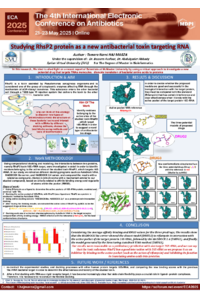
A recent study was published in the journal Molecular Cell in September 2022; Scientists at McMaster University have identified a toxin that bacteria use to kill other bacteria through bacterial competition within the microbiome by a new mechanism targeting RNA molecules, thus disrupting the various vital functions resulting from it.
Among the group of proteins that the team tested is a protein called RhsP2 produced by "Pseudomonas aeruginosa"; this works by directly affecting RNA molecules with two proposed mechanisms:
1/ ADP ribosylation to prevents the binding of amino acids and then synthesis of bacterial proteins necessary for life.
2/ Inactivation of ribonuclease RNase P.
Work methodology:
Using computational docking and modeling, the interactions between two proteins, namely RhsP2toxin/16S rRNA target, were investigated in detail in order to identify residues belonging to the active sites of the studied toxin RhsP2, which targets 16S rRNA. In our study, we relied on different docking programs such as AuotoDock VINA, HADDOCK lite server, and HADDOCK 2.4 server, and compared the results with a reference compound, rifamycin (which works with a mechanism similar to our studied compound), based on criteria related to affinity binding energy and regularity of atoms within the pocket (RMSD).
Conclusions:
The results show that the HADDOCK lite server showed the closest model (DRUD2) to rifamycin in interaction with the active pocket of the target protein 16S rRNA, followed by the HADDOCK 2.4 (DRUG3). and finally the model generated by the Structuring AuotoDock VINA method (DRUG1).
* Our results were reasonable as a preliminary prediction with one target 16S rRNA, and we can say that the toxic substance RhsP2 has a good interaction with 16S rRNA so we propose it as an inhibitor by binding to the active pocket (such as the action of rifamycin) and inhibiting its function in translating amino acids into proteins.
Keywords
RhsP2
16S rRNA
docking
Poster
Studying RhsP2 protein as a new antibacterial toxin_poster.pdf
Recent Knowledge on the Probiotic Saccharomyces cerevisiae in Aquaculture: A Narrative Review
Cell-free supernatants from foodborne lactic acid bacteria isolates disrupt the AI-2 bacterial quorum-sensing system and inhibit biofilm formation in monocultures of Listeria monocytogenes and Staphylococcus aureus