Event submissions
Published
This submission belongs to the session S4. Novel Antimicrobial Agents: Discovery, Design, Synthesis and Action of the event The 4th International Electronic Conference on Antibiotics
Published date
19 May, 2025
Academic Editor
'%3e%3cpath%20d='M12.6657%2010.9104C12.4185%2010.325%2012.0599%209.79327%2011.6097%209.34482C11.1609%208.89508%2010.6293%208.5365%2010.0442%208.28888C10.0389%208.28626%2010.0337%208.28495%2010.0285%208.28233C10.8446%207.69279%2011.3752%206.73249%2011.3752%205.64904C11.3752%203.8542%209.92103%202.39999%208.1262%202.39999C6.33136%202.39999%204.87715%203.8542%204.87715%205.64904C4.87715%206.73249%205.40774%207.69279%206.22393%208.28364C6.21869%208.28626%206.21345%208.28757%206.20821%208.29019C5.62129%208.5378%205.09463%208.89284%204.64265%209.34613C4.1929%209.79493%203.83432%2010.3266%203.58671%2010.9117C3.34345%2011.4845%203.21226%2012.0987%203.20023%2012.7209C3.19988%2012.7349%203.20233%2012.7488%203.20744%2012.7619C3.21255%2012.7749%203.22022%2012.7867%203.22998%2012.7968C3.23975%2012.8068%203.25142%2012.8147%203.26431%2012.8202C3.2772%2012.8256%203.29105%2012.8284%203.30504%2012.8284H4.09109C4.14874%2012.8284%204.19459%2012.7825%204.1959%2012.7262C4.2221%2011.7148%204.62823%2010.7676%205.34617%2010.0497C6.08899%209.30683%207.0755%208.89808%208.1262%208.89808C9.17689%208.89808%2010.1634%209.30683%2010.9062%2010.0497C11.6242%2010.7676%2012.0303%2011.7148%2012.0565%2012.7262C12.0578%2012.7838%2012.1037%2012.8284%2012.1613%2012.8284H12.9474C12.9613%2012.8284%2012.9752%2012.8256%2012.9881%2012.8202C13.001%2012.8147%2013.0126%2012.8068%2013.0224%2012.7968C13.0322%2012.7867%2013.0398%2012.7749%2013.0449%2012.7619C13.0501%2012.7488%2013.0525%2012.7349%2013.0522%2012.7209C13.0391%2012.0947%2012.9094%2011.4855%2012.6657%2010.9104ZM8.1262%207.9024C7.52486%207.9024%206.9589%207.6679%206.53312%207.24211C6.10733%206.81633%205.87283%206.25037%205.87283%205.64904C5.87283%205.0477%206.10733%204.48174%206.53312%204.05596C6.9589%203.63018%207.52486%203.39567%208.1262%203.39567C8.72753%203.39567%209.29349%203.63018%209.71927%204.05596C10.1451%204.48174%2010.3796%205.0477%2010.3796%205.64904C10.3796%206.25037%2010.1451%206.81633%209.71927%207.24211C9.29349%207.6679%208.72753%207.9024%208.1262%207.9024Z'%20fill='%235D1EE1'/%3e%3c/g%3e%3c/svg%3e) Jordi Vila
Jordi VilaCitation
Micaela Stefanía Abilleira Picallo, Celeste Rocío Costilla, Silvia Moreno, Estela Galván, Ciprofloxacin potentiation using the phytochemical 1,8-cineole against Klebsiella pneumoniae in planktonic and biofilm growth, in Proceedings of The 4th International Electronic Conference on Antibiotics, 21 May–23 May 2025, MDPI: Basel, Switzerland
Share
Email
Facebook
Twitter
LinkedIn
Ciprofloxacin potentiation using the phytochemical 1,8-cineole against Klebsiella pneumoniae in planktonic and biofilm growth
'%3e%3cpath%20d='M12.6647%2010.9104C12.4176%2010.325%2012.0589%209.7933%2011.6088%209.34485C11.16%208.89511%2010.6283%208.53653%2010.0432%208.28891C10.038%208.28629%2010.0327%208.28498%2010.0275%208.28236C10.8437%207.69282%2011.3743%206.73252%2011.3743%205.64907C11.3743%203.85423%209.92005%202.40002%208.12522%202.40002C6.33038%202.40002%204.87618%203.85423%204.87618%205.64907C4.87618%206.73252%205.40677%207.69282%206.22296%208.28367C6.21772%208.28629%206.21248%208.2876%206.20724%208.29022C5.62031%208.53783%205.09365%208.89287%204.64167%209.34616C4.19192%209.79496%203.83334%2010.3266%203.58573%2010.9117C3.34247%2011.4846%203.21128%2012.0987%203.19925%2012.721C3.1989%2012.735%203.20135%2012.7489%203.20646%2012.7619C3.21157%2012.7749%203.21924%2012.7868%203.22901%2012.7968C3.23877%2012.8068%203.25045%2012.8148%203.26334%2012.8202C3.27623%2012.8256%203.29007%2012.8284%203.30406%2012.8284H4.09012C4.14776%2012.8284%204.19362%2012.7825%204.19493%2012.7262C4.22113%2011.7148%204.62726%2010.7676%205.34519%2010.0497C6.08802%209.30686%207.07452%208.89811%208.12522%208.89811C9.17592%208.89811%2010.1624%209.30686%2010.9052%2010.0497C11.6232%2010.7676%2012.0293%2011.7148%2012.0555%2012.7262C12.0568%2012.7839%2012.1027%2012.8284%2012.1603%2012.8284H12.9464C12.9604%2012.8284%2012.9742%2012.8256%2012.9871%2012.8202C13%2012.8148%2013.0117%2012.8068%2013.0214%2012.7968C13.0312%2012.7868%2013.0389%2012.7749%2013.044%2012.7619C13.0491%2012.7489%2013.0515%2012.735%2013.0512%2012.721C13.0381%2012.0947%2012.9084%2011.4856%2012.6647%2010.9104ZM8.12522%207.90243C7.52388%207.90243%206.95792%207.66793%206.53214%207.24215C6.10636%206.81636%205.87185%206.2504%205.87185%205.64907C5.87185%205.04773%206.10636%204.48177%206.53214%204.05599C6.95792%203.63021%207.52388%203.3957%208.12522%203.3957C8.72655%203.3957%209.29252%203.63021%209.7183%204.05599C10.1441%204.48177%2010.3786%205.04773%2010.3786%205.64907C10.3786%206.2504%2010.1441%206.81636%209.7183%207.24215C9.29252%207.66793%208.72655%207.90243%208.12522%207.90243Z'%20fill='%235D1EE1'/%3e%3c/g%3e%3c/svg%3e)
Micaela Stefanía Abilleira Picallo 1
Celeste Rocío Costilla 1
Silvia Moreno 1
Estela Galván 1
1. Centro de Estudios Biomedicos Basicos y Desarrollo, Universidad Maimonides - CONICET, Buenos Aires, C1405BNA Argentina
Abstract
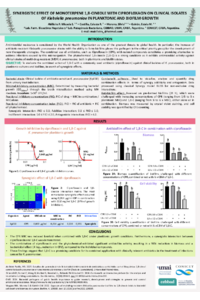
The increasing incidence of antibiotic resistance among Klebsiella pneumoniae isolates, along with their ability to form biofilms, places this pathogen in the critical priority group for which new antimicrobial treatments are urgently needed. The combination of plant compounds and antibiotics is a promising approach for enhancing antimicrobial activity. The phytochemical 1,8-cineole, which is effective against K. pneumoniae, is a good candidate for the development of novel antibacterial combination therapies. The aim of this study was to evaluate the combined action of 1,8-cineole with ciprofloxacin against K. pneumoniae in both planktonic cultures and biofilms. For this purpose, the planktonic growth (OD600nm) of a clinical K. pneumoniae strain was quantified after treatment with the individual compounds or their combinations. Based on the obtained data, two types of drug interaction analyses were performed: 1) the fractional inhibitory concentration index (FICI) was calculated after determining the minimum inhibitory concentrations and 2) the BLISS model in the Combenefit software was used. A synergistic effect of 1,8-cineole with ciprofloxacin was revealed based on both analyses. In addition, the minimum bactericidal concentrations (MBCs) were determined by means of colony-forming unit (CFU) counting. The anti-biofilm effects of ciprofloxacin and 1,8-cineole, either alone or in combination, were assessed on pre-formed (24 h old) K. pneumoniae biofilms. The biomass was measured by means of crystal violet staining, and the cell viability was quantified using CFU counting. The most effective combined treatment was obtained using five-times ciprofloxacin MBC and half the 1,8-cineole MBC, resulting in a 90% biomass decrease and 4 Log10 reduction in cell viability. In contrast, these anti-biofilm effects were not observed when the same concentrations of the individual compounds were assayed. Taken together, our findings indicate that 1,8-cineole is a promising candidate for combinatorial therapies with clinically relevant antibiotics to treat K. pneumoniae infections.
Keywords
Klebsiella pneumoniae
1,8-cineole
ciprofloxacin
combinatorial therapy
synergistic effect
Poster
Poster ECA Micaela Abilleira PDF.pdf
Cell-free supernatants from foodborne lactic acid bacteria isolates disrupt the AI-2 bacterial quorum-sensing system and inhibit biofilm formation in monocultures of Listeria monocytogenes and Staphylococcus aureus
Fabrication and Characterization of Aloe Vera-Based Coatings via MAPLE: An Antimicrobial Strategy for Addressing Antibiotic Resistance through Essential Oil Influence