Event submissions
Published
This submission belongs to the session S5. Multidisciplinary Antimicrobial Strategies: Materials, Peptides, Bacteriophages and Repurposing of the event The 4th International Electronic Conference on Antibiotics
Published date
19 May, 2025
Academic Editor
'%3e%3cpath%20d='M12.6657%2010.9104C12.4185%2010.325%2012.0599%209.79327%2011.6097%209.34482C11.1609%208.89508%2010.6293%208.5365%2010.0442%208.28888C10.0389%208.28626%2010.0337%208.28495%2010.0285%208.28233C10.8446%207.69279%2011.3752%206.73249%2011.3752%205.64904C11.3752%203.8542%209.92103%202.39999%208.1262%202.39999C6.33136%202.39999%204.87715%203.8542%204.87715%205.64904C4.87715%206.73249%205.40774%207.69279%206.22393%208.28364C6.21869%208.28626%206.21345%208.28757%206.20821%208.29019C5.62129%208.5378%205.09463%208.89284%204.64265%209.34613C4.1929%209.79493%203.83432%2010.3266%203.58671%2010.9117C3.34345%2011.4845%203.21226%2012.0987%203.20023%2012.7209C3.19988%2012.7349%203.20233%2012.7488%203.20744%2012.7619C3.21255%2012.7749%203.22022%2012.7867%203.22998%2012.7968C3.23975%2012.8068%203.25142%2012.8147%203.26431%2012.8202C3.2772%2012.8256%203.29105%2012.8284%203.30504%2012.8284H4.09109C4.14874%2012.8284%204.19459%2012.7825%204.1959%2012.7262C4.2221%2011.7148%204.62823%2010.7676%205.34617%2010.0497C6.08899%209.30683%207.0755%208.89808%208.1262%208.89808C9.17689%208.89808%2010.1634%209.30683%2010.9062%2010.0497C11.6242%2010.7676%2012.0303%2011.7148%2012.0565%2012.7262C12.0578%2012.7838%2012.1037%2012.8284%2012.1613%2012.8284H12.9474C12.9613%2012.8284%2012.9752%2012.8256%2012.9881%2012.8202C13.001%2012.8147%2013.0126%2012.8068%2013.0224%2012.7968C13.0322%2012.7867%2013.0398%2012.7749%2013.0449%2012.7619C13.0501%2012.7488%2013.0525%2012.7349%2013.0522%2012.7209C13.0391%2012.0947%2012.9094%2011.4855%2012.6657%2010.9104ZM8.1262%207.9024C7.52486%207.9024%206.9589%207.6679%206.53312%207.24211C6.10733%206.81633%205.87283%206.25037%205.87283%205.64904C5.87283%205.0477%206.10733%204.48174%206.53312%204.05596C6.9589%203.63018%207.52486%203.39567%208.1262%203.39567C8.72753%203.39567%209.29349%203.63018%209.71927%204.05596C10.1451%204.48174%2010.3796%205.0477%2010.3796%205.64904C10.3796%206.25037%2010.1451%206.81633%209.71927%207.24211C9.29349%207.6679%208.72753%207.9024%208.1262%207.9024Z'%20fill='%235D1EE1'/%3e%3c/g%3e%3c/svg%3e) Serena Riela
Serena RielaCitation
Anita Ioana Visan, Carmen Ristoscu, George Stan, T Tite, Gabriel Socol, Rodica Cristescu, Gianina Popescu-Pelin, Izabela Luiza Toderascu, Consuela Matei, Marcela Popa, Mariana Chifiriuc, Fabrication and Characterization of Aloe Vera-Based Coatings via MAPLE: An Antimicrobial Strategy for Addressing Antibiotic Resistance through Essential Oil Influence, in Proceedings of The 4th International Electronic Conference on Antibiotics, 21 May–23 May 2025, MDPI: Basel, Switzerland
Share
Email
Facebook
Twitter
LinkedIn
Fabrication and Characterization of Aloe Vera-Based Coatings via MAPLE: An Antimicrobial Strategy for Addressing Antibiotic Resistance through Essential Oil Influence

Anita Ioana Visan 1
'%3e%3cpath%20d='M12.6647%2010.9104C12.4176%2010.325%2012.0589%209.7933%2011.6088%209.34485C11.16%208.89511%2010.6283%208.53653%2010.0432%208.28891C10.038%208.28629%2010.0327%208.28498%2010.0275%208.28236C10.8437%207.69282%2011.3743%206.73252%2011.3743%205.64907C11.3743%203.85423%209.92005%202.40002%208.12522%202.40002C6.33038%202.40002%204.87618%203.85423%204.87618%205.64907C4.87618%206.73252%205.40677%207.69282%206.22296%208.28367C6.21772%208.28629%206.21248%208.2876%206.20724%208.29022C5.62031%208.53783%205.09365%208.89287%204.64167%209.34616C4.19192%209.79496%203.83334%2010.3266%203.58573%2010.9117C3.34247%2011.4846%203.21128%2012.0987%203.19925%2012.721C3.1989%2012.735%203.20135%2012.7489%203.20646%2012.7619C3.21157%2012.7749%203.21924%2012.7868%203.22901%2012.7968C3.23877%2012.8068%203.25045%2012.8148%203.26334%2012.8202C3.27623%2012.8256%203.29007%2012.8284%203.30406%2012.8284H4.09012C4.14776%2012.8284%204.19362%2012.7825%204.19493%2012.7262C4.22113%2011.7148%204.62726%2010.7676%205.34519%2010.0497C6.08802%209.30686%207.07452%208.89811%208.12522%208.89811C9.17592%208.89811%2010.1624%209.30686%2010.9052%2010.0497C11.6232%2010.7676%2012.0293%2011.7148%2012.0555%2012.7262C12.0568%2012.7839%2012.1027%2012.8284%2012.1603%2012.8284H12.9464C12.9604%2012.8284%2012.9742%2012.8256%2012.9871%2012.8202C13%2012.8148%2013.0117%2012.8068%2013.0214%2012.7968C13.0312%2012.7868%2013.0389%2012.7749%2013.044%2012.7619C13.0491%2012.7489%2013.0515%2012.735%2013.0512%2012.721C13.0381%2012.0947%2012.9084%2011.4856%2012.6647%2010.9104ZM8.12522%207.90243C7.52388%207.90243%206.95792%207.66793%206.53214%207.24215C6.10636%206.81636%205.87185%206.2504%205.87185%205.64907C5.87185%205.04773%206.10636%204.48177%206.53214%204.05599C6.95792%203.63021%207.52388%203.3957%208.12522%203.3957C8.72655%203.3957%209.29252%203.63021%209.7183%204.05599C10.1441%204.48177%2010.3786%205.04773%2010.3786%205.64907C10.3786%206.2504%2010.1441%206.81636%209.7183%207.24215C9.29252%207.66793%208.72655%207.90243%208.12522%207.90243Z'%20fill='%235D1EE1'/%3e%3c/g%3e%3c/svg%3e)
Carmen Ristoscu 1

George Stan 2
T Tite 2

Gabriel Socol 3
Rodica Cristescu 3

Gianina Popescu-Pelin 1
Izabela Luiza Toderascu 1
Consuela Matei 1
Marcela Popa 4

Mariana Chifiriuc 4,5
1. National Institute for Laser, Plasma and Radiation Physics, 077125 Magurele, Ilfov, Romania
2. National Institute of Materials Physics, 077125 Magurele, Ilfov, Romania
3. Lasers Department, National Institute for Lasers, Plasma and Radiation Physics, Magurele, 077190 Ilfov,
Romania
4. Department of Microbiology, Faculty of Biology, University of Bucharest, 060101 Bucharest, Romania
5. Earth, Environmental and Life Sciences Division, Research Institute of the University of Bucharest,050567 Bucharest, Romania
Abstract
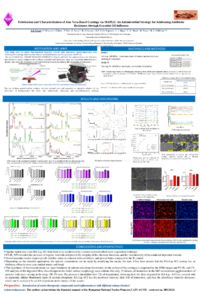
This study presents the synthesis and characterization of apatite–lignin–aloe vera (Ap/Lig/AV) coatings, utilizing the Matrix-Assisted Pulsed Laser Evaporation (MAPLE) technique. The incorporation of natural and renewable materials, such as lignin and aloe vera extract, offers a safer and more environmentally friendly alternative to conventional synthetic antibiotics. This innovative approach aims to not only provide infection prevention but also to address the growing concern of primary and secondary resistance to existing drugs, which poses a significant public health challenge.
Our findings indicate that the chemical properties and stoichiometry of the synthesized coatings were preserved throughout the process. A uniform and homogeneous distribution of the materials was achieved when the amount of essential oil matched that of the organic components. The coatings exhibited hydrophilic characteristics and enhanced cellular viability in cultures with cancerous Mg 63 cells. Furthermore, the composite materials demonstrated significant antimicrobial activity against Gram-positive and Gram-negative bacteria, including Escherichia coli and Staphylococcus aureus, as well as against the fungus Candida albicans.
The utilization of these naturally derived products not only presents a cost-effective solution but also contributes to the development of biodegradable thin films with antibacterial, antioxidant, and anti-inflammatory properties. These advancements highlight the potential of Ap/Lig/AV coatings in biomedical applications, particularly in the context of reducing reliance on synthetic antibacterial agents.
Keywords
MAPLE
antibiotic resistance
essential oils
Poster
Poster conf Antibiotics 2025_Visan_final.pdf
Ciprofloxacin potentiation using the phytochemical 1,8-cineole against Klebsiella pneumoniae in planktonic and biofilm growth
Synthesis and biological evaluation of new amino-alcohol-quinolines in response to non-tuberculous mycobacteria infections.