Event submissions
Published
This submission belongs to the session S4. Novel Antimicrobial Agents: Discovery, Design, Synthesis and Action of the event The 4th International Electronic Conference on Antibiotics
Published date
19 May, 2025
Academic Editor
'%3e%3cpath%20d='M12.6657%2010.9104C12.4185%2010.325%2012.0599%209.79327%2011.6097%209.34482C11.1609%208.89508%2010.6293%208.5365%2010.0442%208.28888C10.0389%208.28626%2010.0337%208.28495%2010.0285%208.28233C10.8446%207.69279%2011.3752%206.73249%2011.3752%205.64904C11.3752%203.8542%209.92103%202.39999%208.1262%202.39999C6.33136%202.39999%204.87715%203.8542%204.87715%205.64904C4.87715%206.73249%205.40774%207.69279%206.22393%208.28364C6.21869%208.28626%206.21345%208.28757%206.20821%208.29019C5.62129%208.5378%205.09463%208.89284%204.64265%209.34613C4.1929%209.79493%203.83432%2010.3266%203.58671%2010.9117C3.34345%2011.4845%203.21226%2012.0987%203.20023%2012.7209C3.19988%2012.7349%203.20233%2012.7488%203.20744%2012.7619C3.21255%2012.7749%203.22022%2012.7867%203.22998%2012.7968C3.23975%2012.8068%203.25142%2012.8147%203.26431%2012.8202C3.2772%2012.8256%203.29105%2012.8284%203.30504%2012.8284H4.09109C4.14874%2012.8284%204.19459%2012.7825%204.1959%2012.7262C4.2221%2011.7148%204.62823%2010.7676%205.34617%2010.0497C6.08899%209.30683%207.0755%208.89808%208.1262%208.89808C9.17689%208.89808%2010.1634%209.30683%2010.9062%2010.0497C11.6242%2010.7676%2012.0303%2011.7148%2012.0565%2012.7262C12.0578%2012.7838%2012.1037%2012.8284%2012.1613%2012.8284H12.9474C12.9613%2012.8284%2012.9752%2012.8256%2012.9881%2012.8202C13.001%2012.8147%2013.0126%2012.8068%2013.0224%2012.7968C13.0322%2012.7867%2013.0398%2012.7749%2013.0449%2012.7619C13.0501%2012.7488%2013.0525%2012.7349%2013.0522%2012.7209C13.0391%2012.0947%2012.9094%2011.4855%2012.6657%2010.9104ZM8.1262%207.9024C7.52486%207.9024%206.9589%207.6679%206.53312%207.24211C6.10733%206.81633%205.87283%206.25037%205.87283%205.64904C5.87283%205.0477%206.10733%204.48174%206.53312%204.05596C6.9589%203.63018%207.52486%203.39567%208.1262%203.39567C8.72753%203.39567%209.29349%203.63018%209.71927%204.05596C10.1451%204.48174%2010.3796%205.0477%2010.3796%205.64904C10.3796%206.25037%2010.1451%206.81633%209.71927%207.24211C9.29349%207.6679%208.72753%207.9024%208.1262%207.9024Z'%20fill='%235D1EE1'/%3e%3c/g%3e%3c/svg%3e) Jordi Vila
Jordi VilaCitation
Elise Charrier, François Peltier, Alexandra Dassonville-Klimpt, Claire Andréjak, Pascal Sonnet, Synthesis and biological evaluation of new amino-alcohol-quinolines in response to non-tuberculous mycobacteria infections., in Proceedings of The 4th International Electronic Conference on Antibiotics, 21 May–23 May 2025, MDPI: Basel, Switzerland
Share
Email
Facebook
Twitter
LinkedIn
Synthesis and biological evaluation of new amino-alcohol-quinolines in response to non-tuberculous mycobacteria infections.
'%3e%3cpath%20d='M12.6647%2010.9104C12.4176%2010.325%2012.0589%209.7933%2011.6088%209.34485C11.16%208.89511%2010.6283%208.53653%2010.0432%208.28891C10.038%208.28629%2010.0327%208.28498%2010.0275%208.28236C10.8437%207.69282%2011.3743%206.73252%2011.3743%205.64907C11.3743%203.85423%209.92005%202.40002%208.12522%202.40002C6.33038%202.40002%204.87618%203.85423%204.87618%205.64907C4.87618%206.73252%205.40677%207.69282%206.22296%208.28367C6.21772%208.28629%206.21248%208.2876%206.20724%208.29022C5.62031%208.53783%205.09365%208.89287%204.64167%209.34616C4.19192%209.79496%203.83334%2010.3266%203.58573%2010.9117C3.34247%2011.4846%203.21128%2012.0987%203.19925%2012.721C3.1989%2012.735%203.20135%2012.7489%203.20646%2012.7619C3.21157%2012.7749%203.21924%2012.7868%203.22901%2012.7968C3.23877%2012.8068%203.25045%2012.8148%203.26334%2012.8202C3.27623%2012.8256%203.29007%2012.8284%203.30406%2012.8284H4.09012C4.14776%2012.8284%204.19362%2012.7825%204.19493%2012.7262C4.22113%2011.7148%204.62726%2010.7676%205.34519%2010.0497C6.08802%209.30686%207.07452%208.89811%208.12522%208.89811C9.17592%208.89811%2010.1624%209.30686%2010.9052%2010.0497C11.6232%2010.7676%2012.0293%2011.7148%2012.0555%2012.7262C12.0568%2012.7839%2012.1027%2012.8284%2012.1603%2012.8284H12.9464C12.9604%2012.8284%2012.9742%2012.8256%2012.9871%2012.8202C13%2012.8148%2013.0117%2012.8068%2013.0214%2012.7968C13.0312%2012.7868%2013.0389%2012.7749%2013.044%2012.7619C13.0491%2012.7489%2013.0515%2012.735%2013.0512%2012.721C13.0381%2012.0947%2012.9084%2011.4856%2012.6647%2010.9104ZM8.12522%207.90243C7.52388%207.90243%206.95792%207.66793%206.53214%207.24215C6.10636%206.81636%205.87185%206.2504%205.87185%205.64907C5.87185%205.04773%206.10636%204.48177%206.53214%204.05599C6.95792%203.63021%207.52388%203.3957%208.12522%203.3957C8.72655%203.3957%209.29252%203.63021%209.7183%204.05599C10.1441%204.48177%2010.3786%205.04773%2010.3786%205.64907C10.3786%206.2504%2010.1441%206.81636%209.7183%207.24215C9.29252%207.66793%208.72655%207.90243%208.12522%207.90243Z'%20fill='%235D1EE1'/%3e%3c/g%3e%3c/svg%3e)
Elise Charrier 1
François Peltier 1,2

Alexandra Dassonville-Klimpt 1
Claire Andréjak 1,3

Pascal Sonnet 1
1. AGents Infectieux, Résistance and chimiothérapie, UR4294, UFR de Pharmacie, Université de Picardie Jules Verne, Amiens-Picardie, Amiens, France
2. Département de Bactériologie, CHU Amiens-Picardie, Amiens, France
3. Unité de soins intensifs respiratoires, CHU Amiens-Picardie, Amiens, France
Abstract
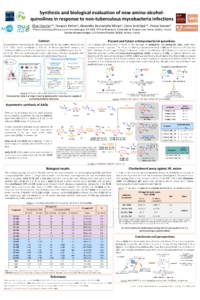
Today, in Europe and North America, the emergence of non-tuberculous mycobacteria (NTM) infections is now outstripping that of Mycobacterium tuberculosis. NTM are ubiquitous and opportunistic in people with bronchiectasis or chronic respiratory disease. Among the NTM known for their pulmonary pathogenicity, mycobacteria from the Mycobacterium avium complex (MAC) are the most common, responsible for 80% of NTM infections. Current NTM treatments require a combination of antibiotics over a long period and have numerous side effects. For example, the first-line treatment for MAC infections includes a combination of three drugs, namely macrolide, rifamycin and ethambutol, administrated for at least twelve months after sputum conversion. These drugs can cause a number of inconveniences or serious effects, including hepatotoxicity, ocular disorders, etc. In addition, the moderate efficacy of this treatment (52% to 60% success rate) is also compromised by the increasing resistance of NTM to macrolides. Consequently, there is an urgent need to develop safer molecules, ideally with novel mechanisms of action, to limit the risk of antibiotic resistance. The quinoline-based pharmacophore is found in mefloquine (MQ), which targets ATP synthase, a vital enzyme for mycobacteria. However, MQ has a moderate activity against NTM (e.g., MIC = 4 µg/mL on MAC) and it can induce side effects on the central nervous system. To improve the selectivity index (SI), novel amino-alcohol-quinolines (AAQs), designed as analogues of MQ, have been developed. A hit compound was identified on MAC with a SI higher than that of MQ (SI = 5.8 vs 0.4) and it has an additive effect with the three drugs used in first-line treatment against MAC. This study presents the design rationale for AAQs, describes their synthesis, and provides an in vitro biological evaluation, including assessments of antimycobacterial activity, cytotoxicity, and potential synergistic effects.
Keywords
Non-tuberculous mycobacteria
amino-alcohol-quinolines
antimycobacterial activity
cytotoxicity
synergistic effects.
Poster
Poster Elise Charrier-ECA 2025.pdf
Fabrication and Characterization of Aloe Vera-Based Coatings via MAPLE: An Antimicrobial Strategy for Addressing Antibiotic Resistance through Essential Oil Influence
Synthesis and Antibacterial Action of New Ni(II), Pd(II) and Pt(II) Complexes with Benzimidazole-Derived Schiff Base Ligands