Event submissions
Published
This submission belongs to the session S2. Antibiotics and One Health of the event The 4th International Electronic Conference on Antibiotics
Published date
19 May, 2025
Academic Editor
'%3e%3cpath%20d='M12.6657%2010.9104C12.4185%2010.325%2012.0599%209.79327%2011.6097%209.34482C11.1609%208.89508%2010.6293%208.5365%2010.0442%208.28888C10.0389%208.28626%2010.0337%208.28495%2010.0285%208.28233C10.8446%207.69279%2011.3752%206.73249%2011.3752%205.64904C11.3752%203.8542%209.92103%202.39999%208.1262%202.39999C6.33136%202.39999%204.87715%203.8542%204.87715%205.64904C4.87715%206.73249%205.40774%207.69279%206.22393%208.28364C6.21869%208.28626%206.21345%208.28757%206.20821%208.29019C5.62129%208.5378%205.09463%208.89284%204.64265%209.34613C4.1929%209.79493%203.83432%2010.3266%203.58671%2010.9117C3.34345%2011.4845%203.21226%2012.0987%203.20023%2012.7209C3.19988%2012.7349%203.20233%2012.7488%203.20744%2012.7619C3.21255%2012.7749%203.22022%2012.7867%203.22998%2012.7968C3.23975%2012.8068%203.25142%2012.8147%203.26431%2012.8202C3.2772%2012.8256%203.29105%2012.8284%203.30504%2012.8284H4.09109C4.14874%2012.8284%204.19459%2012.7825%204.1959%2012.7262C4.2221%2011.7148%204.62823%2010.7676%205.34617%2010.0497C6.08899%209.30683%207.0755%208.89808%208.1262%208.89808C9.17689%208.89808%2010.1634%209.30683%2010.9062%2010.0497C11.6242%2010.7676%2012.0303%2011.7148%2012.0565%2012.7262C12.0578%2012.7838%2012.1037%2012.8284%2012.1613%2012.8284H12.9474C12.9613%2012.8284%2012.9752%2012.8256%2012.9881%2012.8202C13.001%2012.8147%2013.0126%2012.8068%2013.0224%2012.7968C13.0322%2012.7867%2013.0398%2012.7749%2013.0449%2012.7619C13.0501%2012.7488%2013.0525%2012.7349%2013.0522%2012.7209C13.0391%2012.0947%2012.9094%2011.4855%2012.6657%2010.9104ZM8.1262%207.9024C7.52486%207.9024%206.9589%207.6679%206.53312%207.24211C6.10733%206.81633%205.87283%206.25037%205.87283%205.64904C5.87283%205.0477%206.10733%204.48174%206.53312%204.05596C6.9589%203.63018%207.52486%203.39567%208.1262%203.39567C8.72753%203.39567%209.29349%203.63018%209.71927%204.05596C10.1451%204.48174%2010.3796%205.0477%2010.3796%205.64904C10.3796%206.25037%2010.1451%206.81633%209.71927%207.24211C9.29349%207.6679%208.72753%207.9024%208.1262%207.9024Z'%20fill='%235D1EE1'/%3e%3c/g%3e%3c/svg%3e) Efstathios Giaouris
Efstathios GiaourisCitation
Antonia Charalampos Mataragka, Nikolaos Tzimotoudis, John Ikonomopoulos, Nikolaos D. Andritsos, Phenotypic Characterization and Serotyping of Salmonella Spp. and Listeria Monocytogenes Isolates From Feed Samples, in Proceedings of The 4th International Electronic Conference on Antibiotics, 21 May–23 May 2025, MDPI: Basel, Switzerland
Share
Email
Facebook
Twitter
LinkedIn
Phenotypic Characterization and Serotyping of Salmonella Spp. and Listeria Monocytogenes Isolates From Feed Samples

Antonia Charalampos Mataragka 1
'%3e%3cpath%20d='M12.6647%2010.9104C12.4176%2010.325%2012.0589%209.7933%2011.6088%209.34485C11.16%208.89511%2010.6283%208.53653%2010.0432%208.28891C10.038%208.28629%2010.0327%208.28498%2010.0275%208.28236C10.8437%207.69282%2011.3743%206.73252%2011.3743%205.64907C11.3743%203.85423%209.92005%202.40002%208.12522%202.40002C6.33038%202.40002%204.87618%203.85423%204.87618%205.64907C4.87618%206.73252%205.40677%207.69282%206.22296%208.28367C6.21772%208.28629%206.21248%208.2876%206.20724%208.29022C5.62031%208.53783%205.09365%208.89287%204.64167%209.34616C4.19192%209.79496%203.83334%2010.3266%203.58573%2010.9117C3.34247%2011.4846%203.21128%2012.0987%203.19925%2012.721C3.1989%2012.735%203.20135%2012.7489%203.20646%2012.7619C3.21157%2012.7749%203.21924%2012.7868%203.22901%2012.7968C3.23877%2012.8068%203.25045%2012.8148%203.26334%2012.8202C3.27623%2012.8256%203.29007%2012.8284%203.30406%2012.8284H4.09012C4.14776%2012.8284%204.19362%2012.7825%204.19493%2012.7262C4.22113%2011.7148%204.62726%2010.7676%205.34519%2010.0497C6.08802%209.30686%207.07452%208.89811%208.12522%208.89811C9.17592%208.89811%2010.1624%209.30686%2010.9052%2010.0497C11.6232%2010.7676%2012.0293%2011.7148%2012.0555%2012.7262C12.0568%2012.7839%2012.1027%2012.8284%2012.1603%2012.8284H12.9464C12.9604%2012.8284%2012.9742%2012.8256%2012.9871%2012.8202C13%2012.8148%2013.0117%2012.8068%2013.0214%2012.7968C13.0312%2012.7868%2013.0389%2012.7749%2013.044%2012.7619C13.0491%2012.7489%2013.0515%2012.735%2013.0512%2012.721C13.0381%2012.0947%2012.9084%2011.4856%2012.6647%2010.9104ZM8.12522%207.90243C7.52388%207.90243%206.95792%207.66793%206.53214%207.24215C6.10636%206.81636%205.87185%206.2504%205.87185%205.64907C5.87185%205.04773%206.10636%204.48177%206.53214%204.05599C6.95792%203.63021%207.52388%203.3957%208.12522%203.3957C8.72655%203.3957%209.29252%203.63021%209.7183%204.05599C10.1441%204.48177%2010.3786%205.04773%2010.3786%205.64907C10.3786%206.2504%2010.1441%206.81636%209.7183%207.24215C9.29252%207.66793%208.72655%207.90243%208.12522%207.90243Z'%20fill='%235D1EE1'/%3e%3c/g%3e%3c/svg%3e)
Nikolaos Tzimotoudis 2

John Ikonomopoulos 1

Nikolaos D. Andritsos 3
1. Laboratory of Anatomy and Physiology of Farm Animals, Department of Animal Science, School of Animal Biosciences, Agricultural University of Athens, 75 Iera Odos Str., GR-11855 Athens, Greece
2. Hellenic Army Biological Research Centre, 6 Taxiarchou Velliou Str., GR-15236 P. Penteli, Attica, Greece
3. Department of Food Science and Technology, School of Agricultural Sciences, University of Patras, 2 Georgiou Seferi Str., GR-30100 Agrinio, Greece
Abstract
In addition to its presence in foods for human consumption, the foodborne pathogenic bacteria Salmonella spp. and Listeria monocytogenes can also be detected in animal feeding stuff.
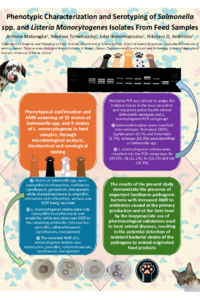
The aim of this work was to phenotypically confirm the presence of the above microorganisms in feed samples, through biochemical and/or serological testing of the microbial isolates following the microbiological analysis for the detection of these pathogens. Thus, 15 strains of Salmonella spp. and 9 strains of L. monocytogenes were confirmed. Multiplex PCR was utilized to assign the isolated strains to the four most prevalent and most important public health-related Salmonella serotypes as well as to the four most frequently identified PCR-serogroups of L. monocytogenes.
Serotyping revealed the presence of Salmonella serotypes Thompson (60%), Typhimurium (6.7%) and Enteritidis (6.7%), whereas four strains were identified as Salmonella spp. (26.6%) but were not assigned to any of the detected serotypes. L. monocytogenes isolates were classified into the PCR-serogroups IIa (44.5%), IIb (11.1%), IIc (11.1%) and Ivb (33.3%).
Furthermore, the bacterial isolates were screened for AMR. Strains of Salmonella spp. were susceptible to five of the antibiotics tested (tetracycline, norfloxacin, ciprofloxacin, gentamicin, meropenem), while they showed resistance to ampicillin (2/15), cefotaxime (7/15) and ceftazidime (5/15), without any multi-drug resistance being recorded whatsoever. L. monocytogenes strains were only susceptible to erythromycin and ampicillin, while one strain of the pathogen was multi-drug resistant to the remaining five antibiotics (tetracycline, penicillin, sulfamethoxazole, ciprofloxacin, meropenem). Moreover, the recorded AMR of L. monocytogenes isolates was as follows: tetracycline (11.1%), penicillin (11.1%), sulfamethoxazole (55.5%), ciprofloxacin (22.2%) and meropenem (11.1%).
The results of the present study demonstrate the presence of important foodborne pathogenic bacteria with increased AMR to antibiotics caused at the primary production and at the farm level by the inappropriate use of pharmacological substances used to treat animal diseases, resulting in the potential detection of resistant bacterial strains of the pathogens to animal-originated food products.
Keywords
antimicrobial resistance
feed
Salmonella spp.
Listeria monocytogenes
Poster
poster1.pdf
Serological Typing and Antibiograms of Listeria Monocytogenes Strains Isolated from Raw Milk, Whey and Ice cream
The Development of a New Antibiotic Class Targeting Enolase in Acinetobacter Baumannii