Event submissions
Published
This submission belongs to the session S3. Epidemiology, Prevalence and Mechanisms of Antibiotic Resistance and Cross-Resistance of the event The 4th International Electronic Conference on Antibiotics
Published date
19 May, 2025
Academic Editor
'%3e%3cpath%20d='M12.6657%2010.9104C12.4185%2010.325%2012.0599%209.79327%2011.6097%209.34482C11.1609%208.89508%2010.6293%208.5365%2010.0442%208.28888C10.0389%208.28626%2010.0337%208.28495%2010.0285%208.28233C10.8446%207.69279%2011.3752%206.73249%2011.3752%205.64904C11.3752%203.8542%209.92103%202.39999%208.1262%202.39999C6.33136%202.39999%204.87715%203.8542%204.87715%205.64904C4.87715%206.73249%205.40774%207.69279%206.22393%208.28364C6.21869%208.28626%206.21345%208.28757%206.20821%208.29019C5.62129%208.5378%205.09463%208.89284%204.64265%209.34613C4.1929%209.79493%203.83432%2010.3266%203.58671%2010.9117C3.34345%2011.4845%203.21226%2012.0987%203.20023%2012.7209C3.19988%2012.7349%203.20233%2012.7488%203.20744%2012.7619C3.21255%2012.7749%203.22022%2012.7867%203.22998%2012.7968C3.23975%2012.8068%203.25142%2012.8147%203.26431%2012.8202C3.2772%2012.8256%203.29105%2012.8284%203.30504%2012.8284H4.09109C4.14874%2012.8284%204.19459%2012.7825%204.1959%2012.7262C4.2221%2011.7148%204.62823%2010.7676%205.34617%2010.0497C6.08899%209.30683%207.0755%208.89808%208.1262%208.89808C9.17689%208.89808%2010.1634%209.30683%2010.9062%2010.0497C11.6242%2010.7676%2012.0303%2011.7148%2012.0565%2012.7262C12.0578%2012.7838%2012.1037%2012.8284%2012.1613%2012.8284H12.9474C12.9613%2012.8284%2012.9752%2012.8256%2012.9881%2012.8202C13.001%2012.8147%2013.0126%2012.8068%2013.0224%2012.7968C13.0322%2012.7867%2013.0398%2012.7749%2013.0449%2012.7619C13.0501%2012.7488%2013.0525%2012.7349%2013.0522%2012.7209C13.0391%2012.0947%2012.9094%2011.4855%2012.6657%2010.9104ZM8.1262%207.9024C7.52486%207.9024%206.9589%207.6679%206.53312%207.24211C6.10733%206.81633%205.87283%206.25037%205.87283%205.64904C5.87283%205.0477%206.10733%204.48174%206.53312%204.05596C6.9589%203.63018%207.52486%203.39567%208.1262%203.39567C8.72753%203.39567%209.29349%203.63018%209.71927%204.05596C10.1451%204.48174%2010.3796%205.0477%2010.3796%205.64904C10.3796%206.25037%2010.1451%206.81633%209.71927%207.24211C9.29349%207.6679%208.72753%207.9024%208.1262%207.9024Z'%20fill='%235D1EE1'/%3e%3c/g%3e%3c/svg%3e) Nicholas Dixon
Nicholas DixonCitation
Sadeeva Zulfirya, Ekaterina Samoilova, Yuliya Gorinova, Olga Simonova, Anna Lazareva, Antimicrobial Susceptibility and Carbapenemases in Pseudomonas Aeruginosa Isolated From Children with Cystic Fibrosis, in Proceedings of The 4th International Electronic Conference on Antibiotics, 21 May–23 May 2025, MDPI: Basel, Switzerland
Share
Email
Facebook
Twitter
LinkedIn
Antimicrobial Susceptibility and Carbapenemases in Pseudomonas Aeruginosa Isolated From Children with Cystic Fibrosis
'%3e%3cpath%20d='M12.6647%2010.9104C12.4176%2010.325%2012.0589%209.7933%2011.6088%209.34485C11.16%208.89511%2010.6283%208.53653%2010.0432%208.28891C10.038%208.28629%2010.0327%208.28498%2010.0275%208.28236C10.8437%207.69282%2011.3743%206.73252%2011.3743%205.64907C11.3743%203.85423%209.92005%202.40002%208.12522%202.40002C6.33038%202.40002%204.87618%203.85423%204.87618%205.64907C4.87618%206.73252%205.40677%207.69282%206.22296%208.28367C6.21772%208.28629%206.21248%208.2876%206.20724%208.29022C5.62031%208.53783%205.09365%208.89287%204.64167%209.34616C4.19192%209.79496%203.83334%2010.3266%203.58573%2010.9117C3.34247%2011.4846%203.21128%2012.0987%203.19925%2012.721C3.1989%2012.735%203.20135%2012.7489%203.20646%2012.7619C3.21157%2012.7749%203.21924%2012.7868%203.22901%2012.7968C3.23877%2012.8068%203.25045%2012.8148%203.26334%2012.8202C3.27623%2012.8256%203.29007%2012.8284%203.30406%2012.8284H4.09012C4.14776%2012.8284%204.19362%2012.7825%204.19493%2012.7262C4.22113%2011.7148%204.62726%2010.7676%205.34519%2010.0497C6.08802%209.30686%207.07452%208.89811%208.12522%208.89811C9.17592%208.89811%2010.1624%209.30686%2010.9052%2010.0497C11.6232%2010.7676%2012.0293%2011.7148%2012.0555%2012.7262C12.0568%2012.7839%2012.1027%2012.8284%2012.1603%2012.8284H12.9464C12.9604%2012.8284%2012.9742%2012.8256%2012.9871%2012.8202C13%2012.8148%2013.0117%2012.8068%2013.0214%2012.7968C13.0312%2012.7868%2013.0389%2012.7749%2013.044%2012.7619C13.0491%2012.7489%2013.0515%2012.735%2013.0512%2012.721C13.0381%2012.0947%2012.9084%2011.4856%2012.6647%2010.9104ZM8.12522%207.90243C7.52388%207.90243%206.95792%207.66793%206.53214%207.24215C6.10636%206.81636%205.87185%206.2504%205.87185%205.64907C5.87185%205.04773%206.10636%204.48177%206.53214%204.05599C6.95792%203.63021%207.52388%203.3957%208.12522%203.3957C8.72655%203.3957%209.29252%203.63021%209.7183%204.05599C10.1441%204.48177%2010.3786%205.04773%2010.3786%205.64907C10.3786%206.2504%2010.1441%206.81636%209.7183%207.24215C9.29252%207.66793%208.72655%207.90243%208.12522%207.90243Z'%20fill='%235D1EE1'/%3e%3c/g%3e%3c/svg%3e)
Sadeeva Zulfirya 1
Ekaterina Samoilova 1
Yuliya Gorinova 1
Olga Simonova 1
Anna Lazareva 1
1. Federal State Autonomous Institution “National Medical Research Center of Children's Health” of the Ministry of Health of the Russian Federation, Moscow, Russia
Abstract
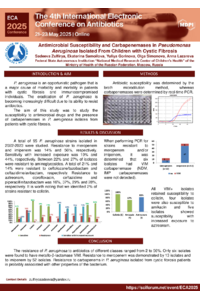
Introduction: P. aeruginosa is an opportunistic pathogen that is a major cause of morbidity and mortality in patients with cystic fibrosis and immunocompromised individuals. The eradication of P. aeruginosa is becoming increasingly difficult due to its ability to resist antibiotics.
Aim The aim of this study was to study the susceptibility to antimicrobial drugs and the presence of carbapenemases in P. aeruginosa isolates from patients with cystic fibrosis.
Methods: Antibiotic susceptibility was determined by the broth microdilution method, whereas carbapenemases were determined by real-time PCR.
Results: A total of 95 P. aeruginosa strains isolated in 2022-2023 were studied. Resistance to meropenem and imipenem was 14% and 56%, respectively. Sensitivity with increased exposure was 19% and 44%, respectively. Between 22% and 27% of isolates were resistant to aminoglycosides. A total of 21% and 14% were resistant to ceftolozane/tazobactam and ceftazidime/avibactam, respectively. Resistance to aztreonam, ciprofloxacin, ceftazidime and piperacillin/tazobactam was 16%, 37%, 29% and 28%, respectively. It is worth noting that we identified 2% of strains resistant to colistin. When performing PCR for strains resistant to meropenem and/or imipenem, it was determined that six isolates had VIM carbapenemase (NDM, IMP carbapenemases were not detected). All VIM+ isolates retained susceptibility to colistin, four isolates were also susceptible to amikacin and five isolates showed susceptibility with increased exposure to aztreonam.
Conclusions: The resistance of P. aeruginosa to antibiotics of different classes ranged from 2 to 56%. Only six isolates were found to have metallo-β-lactamase VIM. Resistance to meropenem was demonstrated by 13 isolates and to imipenem by 52 isolates. Resistance to carbapenems in P. aeruginosa isolated from cystic fibrosis patients is probably associated with other properties of the bacterium.
Keywords
Antibiotic resistance
carbapenemases
Pseudomonas aeruginosa
cystic fibrosis
Poster
Sadeeva E-poster.pdf
Antibiotics for the Treatment of Haemorrhoidal Disease: the Cons and the Pros
Antibiotic Resistance Genes in Aquaculture: Environmental Hotspots and Public Health Implications