Event submissions
Published
This submission belongs to the session S4. Novel Antimicrobial Agents: Discovery, Design, Synthesis and Action of the event The 4th International Electronic Conference on Antibiotics
Published date
19 May, 2025
Academic Editor
'%3e%3cpath%20d='M12.6657%2010.9104C12.4185%2010.325%2012.0599%209.79327%2011.6097%209.34482C11.1609%208.89508%2010.6293%208.5365%2010.0442%208.28888C10.0389%208.28626%2010.0337%208.28495%2010.0285%208.28233C10.8446%207.69279%2011.3752%206.73249%2011.3752%205.64904C11.3752%203.8542%209.92103%202.39999%208.1262%202.39999C6.33136%202.39999%204.87715%203.8542%204.87715%205.64904C4.87715%206.73249%205.40774%207.69279%206.22393%208.28364C6.21869%208.28626%206.21345%208.28757%206.20821%208.29019C5.62129%208.5378%205.09463%208.89284%204.64265%209.34613C4.1929%209.79493%203.83432%2010.3266%203.58671%2010.9117C3.34345%2011.4845%203.21226%2012.0987%203.20023%2012.7209C3.19988%2012.7349%203.20233%2012.7488%203.20744%2012.7619C3.21255%2012.7749%203.22022%2012.7867%203.22998%2012.7968C3.23975%2012.8068%203.25142%2012.8147%203.26431%2012.8202C3.2772%2012.8256%203.29105%2012.8284%203.30504%2012.8284H4.09109C4.14874%2012.8284%204.19459%2012.7825%204.1959%2012.7262C4.2221%2011.7148%204.62823%2010.7676%205.34617%2010.0497C6.08899%209.30683%207.0755%208.89808%208.1262%208.89808C9.17689%208.89808%2010.1634%209.30683%2010.9062%2010.0497C11.6242%2010.7676%2012.0303%2011.7148%2012.0565%2012.7262C12.0578%2012.7838%2012.1037%2012.8284%2012.1613%2012.8284H12.9474C12.9613%2012.8284%2012.9752%2012.8256%2012.9881%2012.8202C13.001%2012.8147%2013.0126%2012.8068%2013.0224%2012.7968C13.0322%2012.7867%2013.0398%2012.7749%2013.0449%2012.7619C13.0501%2012.7488%2013.0525%2012.7349%2013.0522%2012.7209C13.0391%2012.0947%2012.9094%2011.4855%2012.6657%2010.9104ZM8.1262%207.9024C7.52486%207.9024%206.9589%207.6679%206.53312%207.24211C6.10733%206.81633%205.87283%206.25037%205.87283%205.64904C5.87283%205.0477%206.10733%204.48174%206.53312%204.05596C6.9589%203.63018%207.52486%203.39567%208.1262%203.39567C8.72753%203.39567%209.29349%203.63018%209.71927%204.05596C10.1451%204.48174%2010.3796%205.0477%2010.3796%205.64904C10.3796%206.25037%2010.1451%206.81633%209.71927%207.24211C9.29349%207.6679%208.72753%207.9024%208.1262%207.9024Z'%20fill='%235D1EE1'/%3e%3c/g%3e%3c/svg%3e) Jordi Vila
Jordi VilaCitation
Abubakar Sadiq Yakubu, Abdullahi Yunusa Idris, ASMAU NASIR HAMZA, MARYAM ABDULLAHI, Aliyu Musa, IDRIS ABDULLAHI, YUSUF JIMOH, In Silico Exploration of Quinoline Derivatives as Novel Antimicrobial Agents Targeting Resistance Mechanisms, in Proceedings of The 4th International Electronic Conference on Antibiotics, 21 May–23 May 2025, MDPI: Basel, Switzerland
Share
Email
Facebook
Twitter
LinkedIn
In Silico Exploration of Quinoline Derivatives as Novel Antimicrobial Agents Targeting Resistance Mechanisms
'%3e%3cpath%20d='M12.6647%2010.9104C12.4176%2010.325%2012.0589%209.7933%2011.6088%209.34485C11.16%208.89511%2010.6283%208.53653%2010.0432%208.28891C10.038%208.28629%2010.0327%208.28498%2010.0275%208.28236C10.8437%207.69282%2011.3743%206.73252%2011.3743%205.64907C11.3743%203.85423%209.92005%202.40002%208.12522%202.40002C6.33038%202.40002%204.87618%203.85423%204.87618%205.64907C4.87618%206.73252%205.40677%207.69282%206.22296%208.28367C6.21772%208.28629%206.21248%208.2876%206.20724%208.29022C5.62031%208.53783%205.09365%208.89287%204.64167%209.34616C4.19192%209.79496%203.83334%2010.3266%203.58573%2010.9117C3.34247%2011.4846%203.21128%2012.0987%203.19925%2012.721C3.1989%2012.735%203.20135%2012.7489%203.20646%2012.7619C3.21157%2012.7749%203.21924%2012.7868%203.22901%2012.7968C3.23877%2012.8068%203.25045%2012.8148%203.26334%2012.8202C3.27623%2012.8256%203.29007%2012.8284%203.30406%2012.8284H4.09012C4.14776%2012.8284%204.19362%2012.7825%204.19493%2012.7262C4.22113%2011.7148%204.62726%2010.7676%205.34519%2010.0497C6.08802%209.30686%207.07452%208.89811%208.12522%208.89811C9.17592%208.89811%2010.1624%209.30686%2010.9052%2010.0497C11.6232%2010.7676%2012.0293%2011.7148%2012.0555%2012.7262C12.0568%2012.7839%2012.1027%2012.8284%2012.1603%2012.8284H12.9464C12.9604%2012.8284%2012.9742%2012.8256%2012.9871%2012.8202C13%2012.8148%2013.0117%2012.8068%2013.0214%2012.7968C13.0312%2012.7868%2013.0389%2012.7749%2013.044%2012.7619C13.0491%2012.7489%2013.0515%2012.735%2013.0512%2012.721C13.0381%2012.0947%2012.9084%2011.4856%2012.6647%2010.9104ZM8.12522%207.90243C7.52388%207.90243%206.95792%207.66793%206.53214%207.24215C6.10636%206.81636%205.87185%206.2504%205.87185%205.64907C5.87185%205.04773%206.10636%204.48177%206.53214%204.05599C6.95792%203.63021%207.52388%203.3957%208.12522%203.3957C8.72655%203.3957%209.29252%203.63021%209.7183%204.05599C10.1441%204.48177%2010.3786%205.04773%2010.3786%205.64907C10.3786%206.2504%2010.1441%206.81636%209.7183%207.24215C9.29252%207.66793%208.72655%207.90243%208.12522%207.90243Z'%20fill='%235D1EE1'/%3e%3c/g%3e%3c/svg%3e)
Abubakar Sadiq Yakubu 1
Abdullahi Yunusa Idris 1
ASMAU NASIR HAMZA 1
MARYAM ABDULLAHI 1
Aliyu Musa 1
IDRIS ABDULLAHI 2
YUSUF JIMOH 1
1. Faculty Of Pharmaceutical Sciences, Department Of Pharmaceutical And Medicinal Chemistry, Ahmadu Bello University, Zaria, Nigeria
2. Faculty Of Pharmaceutical Sciences, Department Of Pharmaceutical And Medicinal Chemistry, Kaduna State University, Kaduna, Nigeria
Abstract
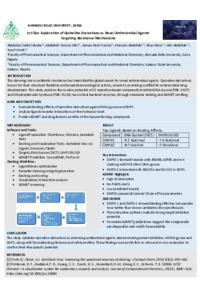
The escalating challenge of antibiotic resistance underscores the urgent need to develop novel antimicrobial agents with innovative mechanisms of action. This study investigates the potential of quinoline derivatives as inhibitors of two critical microbial targets: DNA gyrase (PDB ID: 2XCT) and dihydropteroate synthase (PDB ID: 5U10). A library of 22 quinoline-based compounds was subjected to molecular docking to assess their binding affinities and interactions with these essential enzymes.
CMPD1 and CMPD2 emerged as promising candidates. CMPD1 exhibited a binding affinity of -9.3 kcal/mol with DNA gyrase, forming stabilizing hydrogen bonds with ARG 98 and ASP 85, while CMPD2 displayed a binding affinity of -8.8 kcal/mol with the same target. Against dihydropteroate synthase, CMPD1 and CMPD2 showed binding affinities of -9.0 kcal/mol and -8.5 kcal/mol, respectively, leveraging pi-pi stacking and hydrogen bonding interactions with critical active-site residues. The structure-activity relationship (SAR)-driven library design incorporated electron-donating (-OCH₃) and electron-withdrawing (-Cl) groups, strategically enhancing the binding specificity and affinity of these compounds.
In addition to docking, in silico ADMET profiling confirmed favorable pharmacokinetic properties for the lead compounds. CMPD1 demonstrated high gastrointestinal absorption and zero Lipinski’s rule violations, while CMPD2 demonstrated acceptable absorption with only one rule violation, highlighting their potential for oral bioavailability and safety.
These findings underscore the potential of quinoline scaffolds as novel agents to combat antibiotic resistance. This study highlights the utility of computational tools in identifying promising drug candidates, paving the way for experimental validation, and developing quinoline-based therapies to address the global antibiotic resistance crisis.
Keywords
Quinoline derivatives
Antibiotic resistance
Molecular docking
DNA gyrase
Dihydropteroate synthase
Structure-activity relationship (SAR)
ADMET profiling
Drug discovery
Antimicrobial agents
Computational drug design
Poster
MDPI POSTER(1).pdf
A Multidisciplinary Study Towards Ciprofloxacin Hybrids: Harnessing Carbonic Anhydrase Inhibition in Pseudomonas aeruginosa for Next-Generation Antibacterial Agents
Multidrug-Resistant Klebsiella Pneumoniae in Native Portuguese Cattle Breeds: A Public Health Concern