Event submissions
Published
This submission belongs to the session S5. Multidisciplinary Antimicrobial Strategies: Materials, Peptides, Bacteriophages and Repurposing of the event The 4th International Electronic Conference on Antibiotics
Published date
19 May, 2025
Academic Editor
'%3e%3cpath%20d='M12.6657%2010.9104C12.4185%2010.325%2012.0599%209.79327%2011.6097%209.34482C11.1609%208.89508%2010.6293%208.5365%2010.0442%208.28888C10.0389%208.28626%2010.0337%208.28495%2010.0285%208.28233C10.8446%207.69279%2011.3752%206.73249%2011.3752%205.64904C11.3752%203.8542%209.92103%202.39999%208.1262%202.39999C6.33136%202.39999%204.87715%203.8542%204.87715%205.64904C4.87715%206.73249%205.40774%207.69279%206.22393%208.28364C6.21869%208.28626%206.21345%208.28757%206.20821%208.29019C5.62129%208.5378%205.09463%208.89284%204.64265%209.34613C4.1929%209.79493%203.83432%2010.3266%203.58671%2010.9117C3.34345%2011.4845%203.21226%2012.0987%203.20023%2012.7209C3.19988%2012.7349%203.20233%2012.7488%203.20744%2012.7619C3.21255%2012.7749%203.22022%2012.7867%203.22998%2012.7968C3.23975%2012.8068%203.25142%2012.8147%203.26431%2012.8202C3.2772%2012.8256%203.29105%2012.8284%203.30504%2012.8284H4.09109C4.14874%2012.8284%204.19459%2012.7825%204.1959%2012.7262C4.2221%2011.7148%204.62823%2010.7676%205.34617%2010.0497C6.08899%209.30683%207.0755%208.89808%208.1262%208.89808C9.17689%208.89808%2010.1634%209.30683%2010.9062%2010.0497C11.6242%2010.7676%2012.0303%2011.7148%2012.0565%2012.7262C12.0578%2012.7838%2012.1037%2012.8284%2012.1613%2012.8284H12.9474C12.9613%2012.8284%2012.9752%2012.8256%2012.9881%2012.8202C13.001%2012.8147%2013.0126%2012.8068%2013.0224%2012.7968C13.0322%2012.7867%2013.0398%2012.7749%2013.0449%2012.7619C13.0501%2012.7488%2013.0525%2012.7349%2013.0522%2012.7209C13.0391%2012.0947%2012.9094%2011.4855%2012.6657%2010.9104ZM8.1262%207.9024C7.52486%207.9024%206.9589%207.6679%206.53312%207.24211C6.10733%206.81633%205.87283%206.25037%205.87283%205.64904C5.87283%205.0477%206.10733%204.48174%206.53312%204.05596C6.9589%203.63018%207.52486%203.39567%208.1262%203.39567C8.72753%203.39567%209.29349%203.63018%209.71927%204.05596C10.1451%204.48174%2010.3796%205.0477%2010.3796%205.64904C10.3796%206.25037%2010.1451%206.81633%209.71927%207.24211C9.29349%207.6679%208.72753%207.9024%208.1262%207.9024Z'%20fill='%235D1EE1'/%3e%3c/g%3e%3c/svg%3e) Serena Riela
Serena RielaCitation
Zoobaria Zahid, Jamil Jubrail, Aref Kyyaly, Potentiation of Antibacterial Activity of Cefixime in Synergy with Cirsium Arvense (L.), in Proceedings of The 4th International Electronic Conference on Antibiotics, 21 May–23 May 2025, MDPI: Basel, Switzerland
Share
Email
Facebook
Twitter
LinkedIn
Potentiation of Antibacterial Activity of Cefixime in Synergy with Cirsium Arvense (L.)
'%3e%3cpath%20d='M12.6647%2010.9104C12.4176%2010.325%2012.0589%209.7933%2011.6088%209.34485C11.16%208.89511%2010.6283%208.53653%2010.0432%208.28891C10.038%208.28629%2010.0327%208.28498%2010.0275%208.28236C10.8437%207.69282%2011.3743%206.73252%2011.3743%205.64907C11.3743%203.85423%209.92005%202.40002%208.12522%202.40002C6.33038%202.40002%204.87618%203.85423%204.87618%205.64907C4.87618%206.73252%205.40677%207.69282%206.22296%208.28367C6.21772%208.28629%206.21248%208.2876%206.20724%208.29022C5.62031%208.53783%205.09365%208.89287%204.64167%209.34616C4.19192%209.79496%203.83334%2010.3266%203.58573%2010.9117C3.34247%2011.4846%203.21128%2012.0987%203.19925%2012.721C3.1989%2012.735%203.20135%2012.7489%203.20646%2012.7619C3.21157%2012.7749%203.21924%2012.7868%203.22901%2012.7968C3.23877%2012.8068%203.25045%2012.8148%203.26334%2012.8202C3.27623%2012.8256%203.29007%2012.8284%203.30406%2012.8284H4.09012C4.14776%2012.8284%204.19362%2012.7825%204.19493%2012.7262C4.22113%2011.7148%204.62726%2010.7676%205.34519%2010.0497C6.08802%209.30686%207.07452%208.89811%208.12522%208.89811C9.17592%208.89811%2010.1624%209.30686%2010.9052%2010.0497C11.6232%2010.7676%2012.0293%2011.7148%2012.0555%2012.7262C12.0568%2012.7839%2012.1027%2012.8284%2012.1603%2012.8284H12.9464C12.9604%2012.8284%2012.9742%2012.8256%2012.9871%2012.8202C13%2012.8148%2013.0117%2012.8068%2013.0214%2012.7968C13.0312%2012.7868%2013.0389%2012.7749%2013.044%2012.7619C13.0491%2012.7489%2013.0515%2012.735%2013.0512%2012.721C13.0381%2012.0947%2012.9084%2011.4856%2012.6647%2010.9104ZM8.12522%207.90243C7.52388%207.90243%206.95792%207.66793%206.53214%207.24215C6.10636%206.81636%205.87185%206.2504%205.87185%205.64907C5.87185%205.04773%206.10636%204.48177%206.53214%204.05599C6.95792%203.63021%207.52388%203.3957%208.12522%203.3957C8.72655%203.3957%209.29252%203.63021%209.7183%204.05599C10.1441%204.48177%2010.3786%205.04773%2010.3786%205.64907C10.3786%206.2504%2010.1441%206.81636%209.7183%207.24215C9.29252%207.66793%208.72655%207.90243%208.12522%207.90243Z'%20fill='%235D1EE1'/%3e%3c/g%3e%3c/svg%3e)
Zoobaria Zahid 1
Jamil Jubrail 1

Aref Kyyaly 1
1. Southampton Solent University, Southampton, UK
Abstract
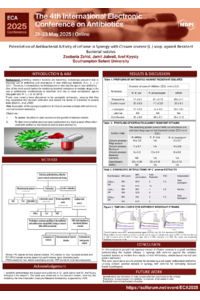
Background: Antibiotics have been known as "miracle drugs" for good reason, but due to their overuse, most antibiotic bacterial combinations now have higher frequencies of resistance. Plants have been discovered to be synergistic enhancers, meaning that they may not possess any antimicrobial qualities alone but can increase the effectiveness of conventional medications.
Methodology
Successive extraction with sonication-aided maceration was used to prepare ethyl acetate (EA), methanol (M), and aqueous (Aq) extracts of C. arvense, which were subjected to chromogenic assays for phytochemical evaluation and antioxidant activity. Antibacterial activity was determined using disc diffusion and microbroth dilution assays. Synergistic evaluation of the extracts and mechanistic insights were provided using the checkerboard method, time–kill kinetics, and protein estimation studies.
Results
The aqueous extract exhibited the highest percent recovery (7.33%), the highest total phenolic (16.95±0.16 µg GAE/mg of extract) and flavonoid contents (10.925±0.13 µg QE/mg of extract), and a notable antioxidant capacity (102.86±0.01 µg AAE/mg of extract) and reducing power (121.5±0.03 µg AAE/mg of extract) and significant radical scavenging activity (18.2±0.09%). The extracts showed noteworthy antibacterial activity (MIC = 500 μg/ml). The checkerboard method revealed total synergism, with 4- and 16-fold reductions in the MICs of the C. arvense extracts and cefixime, leading to a time-dependent reduction in bacterial growth. Together with the cell membrane damage brought on by cefixime, the synergistic combinations resulted in greater inhibition of bacterial proteins. Our findings suggest that the C. arvense aqueous extract showed the maximum synergistic activity and could be a potential candidate for the treatment challenges of global multidrug resistance.
Conclusion
This research highlights the promising antibacterial efficacy of C. arvense extracts, demonstrating their potential in combination with cefixime to inhibit bacterial growth. This study underscores the potential to integrate C. arvense extracts with conventional antibiotics, offering a novel approach to combating infectious diseases.
Keywords
plant extracts
cefixime
antimicrobial resistance
Poster
Poster Presentation_Zoobaria Zahid.pdf
Multidrug-Resistant Klebsiella Pneumoniae in Native Portuguese Cattle Breeds: A Public Health Concern
Blue-Light Photoactivation of Berberine-Gentamicin Combination: A Synergistic Strategy Against Staphylococcus aureus Acute Wound Infections