Event submissions
Published
This submission belongs to the session S4. Novel Antimicrobial Agents: Discovery, Design, Synthesis and Action of the event The 4th International Electronic Conference on Antibiotics
Published date
19 May, 2025
Academic Editor
'%3e%3cpath%20d='M12.6657%2010.9104C12.4185%2010.325%2012.0599%209.79327%2011.6097%209.34482C11.1609%208.89508%2010.6293%208.5365%2010.0442%208.28888C10.0389%208.28626%2010.0337%208.28495%2010.0285%208.28233C10.8446%207.69279%2011.3752%206.73249%2011.3752%205.64904C11.3752%203.8542%209.92103%202.39999%208.1262%202.39999C6.33136%202.39999%204.87715%203.8542%204.87715%205.64904C4.87715%206.73249%205.40774%207.69279%206.22393%208.28364C6.21869%208.28626%206.21345%208.28757%206.20821%208.29019C5.62129%208.5378%205.09463%208.89284%204.64265%209.34613C4.1929%209.79493%203.83432%2010.3266%203.58671%2010.9117C3.34345%2011.4845%203.21226%2012.0987%203.20023%2012.7209C3.19988%2012.7349%203.20233%2012.7488%203.20744%2012.7619C3.21255%2012.7749%203.22022%2012.7867%203.22998%2012.7968C3.23975%2012.8068%203.25142%2012.8147%203.26431%2012.8202C3.2772%2012.8256%203.29105%2012.8284%203.30504%2012.8284H4.09109C4.14874%2012.8284%204.19459%2012.7825%204.1959%2012.7262C4.2221%2011.7148%204.62823%2010.7676%205.34617%2010.0497C6.08899%209.30683%207.0755%208.89808%208.1262%208.89808C9.17689%208.89808%2010.1634%209.30683%2010.9062%2010.0497C11.6242%2010.7676%2012.0303%2011.7148%2012.0565%2012.7262C12.0578%2012.7838%2012.1037%2012.8284%2012.1613%2012.8284H12.9474C12.9613%2012.8284%2012.9752%2012.8256%2012.9881%2012.8202C13.001%2012.8147%2013.0126%2012.8068%2013.0224%2012.7968C13.0322%2012.7867%2013.0398%2012.7749%2013.0449%2012.7619C13.0501%2012.7488%2013.0525%2012.7349%2013.0522%2012.7209C13.0391%2012.0947%2012.9094%2011.4855%2012.6657%2010.9104ZM8.1262%207.9024C7.52486%207.9024%206.9589%207.6679%206.53312%207.24211C6.10733%206.81633%205.87283%206.25037%205.87283%205.64904C5.87283%205.0477%206.10733%204.48174%206.53312%204.05596C6.9589%203.63018%207.52486%203.39567%208.1262%203.39567C8.72753%203.39567%209.29349%203.63018%209.71927%204.05596C10.1451%204.48174%2010.3796%205.0477%2010.3796%205.64904C10.3796%206.25037%2010.1451%206.81633%209.71927%207.24211C9.29349%207.6679%208.72753%207.9024%208.1262%207.9024Z'%20fill='%235D1EE1'/%3e%3c/g%3e%3c/svg%3e) Jordi Vila
Jordi VilaCitation
Lília Soares Teixeira, Sónia Fraga, Manuel Simões, Anabela Borges, Combinations of Riboflavin with Antiseptics for Tackling Staphylococcus aureus Methicillin Resistant Infections by Photodynamic Inactivation, in Proceedings of The 4th International Electronic Conference on Antibiotics, 21 May–23 May 2025, MDPI: Basel, Switzerland
Share
Email
Facebook
Twitter
LinkedIn
Combinations of Riboflavin with Antiseptics for Tackling Staphylococcus aureus Methicillin Resistant Infections by Photodynamic Inactivation
'%3e%3cpath%20d='M12.6647%2010.9104C12.4176%2010.325%2012.0589%209.7933%2011.6088%209.34485C11.16%208.89511%2010.6283%208.53653%2010.0432%208.28891C10.038%208.28629%2010.0327%208.28498%2010.0275%208.28236C10.8437%207.69282%2011.3743%206.73252%2011.3743%205.64907C11.3743%203.85423%209.92005%202.40002%208.12522%202.40002C6.33038%202.40002%204.87618%203.85423%204.87618%205.64907C4.87618%206.73252%205.40677%207.69282%206.22296%208.28367C6.21772%208.28629%206.21248%208.2876%206.20724%208.29022C5.62031%208.53783%205.09365%208.89287%204.64167%209.34616C4.19192%209.79496%203.83334%2010.3266%203.58573%2010.9117C3.34247%2011.4846%203.21128%2012.0987%203.19925%2012.721C3.1989%2012.735%203.20135%2012.7489%203.20646%2012.7619C3.21157%2012.7749%203.21924%2012.7868%203.22901%2012.7968C3.23877%2012.8068%203.25045%2012.8148%203.26334%2012.8202C3.27623%2012.8256%203.29007%2012.8284%203.30406%2012.8284H4.09012C4.14776%2012.8284%204.19362%2012.7825%204.19493%2012.7262C4.22113%2011.7148%204.62726%2010.7676%205.34519%2010.0497C6.08802%209.30686%207.07452%208.89811%208.12522%208.89811C9.17592%208.89811%2010.1624%209.30686%2010.9052%2010.0497C11.6232%2010.7676%2012.0293%2011.7148%2012.0555%2012.7262C12.0568%2012.7839%2012.1027%2012.8284%2012.1603%2012.8284H12.9464C12.9604%2012.8284%2012.9742%2012.8256%2012.9871%2012.8202C13%2012.8148%2013.0117%2012.8068%2013.0214%2012.7968C13.0312%2012.7868%2013.0389%2012.7749%2013.044%2012.7619C13.0491%2012.7489%2013.0515%2012.735%2013.0512%2012.721C13.0381%2012.0947%2012.9084%2011.4856%2012.6647%2010.9104ZM8.12522%207.90243C7.52388%207.90243%206.95792%207.66793%206.53214%207.24215C6.10636%206.81636%205.87185%206.2504%205.87185%205.64907C5.87185%205.04773%206.10636%204.48177%206.53214%204.05599C6.95792%203.63021%207.52388%203.3957%208.12522%203.3957C8.72655%203.3957%209.29252%203.63021%209.7183%204.05599C10.1441%204.48177%2010.3786%205.04773%2010.3786%205.64907C10.3786%206.2504%2010.1441%206.81636%209.7183%207.24215C9.29252%207.66793%208.72655%207.90243%208.12522%207.90243Z'%20fill='%235D1EE1'/%3e%3c/g%3e%3c/svg%3e)
Lília Soares Teixeira 1,2
Sónia Fraga 3,4,5,6

Manuel Simões 1,7,8

Anabela Borges 1,7,8
1. LEPABE-Laboratory for Process Engineering, Environment, Biotechnology and Energy, Faculty of Engineering, University of Porto, Rua Dr. Roberto Frias, 4200-465 Porto, Portugal
2. National Institute of Health Dr. Ricardo Jorge, Rua Alexandre Herculano, 321, Porto 4000-055, Portugal
3. Environmental Health Department, National Institute of Health Dr. Ricardo Jorge, Rua Alexandre Herculano, 321, Porto 4000-055, Portugal
4. EPIUnit—Instituto de Saúde Pública, Universidade do Porto, Rua das Taipas 135, Porto 4050-600, Portugal
5. Laboratory for Integrative and Translational Research in Population Health (ITR), Rua das Taipas 135, Porto 4050-600, Portugal
6. Department of Biomedicine, Unit of Pharmacology and Therapeutics, Faculty of Medicine, University of Porto, Porto 4200-319, Portugal
7. ALICE-Associate Laboratory for Innovation in Chemical Engineering, Faculty of Engineering, University of Porto, Rua Dr. Roberto Frias, s/n, 4200-465 Porto, Portugal
8. DEQ-Department of Chemical Engineering, Faculty of Engineering, University of Porto, Rua Dr. Roberto Frias, s/n, 4200-465 Porto, Portugal
Abstract
Antibiotic-resistant pathogens, such as methicillin resistant Staphylococcus aureus (MRSA), pose significant challenges in managing chronic wound infections. Antibacterial photodynamic inactivation (aPDI) has emerged as an alternative to antibiotics by offering localized and resistance-independent bacterial elimination. Natural compounds with photosensitizing properties are particularly attractive due to their biocompatibility and sustainability. Therefore, this study investigates the potential of aPDI using riboflavin (RB), a vitamin and vital micronutrient commonly found in various animals and plants. RB is known to be a promising natural photosensitizer, capable of causing bacterial cell damage by reactive oxygen species (ROS) generation. Additionally, the potential synergistic combinations with the commonly used wound antiseptics, namely octenidine dihydrochloride (OCT) and polyhexamethylene biguanide (PHMB) against S. aureus clinical strain (MJMC568-B: MRSA) was assessed. The approach aimed to improve antiseptic effiency by reducing the necessary concentrations. The antibacterial efficacy of RB, OCT and PHMB were determined independently by minimum inhibitory concentration (MIC) and minimum bactericidal concentration (MBC). The photodynamic activity of RB was assessed by irradiating with blue light (420 nm) using a light-emitting diode (LED) system and quantification through colony-forming unit (CFU) analysis. An evaluation of the potential synergistic interactions of RB-mediated aPDI, with OCT and PHMB was conducted by a disk diffusion assay, and a checkerboard assay. The results highlight the potential of combining aPDI with antiseptics to achieve enhanced antibacterial effects against S. aureus. This dual approach could offer a promising solution for managing chronic wound infections, reducing the reliance on traditional antibiotics, and mitigating the risk of resistance development.
Acknowledgments: This work was supported by:Project InnovAntiBiofilm(ref. 101157363) financed by European Commission(Horizon-Widera 2023-Acess-02/Horizon-CSA); LEPABE, UIDB/00511/2020((DOI: 10.54499/UIDB/00511/2020)) and UIDP/00511/2020(DOI: 10.54499/UIDP/00511/2020); ALiCE, LA/P/0045/2020(DOI: 10.54499/LA/P/0045/2020); funded by national funds through the FCT/MCTES(PIDDAC; Lisbon, Portugal). Lília S. Teixeira acknowledges individual PhD fellowship from FCT(2023.04774.BDANA).
Keywords
Antibacterial Photodynamic Inactivation
Antibiotic resistance
Antiseptics
Riboflavin
Staphylococcus aureus
Chronic Wounds
Poster
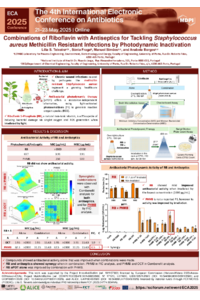
Poster_Flash_Presentaion_L. Teixeira et. al_ECA.pdf
Disruption of Quorum Sensing in Pseudomonas aeruginosa by Sinapic Acid: Impacts on Biofilm Formation and Virulence
Genomic Insights Into Multidrug Resistance In Pseudomonas Aeruginosa, Klebsiella Pneumoniae, And Escherichia Coli: Implications For Cancer Patient Care