Event submissions
Published
This submission belongs to the session S2. Antibiotics and One Health of the event The 4th International Electronic Conference on Antibiotics
Published date
19 May, 2025
Academic Editor
'%3e%3cpath%20d='M12.6657%2010.9104C12.4185%2010.325%2012.0599%209.79327%2011.6097%209.34482C11.1609%208.89508%2010.6293%208.5365%2010.0442%208.28888C10.0389%208.28626%2010.0337%208.28495%2010.0285%208.28233C10.8446%207.69279%2011.3752%206.73249%2011.3752%205.64904C11.3752%203.8542%209.92103%202.39999%208.1262%202.39999C6.33136%202.39999%204.87715%203.8542%204.87715%205.64904C4.87715%206.73249%205.40774%207.69279%206.22393%208.28364C6.21869%208.28626%206.21345%208.28757%206.20821%208.29019C5.62129%208.5378%205.09463%208.89284%204.64265%209.34613C4.1929%209.79493%203.83432%2010.3266%203.58671%2010.9117C3.34345%2011.4845%203.21226%2012.0987%203.20023%2012.7209C3.19988%2012.7349%203.20233%2012.7488%203.20744%2012.7619C3.21255%2012.7749%203.22022%2012.7867%203.22998%2012.7968C3.23975%2012.8068%203.25142%2012.8147%203.26431%2012.8202C3.2772%2012.8256%203.29105%2012.8284%203.30504%2012.8284H4.09109C4.14874%2012.8284%204.19459%2012.7825%204.1959%2012.7262C4.2221%2011.7148%204.62823%2010.7676%205.34617%2010.0497C6.08899%209.30683%207.0755%208.89808%208.1262%208.89808C9.17689%208.89808%2010.1634%209.30683%2010.9062%2010.0497C11.6242%2010.7676%2012.0303%2011.7148%2012.0565%2012.7262C12.0578%2012.7838%2012.1037%2012.8284%2012.1613%2012.8284H12.9474C12.9613%2012.8284%2012.9752%2012.8256%2012.9881%2012.8202C13.001%2012.8147%2013.0126%2012.8068%2013.0224%2012.7968C13.0322%2012.7867%2013.0398%2012.7749%2013.0449%2012.7619C13.0501%2012.7488%2013.0525%2012.7349%2013.0522%2012.7209C13.0391%2012.0947%2012.9094%2011.4855%2012.6657%2010.9104ZM8.1262%207.9024C7.52486%207.9024%206.9589%207.6679%206.53312%207.24211C6.10733%206.81633%205.87283%206.25037%205.87283%205.64904C5.87283%205.0477%206.10733%204.48174%206.53312%204.05596C6.9589%203.63018%207.52486%203.39567%208.1262%203.39567C8.72753%203.39567%209.29349%203.63018%209.71927%204.05596C10.1451%204.48174%2010.3796%205.0477%2010.3796%205.64904C10.3796%206.25037%2010.1451%206.81633%209.71927%207.24211C9.29349%207.6679%208.72753%207.9024%208.1262%207.9024Z'%20fill='%235D1EE1'/%3e%3c/g%3e%3c/svg%3e) Efstathios Giaouris
Efstathios GiaourisCitation
Rita Jesus, Virgínia Ribeiro, Hugo Lopes, Rui Dantas, Ana R. Freitas, Nuno V. Brito, Sandra Quinteira, Carla Miranda, Exploring the Role of Autochthonous Portuguese Hens in Antimicrobial Resistance Dissemination: A Study of Escherichia coli in Cloacal and Eggshell Samples, in Proceedings of The 4th International Electronic Conference on Antibiotics, 21 May–23 May 2025, MDPI: Basel, Switzerland
Share
Email
Facebook
Twitter
LinkedIn
Exploring the Role of Autochthonous Portuguese Hens in Antimicrobial Resistance Dissemination: A Study of Escherichia coli in Cloacal and Eggshell Samples
'%3e%3cpath%20d='M12.6647%2010.9104C12.4176%2010.325%2012.0589%209.7933%2011.6088%209.34485C11.16%208.89511%2010.6283%208.53653%2010.0432%208.28891C10.038%208.28629%2010.0327%208.28498%2010.0275%208.28236C10.8437%207.69282%2011.3743%206.73252%2011.3743%205.64907C11.3743%203.85423%209.92005%202.40002%208.12522%202.40002C6.33038%202.40002%204.87618%203.85423%204.87618%205.64907C4.87618%206.73252%205.40677%207.69282%206.22296%208.28367C6.21772%208.28629%206.21248%208.2876%206.20724%208.29022C5.62031%208.53783%205.09365%208.89287%204.64167%209.34616C4.19192%209.79496%203.83334%2010.3266%203.58573%2010.9117C3.34247%2011.4846%203.21128%2012.0987%203.19925%2012.721C3.1989%2012.735%203.20135%2012.7489%203.20646%2012.7619C3.21157%2012.7749%203.21924%2012.7868%203.22901%2012.7968C3.23877%2012.8068%203.25045%2012.8148%203.26334%2012.8202C3.27623%2012.8256%203.29007%2012.8284%203.30406%2012.8284H4.09012C4.14776%2012.8284%204.19362%2012.7825%204.19493%2012.7262C4.22113%2011.7148%204.62726%2010.7676%205.34519%2010.0497C6.08802%209.30686%207.07452%208.89811%208.12522%208.89811C9.17592%208.89811%2010.1624%209.30686%2010.9052%2010.0497C11.6232%2010.7676%2012.0293%2011.7148%2012.0555%2012.7262C12.0568%2012.7839%2012.1027%2012.8284%2012.1603%2012.8284H12.9464C12.9604%2012.8284%2012.9742%2012.8256%2012.9871%2012.8202C13%2012.8148%2013.0117%2012.8068%2013.0214%2012.7968C13.0312%2012.7868%2013.0389%2012.7749%2013.044%2012.7619C13.0491%2012.7489%2013.0515%2012.735%2013.0512%2012.721C13.0381%2012.0947%2012.9084%2011.4856%2012.6647%2010.9104ZM8.12522%207.90243C7.52388%207.90243%206.95792%207.66793%206.53214%207.24215C6.10636%206.81636%205.87185%206.2504%205.87185%205.64907C5.87185%205.04773%206.10636%204.48177%206.53214%204.05599C6.95792%203.63021%207.52388%203.3957%208.12522%203.3957C8.72655%203.3957%209.29252%203.63021%209.7183%204.05599C10.1441%204.48177%2010.3786%205.04773%2010.3786%205.64907C10.3786%206.2504%2010.1441%206.81636%209.7183%207.24215C9.29252%207.66793%208.72655%207.90243%208.12522%207.90243Z'%20fill='%235D1EE1'/%3e%3c/g%3e%3c/svg%3e)
Rita Jesus 1
Virgínia Ribeiro 2
Hugo Lopes 1

Rui Dantas 3,4
Ana R. Freitas 3,5,6
Nuno V. Brito 3,7

Sandra Quinteira 3,8,9,10

Carla Miranda 3,11
1. University Institute of Health Sciences, CESPU, 4585-116 Gandra, Portugal
2. AMIBA–Associação dos Criadores de Bovinos de Raça Barrosã, 4730-260 Vila Verde, Portugal
3. UCIBIO—Applied Molecular Biosciences Unit, University Institute of Health Sciences (1H-TOXRUN, IUCS-CESPU), Avenida Central de Gandra 1317, 4585-116 Paredes, Portugal
4. ACRC—Associação Criadores da Raça Cachena, Parque Empresarial de Paçô, Rua da Roca 107,
4970-249 Arcos de Valdevez, Portugal
5. UCIBIO—Applied Molecular Biosciences Unit, Faculty of Pharmacy, University of Porto, Rua Jorge de Viterbo Ferreira 228, 4050-313 Porto, Portugal
6. Associate Laboratory i4HB, Institute for Health and Bioeconomy, Faculty of Pharmacy, University of Porto, Rua Jorge de Viterbo Ferreira 228, 4050-313 Porto, Portugal
7. CISAS–Center for Research and Development in Agrifood Systems and Sustainability, Polytechnic Institute of Viana do Castelo, NUTRIR (Technological Center for AgriFood Sustainability), Monte de Prado, 4960-320 Melgaço, Portugal
8. CIBIO—Research Center in Biodiversity and Genetic Resources, InBIO, Research Network in Biodiversity and Evolutionary Biology, Associated Laboratory, University of Porto, Campus de Vairão, Rua Padre Armando Quintas 7,4485-661 Vairão, Portugal
9. BIOPOLIS Program in Genomics, Biodiversity and Land Planning, Campus de Vairão, Rua Padre Armando Quintas 7, 4485-661 Vairão, Portugal
10. Department of Biology, Faculty of Sciences, University of Porto, Rua do Campo Alegre s/n,
4169-007 Porto, Portugal
11. LAQV-REQUIMTE–Associated Laboratory for Green Chemistry, University NOVA of Lisbon,
1099-085 Caparica, Portugal
Abstract
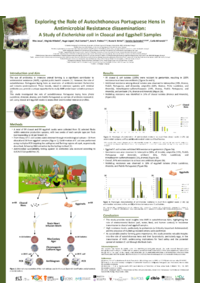
Introduction: The use of antibiotics in intensive animal farming is a significant contributor to antimicrobial resistance (AMR), which is a global public health concern. However, the role of autochthonous Portuguese laying hens as reservoirs of antibiotic-resistant Escherichia coli remains underexplored. These breeds, raised in extensive systems with minimal antibiotic use, provide a unique opportunity to study AMR under lower selective pressure. This study investigated the role of autochthonous Portuguese laying hens (Preta Lusitânica, Amarela, Branca, and Pedrês Portuguesa) as carriers of antibiotic-resistant E. coli, using cloacal and eggshell swabs to assess their antimicrobial resistance profiles.
Methods: A total of 64 cloacal and 64 eggshell swabs were collected from 31 selected flocks (2 per flock, 16 per breed), yielding 67 E. coli isolates (33 from cloaca, 34 from eggshell). The isolates’ susceptibility against 10 antibiotics was assessed following EUCAST/CLSI guidelines.
Results: All cloacal isolates (100%) and 94% of eggshells isolates exhibited resistance to gentamicin. Additional resistance in cloacal isolates was observed to tetracycline (29%, Branca, Pedrês Portuguesa, andAmarela), ampicillin (14%, Branca, Preta Lusitânica, and Amarela), trimethoprim+sulfamethoxazole (14%, Branca, Pedrês Portuguesa, and Amarela), and amikacin (7%, Branca and Amarela). In eggshell isolates, resistance was observed to tetracycline (38%, across all breeds), ampicillin (15%, Pedrês Portuguesa and Amarela), amikacin (6%, Preta Lusitânica), and trimethoprim+sulfamethoxazole (3%, Branca). Resistance to at least one antibiotic was found in 100% of cloacal isolates and 97% of eggshell isolates. Multidrug resistance was identified in 14% of cloacal isolates (Branca and Amarela) and 18% of eggshell isolates (Preta Lusitânica, Amarela, and Pedrês Portuguesa).
Conclusions: As sustainable poultry farming gains importance, this pioneering study provides valuable insights into the role of autochthonous hens in AMR transmission, emphasizing their impact on food safety and global AMR mitigation. Additionally, it explores whether native hens’ by-products contribute to the spread of antibiotic-resistant E. coli through the food chain.
Acknowledgements: SALMYTH_GI2-CESPU_2022; FCT/MCTES – UIDB/50006/2020 and UIDP/50006/2020.
Keywords
Native breeds
Escherichia coli
one health
antimicrobial resistance
Poster
Poster_ECA2025_Jesus et al.pdf
Microbial Importance in the Synthesis of Chiral Drugs and Drug Intermediates for the Benefit of Mankind
Antimicrobial Resistance and Biofilm Formation in Staphylococcus Aureus Isolated from Retail Meat: Implications for Food Safety