Event submissions
Published
This submission belongs to the session S3. Epidemiology, Prevalence and Mechanisms of Antibiotic Resistance and Cross-Resistance of the event The 4th International Electronic Conference on Antibiotics
Published date
19 May, 2025
Academic Editor
'%3e%3cpath%20d='M12.6657%2010.9104C12.4185%2010.325%2012.0599%209.79327%2011.6097%209.34482C11.1609%208.89508%2010.6293%208.5365%2010.0442%208.28888C10.0389%208.28626%2010.0337%208.28495%2010.0285%208.28233C10.8446%207.69279%2011.3752%206.73249%2011.3752%205.64904C11.3752%203.8542%209.92103%202.39999%208.1262%202.39999C6.33136%202.39999%204.87715%203.8542%204.87715%205.64904C4.87715%206.73249%205.40774%207.69279%206.22393%208.28364C6.21869%208.28626%206.21345%208.28757%206.20821%208.29019C5.62129%208.5378%205.09463%208.89284%204.64265%209.34613C4.1929%209.79493%203.83432%2010.3266%203.58671%2010.9117C3.34345%2011.4845%203.21226%2012.0987%203.20023%2012.7209C3.19988%2012.7349%203.20233%2012.7488%203.20744%2012.7619C3.21255%2012.7749%203.22022%2012.7867%203.22998%2012.7968C3.23975%2012.8068%203.25142%2012.8147%203.26431%2012.8202C3.2772%2012.8256%203.29105%2012.8284%203.30504%2012.8284H4.09109C4.14874%2012.8284%204.19459%2012.7825%204.1959%2012.7262C4.2221%2011.7148%204.62823%2010.7676%205.34617%2010.0497C6.08899%209.30683%207.0755%208.89808%208.1262%208.89808C9.17689%208.89808%2010.1634%209.30683%2010.9062%2010.0497C11.6242%2010.7676%2012.0303%2011.7148%2012.0565%2012.7262C12.0578%2012.7838%2012.1037%2012.8284%2012.1613%2012.8284H12.9474C12.9613%2012.8284%2012.9752%2012.8256%2012.9881%2012.8202C13.001%2012.8147%2013.0126%2012.8068%2013.0224%2012.7968C13.0322%2012.7867%2013.0398%2012.7749%2013.0449%2012.7619C13.0501%2012.7488%2013.0525%2012.7349%2013.0522%2012.7209C13.0391%2012.0947%2012.9094%2011.4855%2012.6657%2010.9104ZM8.1262%207.9024C7.52486%207.9024%206.9589%207.6679%206.53312%207.24211C6.10733%206.81633%205.87283%206.25037%205.87283%205.64904C5.87283%205.0477%206.10733%204.48174%206.53312%204.05596C6.9589%203.63018%207.52486%203.39567%208.1262%203.39567C8.72753%203.39567%209.29349%203.63018%209.71927%204.05596C10.1451%204.48174%2010.3796%205.0477%2010.3796%205.64904C10.3796%206.25037%2010.1451%206.81633%209.71927%207.24211C9.29349%207.6679%208.72753%207.9024%208.1262%207.9024Z'%20fill='%235D1EE1'/%3e%3c/g%3e%3c/svg%3e) Nicholas Dixon
Nicholas DixonCitation
Marta Katkowska, Maja Kosecka-Strojek, Mariola Wolska-Gębarzewska, Ewa Kwapisz, Maria Wierzbowska, Jacek Międzobrodzki, Katarzyna Garbacz, Efficiency Of Routine Methods In the Detection Of Methicillin-Resistant Coagulase-Negative Staphylococci., in Proceedings of The 4th International Electronic Conference on Antibiotics, 21 May–23 May 2025, MDPI: Basel, Switzerland
Share
Email
Facebook
Twitter
LinkedIn
Efficiency Of Routine Methods In the Detection Of Methicillin-Resistant Coagulase-Negative Staphylococci.
'%3e%3cpath%20d='M12.6647%2010.9104C12.4176%2010.325%2012.0589%209.7933%2011.6088%209.34485C11.16%208.89511%2010.6283%208.53653%2010.0432%208.28891C10.038%208.28629%2010.0327%208.28498%2010.0275%208.28236C10.8437%207.69282%2011.3743%206.73252%2011.3743%205.64907C11.3743%203.85423%209.92005%202.40002%208.12522%202.40002C6.33038%202.40002%204.87618%203.85423%204.87618%205.64907C4.87618%206.73252%205.40677%207.69282%206.22296%208.28367C6.21772%208.28629%206.21248%208.2876%206.20724%208.29022C5.62031%208.53783%205.09365%208.89287%204.64167%209.34616C4.19192%209.79496%203.83334%2010.3266%203.58573%2010.9117C3.34247%2011.4846%203.21128%2012.0987%203.19925%2012.721C3.1989%2012.735%203.20135%2012.7489%203.20646%2012.7619C3.21157%2012.7749%203.21924%2012.7868%203.22901%2012.7968C3.23877%2012.8068%203.25045%2012.8148%203.26334%2012.8202C3.27623%2012.8256%203.29007%2012.8284%203.30406%2012.8284H4.09012C4.14776%2012.8284%204.19362%2012.7825%204.19493%2012.7262C4.22113%2011.7148%204.62726%2010.7676%205.34519%2010.0497C6.08802%209.30686%207.07452%208.89811%208.12522%208.89811C9.17592%208.89811%2010.1624%209.30686%2010.9052%2010.0497C11.6232%2010.7676%2012.0293%2011.7148%2012.0555%2012.7262C12.0568%2012.7839%2012.1027%2012.8284%2012.1603%2012.8284H12.9464C12.9604%2012.8284%2012.9742%2012.8256%2012.9871%2012.8202C13%2012.8148%2013.0117%2012.8068%2013.0214%2012.7968C13.0312%2012.7868%2013.0389%2012.7749%2013.044%2012.7619C13.0491%2012.7489%2013.0515%2012.735%2013.0512%2012.721C13.0381%2012.0947%2012.9084%2011.4856%2012.6647%2010.9104ZM8.12522%207.90243C7.52388%207.90243%206.95792%207.66793%206.53214%207.24215C6.10636%206.81636%205.87185%206.2504%205.87185%205.64907C5.87185%205.04773%206.10636%204.48177%206.53214%204.05599C6.95792%203.63021%207.52388%203.3957%208.12522%203.3957C8.72655%203.3957%209.29252%203.63021%209.7183%204.05599C10.1441%204.48177%2010.3786%205.04773%2010.3786%205.64907C10.3786%206.2504%2010.1441%206.81636%209.7183%207.24215C9.29252%207.66793%208.72655%207.90243%208.12522%207.90243Z'%20fill='%235D1EE1'/%3e%3c/g%3e%3c/svg%3e)
Marta Katkowska 1

Maja Kosecka-Strojek 2
Mariola Wolska-Gębarzewska 2,3
Ewa Kwapisz 1
Maria Wierzbowska 1

Jacek Międzobrodzki 2
Katarzyna Garbacz 1
1. Department of Oral Microbiology, Medical Faculty, Medical University of Gdansk, Gdansk, Poland
2. Department of Microbiology, Faculty of Biochemistry, Biophysics and Biotechnology, Jagiellonian University, Krakow, Poland
3. Doctoral School of Exact and Natural Sciences, Jagiellonian University, Krakow, Poland
Abstract
Introduction: Among the multiple mechanisms of acquired drug resistance in coagulase-negative staphylococci (CoNS), methicillin resistance appears to be the most important from a clinical and epidemiological perspective. According to the Clinical and Laboratory Standard Institute (CLSI) guidelines, the detection of mec genes is the gold standard for identification of staphylococcal methicillin resistance. In this study, we tested the efficiency of routine methods in the detection of methicillin-resistant coagulase-negative staphylococci strains (MRCoNS).
Methods: Methicillin resistance was identified using cefoxitin (30 μg) and oxacillin (1 μg) by the disk diffusion method (DDM) on Mueller–Hinton agar (Becton Dickinson, Franklin Lakes, NJ, USA) per CLSI recommendations. Oxacillin MICs (Minimal Inhibitory Concentrations) were determined by the agar dilution method (ADM) according to CLSI recommendations [M07-A10]. To detect the mecA gene, mecA primers were designed. For mecA-negative CoNS strains, the mecC and mecB genes were tested by simplex PCR.
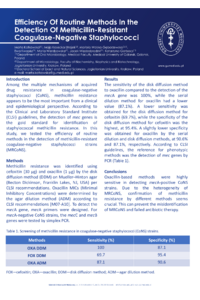
Results: The sensitivity of the disk diffusion method to oxacillin compared to the detection of the mecA gene was 100%, while the serial dilution method for oxacillin had a lower value (87.1%). A lower sensitivity was obtained for the disk diffusion method for cefoxitin (69.7%), while the specificity of the disk diffusion method for cefoxitin was the highest, at 95.4%. A slightly lower specificity was obtained for oxacillin by the serial dilution and disk diffusion methods, at 90.6% and 87.1%, respectively. According to CLSI guidelines, the reference for phenotypic methods was the detection of mec genes by PCR.
Conclusions: Oxacillin-based methods were highly sensitive in detecting mecA-positive CoNS strains. Due to the heterogeneity of MRCoNS, confirmation of methicillin resistance by different methods seems crucial. This can prevent the misidentification of MRCoNS and failed antibiotic therapy.
Keywords
coagulase-negative staphylococci
CoNS
methicillin-resistance
mecA
cefoxitin
oxacillin
methicillin
Poster
Marta Katkowska 21-23 May 2025.pdf
Decoding Bel-1: Structural Insights into an Extended-Spectrum Beta-Lactamase with Carbapenemase-Like Disulfide Features from Pseudomonas aeruginosa
Comparative Evaluation Of The Activity Of Staphylococcal Bacteriophages With Different Classes Of Antibiotics