Event submissions
Published
This submission belongs to the session S5. Multidisciplinary Antimicrobial Strategies: Materials, Peptides, Bacteriophages and Repurposing of the event The 4th International Electronic Conference on Antibiotics
Published date
19 May, 2025
Academic Editor
'%3e%3cpath%20d='M12.6657%2010.9104C12.4185%2010.325%2012.0599%209.79327%2011.6097%209.34482C11.1609%208.89508%2010.6293%208.5365%2010.0442%208.28888C10.0389%208.28626%2010.0337%208.28495%2010.0285%208.28233C10.8446%207.69279%2011.3752%206.73249%2011.3752%205.64904C11.3752%203.8542%209.92103%202.39999%208.1262%202.39999C6.33136%202.39999%204.87715%203.8542%204.87715%205.64904C4.87715%206.73249%205.40774%207.69279%206.22393%208.28364C6.21869%208.28626%206.21345%208.28757%206.20821%208.29019C5.62129%208.5378%205.09463%208.89284%204.64265%209.34613C4.1929%209.79493%203.83432%2010.3266%203.58671%2010.9117C3.34345%2011.4845%203.21226%2012.0987%203.20023%2012.7209C3.19988%2012.7349%203.20233%2012.7488%203.20744%2012.7619C3.21255%2012.7749%203.22022%2012.7867%203.22998%2012.7968C3.23975%2012.8068%203.25142%2012.8147%203.26431%2012.8202C3.2772%2012.8256%203.29105%2012.8284%203.30504%2012.8284H4.09109C4.14874%2012.8284%204.19459%2012.7825%204.1959%2012.7262C4.2221%2011.7148%204.62823%2010.7676%205.34617%2010.0497C6.08899%209.30683%207.0755%208.89808%208.1262%208.89808C9.17689%208.89808%2010.1634%209.30683%2010.9062%2010.0497C11.6242%2010.7676%2012.0303%2011.7148%2012.0565%2012.7262C12.0578%2012.7838%2012.1037%2012.8284%2012.1613%2012.8284H12.9474C12.9613%2012.8284%2012.9752%2012.8256%2012.9881%2012.8202C13.001%2012.8147%2013.0126%2012.8068%2013.0224%2012.7968C13.0322%2012.7867%2013.0398%2012.7749%2013.0449%2012.7619C13.0501%2012.7488%2013.0525%2012.7349%2013.0522%2012.7209C13.0391%2012.0947%2012.9094%2011.4855%2012.6657%2010.9104ZM8.1262%207.9024C7.52486%207.9024%206.9589%207.6679%206.53312%207.24211C6.10733%206.81633%205.87283%206.25037%205.87283%205.64904C5.87283%205.0477%206.10733%204.48174%206.53312%204.05596C6.9589%203.63018%207.52486%203.39567%208.1262%203.39567C8.72753%203.39567%209.29349%203.63018%209.71927%204.05596C10.1451%204.48174%2010.3796%205.0477%2010.3796%205.64904C10.3796%206.25037%2010.1451%206.81633%209.71927%207.24211C9.29349%207.6679%208.72753%207.9024%208.1262%207.9024Z'%20fill='%235D1EE1'/%3e%3c/g%3e%3c/svg%3e) Serena Riela
Serena RielaCitation
Zuhayr Mahtab, Fahmida Haque, Sohidul Islam, Ishrat Jabeen, Sabbir R. Shuvo, Genomic Insights into Bacteriophage PaFZ4: A Potential Alternative to Antibiotics for MDR Pseudomonas aeruginosa, in Proceedings of The 4th International Electronic Conference on Antibiotics, 21 May–23 May 2025, MDPI: Basel, Switzerland
Share
Email
Facebook
Twitter
LinkedIn
Genomic Insights into Bacteriophage PaFZ4: A Potential Alternative to Antibiotics for MDR Pseudomonas aeruginosa
'%3e%3cpath%20d='M12.6647%2010.9104C12.4176%2010.325%2012.0589%209.7933%2011.6088%209.34485C11.16%208.89511%2010.6283%208.53653%2010.0432%208.28891C10.038%208.28629%2010.0327%208.28498%2010.0275%208.28236C10.8437%207.69282%2011.3743%206.73252%2011.3743%205.64907C11.3743%203.85423%209.92005%202.40002%208.12522%202.40002C6.33038%202.40002%204.87618%203.85423%204.87618%205.64907C4.87618%206.73252%205.40677%207.69282%206.22296%208.28367C6.21772%208.28629%206.21248%208.2876%206.20724%208.29022C5.62031%208.53783%205.09365%208.89287%204.64167%209.34616C4.19192%209.79496%203.83334%2010.3266%203.58573%2010.9117C3.34247%2011.4846%203.21128%2012.0987%203.19925%2012.721C3.1989%2012.735%203.20135%2012.7489%203.20646%2012.7619C3.21157%2012.7749%203.21924%2012.7868%203.22901%2012.7968C3.23877%2012.8068%203.25045%2012.8148%203.26334%2012.8202C3.27623%2012.8256%203.29007%2012.8284%203.30406%2012.8284H4.09012C4.14776%2012.8284%204.19362%2012.7825%204.19493%2012.7262C4.22113%2011.7148%204.62726%2010.7676%205.34519%2010.0497C6.08802%209.30686%207.07452%208.89811%208.12522%208.89811C9.17592%208.89811%2010.1624%209.30686%2010.9052%2010.0497C11.6232%2010.7676%2012.0293%2011.7148%2012.0555%2012.7262C12.0568%2012.7839%2012.1027%2012.8284%2012.1603%2012.8284H12.9464C12.9604%2012.8284%2012.9742%2012.8256%2012.9871%2012.8202C13%2012.8148%2013.0117%2012.8068%2013.0214%2012.7968C13.0312%2012.7868%2013.0389%2012.7749%2013.044%2012.7619C13.0491%2012.7489%2013.0515%2012.735%2013.0512%2012.721C13.0381%2012.0947%2012.9084%2011.4856%2012.6647%2010.9104ZM8.12522%207.90243C7.52388%207.90243%206.95792%207.66793%206.53214%207.24215C6.10636%206.81636%205.87185%206.2504%205.87185%205.64907C5.87185%205.04773%206.10636%204.48177%206.53214%204.05599C6.95792%203.63021%207.52388%203.3957%208.12522%203.3957C8.72655%203.3957%209.29252%203.63021%209.7183%204.05599C10.1441%204.48177%2010.3786%205.04773%2010.3786%205.64907C10.3786%206.2504%2010.1441%206.81636%209.7183%207.24215C9.29252%207.66793%208.72655%207.90243%208.12522%207.90243Z'%20fill='%235D1EE1'/%3e%3c/g%3e%3c/svg%3e)
Zuhayr Mahtab 1
Fahmida Haque 1
Sohidul Islam 1
Ishrat Jabeen 1
Sabbir R. Shuvo 1
1. Department of Biochemistry & Microbiology, North South University, Dhaka, Bangladesh
Abstract
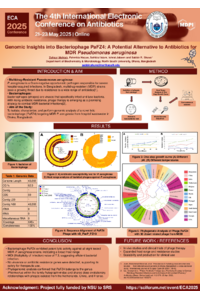
Introduction: Pseudomonas aeruginosa is a Gram-negative opportunistic pathogen that demonstrates significant resistance to multiple antibiotics of different classes. Bacteriophages, viruses that kill bacteria, have shown great potential against multidrug-resistant (MDR) infections. The phage PaFZ4 was isolated in this study, and its capability to infect MDR Pseudomonas aeruginosa strains was characterized. The whole genome sequencing analysis of the phage was performed to understand its potential as an anti-microbial agent.
Methods: A total of 10 bacteriophages (PaFZ 1-10) were isolated from sewage samples from different areas of Dhaka city. The host range of the bacteriophages was tested against 10 different MDR P. aeruginosa strains. The most effective PaFZ4 phage was characterized at different temperatures and pH levels. The whole genome sequencing of PaFZ4 and annotation was performed using the Phagenomics server. BLASTP was used to analyze the putative products of the ORFs, and phylogenetic analysis was performed using MEGA and iTOL. Proksee was used for sequence alignment and the visualization of the coding genes.
Results: The bacteriophage PaFZ4 has a broad host range and can kill all 10 MDR strains of P. aeruginosa studied. The characterizations of the phage indicated that the optimum pH was 8 and the temperature was 50°C. However, at higher temperatures, phage stability decreased significantly. The phage PaFZ4 has a genome sequence length of 43,208 bp with 62.3% GC content. A total of 147 ORFs, along with 59 coding sequences, were detected.
Conclusion: The phage PaFZ4 shows significant potential to fight against MDR P. aeruginosa, with its broad host range and stability under optimal conditions. In the future, an in-vivo analysis will be performed to understand the effectiveness of the isolated phage.
Keywords
Bacteriophage
Multidrug-resistant (MDR)
Pseudomonas aeruginosa
Bangladesh
Whole genome sequencing
Poster
Sciforum Zuhayr Poster.pdf
Reviving GE23077: Investigating the Biosynthetic Pathways and Antimicrobial Potential of a Promising RNAP Inhibitor
Antibacterial Activity of Three Essential-oil-loaded Nanoemulsions Against Six Pathogenic Bacterial Strains