Event submissions
Published
This submission belongs to the session S3. Epidemiology, Prevalence and Mechanisms of Antibiotic Resistance and Cross-Resistance of the event The 4th International Electronic Conference on Antibiotics
Published date
19 May, 2025
Academic Editor
'%3e%3cpath%20d='M12.6657%2010.9104C12.4185%2010.325%2012.0599%209.79327%2011.6097%209.34482C11.1609%208.89508%2010.6293%208.5365%2010.0442%208.28888C10.0389%208.28626%2010.0337%208.28495%2010.0285%208.28233C10.8446%207.69279%2011.3752%206.73249%2011.3752%205.64904C11.3752%203.8542%209.92103%202.39999%208.1262%202.39999C6.33136%202.39999%204.87715%203.8542%204.87715%205.64904C4.87715%206.73249%205.40774%207.69279%206.22393%208.28364C6.21869%208.28626%206.21345%208.28757%206.20821%208.29019C5.62129%208.5378%205.09463%208.89284%204.64265%209.34613C4.1929%209.79493%203.83432%2010.3266%203.58671%2010.9117C3.34345%2011.4845%203.21226%2012.0987%203.20023%2012.7209C3.19988%2012.7349%203.20233%2012.7488%203.20744%2012.7619C3.21255%2012.7749%203.22022%2012.7867%203.22998%2012.7968C3.23975%2012.8068%203.25142%2012.8147%203.26431%2012.8202C3.2772%2012.8256%203.29105%2012.8284%203.30504%2012.8284H4.09109C4.14874%2012.8284%204.19459%2012.7825%204.1959%2012.7262C4.2221%2011.7148%204.62823%2010.7676%205.34617%2010.0497C6.08899%209.30683%207.0755%208.89808%208.1262%208.89808C9.17689%208.89808%2010.1634%209.30683%2010.9062%2010.0497C11.6242%2010.7676%2012.0303%2011.7148%2012.0565%2012.7262C12.0578%2012.7838%2012.1037%2012.8284%2012.1613%2012.8284H12.9474C12.9613%2012.8284%2012.9752%2012.8256%2012.9881%2012.8202C13.001%2012.8147%2013.0126%2012.8068%2013.0224%2012.7968C13.0322%2012.7867%2013.0398%2012.7749%2013.0449%2012.7619C13.0501%2012.7488%2013.0525%2012.7349%2013.0522%2012.7209C13.0391%2012.0947%2012.9094%2011.4855%2012.6657%2010.9104ZM8.1262%207.9024C7.52486%207.9024%206.9589%207.6679%206.53312%207.24211C6.10733%206.81633%205.87283%206.25037%205.87283%205.64904C5.87283%205.0477%206.10733%204.48174%206.53312%204.05596C6.9589%203.63018%207.52486%203.39567%208.1262%203.39567C8.72753%203.39567%209.29349%203.63018%209.71927%204.05596C10.1451%204.48174%2010.3796%205.0477%2010.3796%205.64904C10.3796%206.25037%2010.1451%206.81633%209.71927%207.24211C9.29349%207.6679%208.72753%207.9024%208.1262%207.9024Z'%20fill='%235D1EE1'/%3e%3c/g%3e%3c/svg%3e) Nicholas Dixon
Nicholas DixonCitation
Namra Yunus, Muhammad Abid Farooq, Muna Malik, Sadaf Munir, Aneela Khawaja, Mehwish Saba, The Antimicrobial Susceptibility Of Cefiderocol, A Novel Siderophore Cephalosporin, Against Clinically Isolated Carbapenem-Resistant Gram-Negative Bacilli From A Tertiary Care Hospital Of Punjab, Pakistan, in Proceedings of The 4th International Electronic Conference on Antibiotics, 21 May–23 May 2025, MDPI: Basel, Switzerland
Share
Email
Facebook
Twitter
LinkedIn
The Antimicrobial Susceptibility Of Cefiderocol, A Novel Siderophore Cephalosporin, Against Clinically Isolated Carbapenem-Resistant Gram-Negative Bacilli From A Tertiary Care Hospital Of Punjab, Pakistan
'%3e%3cpath%20d='M12.6647%2010.9104C12.4176%2010.325%2012.0589%209.7933%2011.6088%209.34485C11.16%208.89511%2010.6283%208.53653%2010.0432%208.28891C10.038%208.28629%2010.0327%208.28498%2010.0275%208.28236C10.8437%207.69282%2011.3743%206.73252%2011.3743%205.64907C11.3743%203.85423%209.92005%202.40002%208.12522%202.40002C6.33038%202.40002%204.87618%203.85423%204.87618%205.64907C4.87618%206.73252%205.40677%207.69282%206.22296%208.28367C6.21772%208.28629%206.21248%208.2876%206.20724%208.29022C5.62031%208.53783%205.09365%208.89287%204.64167%209.34616C4.19192%209.79496%203.83334%2010.3266%203.58573%2010.9117C3.34247%2011.4846%203.21128%2012.0987%203.19925%2012.721C3.1989%2012.735%203.20135%2012.7489%203.20646%2012.7619C3.21157%2012.7749%203.21924%2012.7868%203.22901%2012.7968C3.23877%2012.8068%203.25045%2012.8148%203.26334%2012.8202C3.27623%2012.8256%203.29007%2012.8284%203.30406%2012.8284H4.09012C4.14776%2012.8284%204.19362%2012.7825%204.19493%2012.7262C4.22113%2011.7148%204.62726%2010.7676%205.34519%2010.0497C6.08802%209.30686%207.07452%208.89811%208.12522%208.89811C9.17592%208.89811%2010.1624%209.30686%2010.9052%2010.0497C11.6232%2010.7676%2012.0293%2011.7148%2012.0555%2012.7262C12.0568%2012.7839%2012.1027%2012.8284%2012.1603%2012.8284H12.9464C12.9604%2012.8284%2012.9742%2012.8256%2012.9871%2012.8202C13%2012.8148%2013.0117%2012.8068%2013.0214%2012.7968C13.0312%2012.7868%2013.0389%2012.7749%2013.044%2012.7619C13.0491%2012.7489%2013.0515%2012.735%2013.0512%2012.721C13.0381%2012.0947%2012.9084%2011.4856%2012.6647%2010.9104ZM8.12522%207.90243C7.52388%207.90243%206.95792%207.66793%206.53214%207.24215C6.10636%206.81636%205.87185%206.2504%205.87185%205.64907C5.87185%205.04773%206.10636%204.48177%206.53214%204.05599C6.95792%203.63021%207.52388%203.3957%208.12522%203.3957C8.72655%203.3957%209.29252%203.63021%209.7183%204.05599C10.1441%204.48177%2010.3786%205.04773%2010.3786%205.64907C10.3786%206.2504%2010.1441%206.81636%209.7183%207.24215C9.29252%207.66793%208.72655%207.90243%208.12522%207.90243Z'%20fill='%235D1EE1'/%3e%3c/g%3e%3c/svg%3e)
Namra Yunus 1
Muhammad Abid Farooq 2
Muna Malik 3
Sadaf Munir 4
Aneela Khawaja 5
Mehwish Saba 6
1. Microbiology Department, Fatima Memorial Hospital College of Medicine and Dentistry, Lahore, Pakistan
2. Combined Military Hospital, Kohat, Pakistan
3. King Edward Medical University Lahore Pakistan
4. Rehbar Dental College Lahore, Pakistan
5. Rehbar Medical And Dental College Lahore Pakistan
6. Combined Military Hospital, Lahore, Pakistan
Abstract
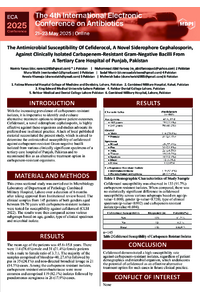
INTRODUCTION: With the increasing prevalence of carbapenem-resistant isolates, it is imperative to identify and evaluate alternative treatment options to improve patient outcomes. Cefiderocol, a novel siderophore cephalosporin, is highly effective against these organisms and studies advocate its preferred use in clinical practice. A lack of local published material necessitated the present study, which is aimed to determine the antimicrobial susceptibility of cefiderocol against carbapenem-resistant Gram-negative bacilli isolated from various clinically significant specimens.
METHODS: This cross-sectional study was carried out in the Microbiology Laboratory of the Combined Military Hospital, Lahore, Pakistan over a duration of 6 months. The clinical samples from 145 patients with carbapenem-resistant isolates were tested for susceptibility against cefiderocol (CLSI 2022). The results were then compared across various subgroups.
RESULTS: The mean age of the patients was 45.8±15.8 years. There were 114 (78.6%) male and 31 (21.4%) female patients with a male-to-female ratio of 3.7:1. The majority of the samples comprised blood (n=40, 27.6%) followed by pus in 35 (24.1%) and non-directed bronchial lavage in 21 (14.5%) cases. Among the carbapenem-resistant isolates, carbapenem-resistant enterobacteriacae were more common and comprised 119 (82.1%) isolates, followed by pseudomonas aeruginosa in 26 (17.9%) cases. Cefiderocol susceptibility was observed in 133 (91.7%) carbapenem-resistant isolates. When compared, there was no statistically significant difference in cefiderocol susceptibility across various subgroups based on age (p-value=1.000), gender (p-value=0.720), type of clinical specimen (p-value=0.992), or carbapenem-resistant isolate (p-value=0.694).
CONCLUSION: Cefiderocol demonstrated a high susceptibility rate against carbapenem-resistant isolates, regardless of patient demographics and microbial organism, which underscores the potential of cefiderocol as an effective alternative treatment option for such cases in future clinical practice.
Keywords
Carbapenem-Resistant Enterobacteriacae
Cefiderocol ,Antimicrobial susceptibility
Pseudomonas aeruginosa
Poster
poster 38.1x54.2 cm.pdf
Antibacterial Activity of Three Essential-oil-loaded Nanoemulsions Against Six Pathogenic Bacterial Strains
Conditions Mimicking Host Infection Environments Impact Antimicrobial Susceptibilities