Event submissions
Published
This submission belongs to the session S5. Multidisciplinary Antimicrobial Strategies: Materials, Peptides, Bacteriophages and Repurposing of the event The 4th International Electronic Conference on Antibiotics
Published date
19 May, 2025
Academic Editor
'%3e%3cpath%20d='M12.6657%2010.9104C12.4185%2010.325%2012.0599%209.79327%2011.6097%209.34482C11.1609%208.89508%2010.6293%208.5365%2010.0442%208.28888C10.0389%208.28626%2010.0337%208.28495%2010.0285%208.28233C10.8446%207.69279%2011.3752%206.73249%2011.3752%205.64904C11.3752%203.8542%209.92103%202.39999%208.1262%202.39999C6.33136%202.39999%204.87715%203.8542%204.87715%205.64904C4.87715%206.73249%205.40774%207.69279%206.22393%208.28364C6.21869%208.28626%206.21345%208.28757%206.20821%208.29019C5.62129%208.5378%205.09463%208.89284%204.64265%209.34613C4.1929%209.79493%203.83432%2010.3266%203.58671%2010.9117C3.34345%2011.4845%203.21226%2012.0987%203.20023%2012.7209C3.19988%2012.7349%203.20233%2012.7488%203.20744%2012.7619C3.21255%2012.7749%203.22022%2012.7867%203.22998%2012.7968C3.23975%2012.8068%203.25142%2012.8147%203.26431%2012.8202C3.2772%2012.8256%203.29105%2012.8284%203.30504%2012.8284H4.09109C4.14874%2012.8284%204.19459%2012.7825%204.1959%2012.7262C4.2221%2011.7148%204.62823%2010.7676%205.34617%2010.0497C6.08899%209.30683%207.0755%208.89808%208.1262%208.89808C9.17689%208.89808%2010.1634%209.30683%2010.9062%2010.0497C11.6242%2010.7676%2012.0303%2011.7148%2012.0565%2012.7262C12.0578%2012.7838%2012.1037%2012.8284%2012.1613%2012.8284H12.9474C12.9613%2012.8284%2012.9752%2012.8256%2012.9881%2012.8202C13.001%2012.8147%2013.0126%2012.8068%2013.0224%2012.7968C13.0322%2012.7867%2013.0398%2012.7749%2013.0449%2012.7619C13.0501%2012.7488%2013.0525%2012.7349%2013.0522%2012.7209C13.0391%2012.0947%2012.9094%2011.4855%2012.6657%2010.9104ZM8.1262%207.9024C7.52486%207.9024%206.9589%207.6679%206.53312%207.24211C6.10733%206.81633%205.87283%206.25037%205.87283%205.64904C5.87283%205.0477%206.10733%204.48174%206.53312%204.05596C6.9589%203.63018%207.52486%203.39567%208.1262%203.39567C8.72753%203.39567%209.29349%203.63018%209.71927%204.05596C10.1451%204.48174%2010.3796%205.0477%2010.3796%205.64904C10.3796%206.25037%2010.1451%206.81633%209.71927%207.24211C9.29349%207.6679%208.72753%207.9024%208.1262%207.9024Z'%20fill='%235D1EE1'/%3e%3c/g%3e%3c/svg%3e) Serena Riela
Serena RielaCitation
Patrícia Branco, Ana Teresa Fonseca, Elisabete Muchagato Maurício, Evaluation of yeast metabolites as natural preservatives for cosmetic formulations, in Proceedings of The 4th International Electronic Conference on Antibiotics, 21 May–23 May 2025, MDPI: Basel, Switzerland
Share
Email
Facebook
Twitter
LinkedIn
Evaluation of yeast metabolites as natural preservatives for cosmetic formulations

Patrícia Branco 1,2
'%3e%3cpath%20d='M12.6647%2010.9104C12.4176%2010.325%2012.0589%209.7933%2011.6088%209.34485C11.16%208.89511%2010.6283%208.53653%2010.0432%208.28891C10.038%208.28629%2010.0327%208.28498%2010.0275%208.28236C10.8437%207.69282%2011.3743%206.73252%2011.3743%205.64907C11.3743%203.85423%209.92005%202.40002%208.12522%202.40002C6.33038%202.40002%204.87618%203.85423%204.87618%205.64907C4.87618%206.73252%205.40677%207.69282%206.22296%208.28367C6.21772%208.28629%206.21248%208.2876%206.20724%208.29022C5.62031%208.53783%205.09365%208.89287%204.64167%209.34616C4.19192%209.79496%203.83334%2010.3266%203.58573%2010.9117C3.34247%2011.4846%203.21128%2012.0987%203.19925%2012.721C3.1989%2012.735%203.20135%2012.7489%203.20646%2012.7619C3.21157%2012.7749%203.21924%2012.7868%203.22901%2012.7968C3.23877%2012.8068%203.25045%2012.8148%203.26334%2012.8202C3.27623%2012.8256%203.29007%2012.8284%203.30406%2012.8284H4.09012C4.14776%2012.8284%204.19362%2012.7825%204.19493%2012.7262C4.22113%2011.7148%204.62726%2010.7676%205.34519%2010.0497C6.08802%209.30686%207.07452%208.89811%208.12522%208.89811C9.17592%208.89811%2010.1624%209.30686%2010.9052%2010.0497C11.6232%2010.7676%2012.0293%2011.7148%2012.0555%2012.7262C12.0568%2012.7839%2012.1027%2012.8284%2012.1603%2012.8284H12.9464C12.9604%2012.8284%2012.9742%2012.8256%2012.9871%2012.8202C13%2012.8148%2013.0117%2012.8068%2013.0214%2012.7968C13.0312%2012.7868%2013.0389%2012.7749%2013.044%2012.7619C13.0491%2012.7489%2013.0515%2012.735%2013.0512%2012.721C13.0381%2012.0947%2012.9084%2011.4856%2012.6647%2010.9104ZM8.12522%207.90243C7.52388%207.90243%206.95792%207.66793%206.53214%207.24215C6.10636%206.81636%205.87185%206.2504%205.87185%205.64907C5.87185%205.04773%206.10636%204.48177%206.53214%204.05599C6.95792%203.63021%207.52388%203.3957%208.12522%203.3957C8.72655%203.3957%209.29252%203.63021%209.7183%204.05599C10.1441%204.48177%2010.3786%205.04773%2010.3786%205.64907C10.3786%206.2504%2010.1441%206.81636%209.7183%207.24215C9.29252%207.66793%208.72655%207.90243%208.12522%207.90243Z'%20fill='%235D1EE1'/%3e%3c/g%3e%3c/svg%3e)
Ana Teresa Fonseca 1
Elisabete Muchagato Maurício 1,3,4
1. BIORG—Bioengineering and Sustainability Research Group, Faculdade de Engenharia, Universidade Lusófona, Av. Campo Grande 376, 1749-024 Lisbon, Portugal
2. Linking Landscape, Environment, Agriculture and Food (LEAF), Associated Laboratory TERRA, Instituto Superior de Agronomia, University of Lisbon, Tapada da Ajuda, 1349-017 Lisbon, Portugal
3. CBIOS—Research Center for Biosciences & Health Technologies, Universidade Lusófona, Campo Grande 376, 1749-024 Lisbon, Portugal
4. Elisa Câmara, Lda, Dermocosmética, Centro Empresarial de Talaíde, n°7 e 8, 2785-723 Lisbon, Portugal
Abstract
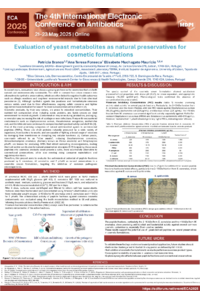
The increasing demand for natural cosmetic products is indicative of a growing awareness of the potential adverse environmental and health implications associated with synthetic compounds. Synthetic preservatives, which are commonly employed in cosmetics to prevent microbial contamination, have been implicated in the occurrence of allergic reactions and contribute to environmental pollution. This has led to a growing demand for safer and more sustainable alternatives. Natural preservatives, particularly bioactive compounds derived from microorganisms, have emerged as a promising substitute due to their biodegradability and compatibility with consumer safety standards.
Of particular interest are bioactive metabolites produced by yeasts, which have gained attention for their ability to inhibit the growth of pathogenic microorganisms.
This study investigated the antimicrobial potential of peptides produced by the yeasts Saccharomyces cerevisiae and Wickerhamomyces anomalus as natural preservatives in a cosmetic emulsion formulation. Antimicrobial efficacy was evaluated using minimum inhibitory concentration (MIC), minimum bactericidal concentration (MBC) and a 48-hour challenge test against common pathogenic microorganisms including Escherichia coli, Pseudomonas aeruginosa, Staphylococcus aureus, Staphylococcus epidermidis and Candida albicans. The results showed that the 2-10 kDa peptidic fraction derived from S. cerevisiae metabolism achieved MICs as low as 450 µg/mL for E. coli and 56.25 µg/mL for S. aureus. Similarly, metabolites from W. anomalus exhibited MICs of 450 µg/mL against E. coli and 575 µg/mL against S. epidermidis. The 48-hour challenge test showed a significant reduction in microbial growth when the peptide fractions were applied, particularly against E. coli and S. aureus.
This study highlights the potential of yeast-derived bioactive metabolites as sustainable and effective alternatives to synthetic preservatives in cosmetics.
Keywords
Antimicrobial peptides
Yeast bioactive metabolites
natural preservatives
cosmetics
pathogenic microorganisms
challenge test.
Poster
poster antibiotics_final.pdf
Novel Aminoquinoline Bi-Aromatic Hybrids As Anti-Biofilm Agents Against Pseudomonas Aeruginosa
Feasibility of 24 h Continuous Infusion of Cefiderocol Administered by Elastomeric Pump in Attaining an Aggressive Pharmacokinetic/Pharmacodynamic (PK/PD) Target in the Treatment of NDM-Producing Klebsiella Pneumoniae Otomastoiditis