Event submissions
Published
This submission belongs to the session S2. Antibiotics and One Health of the event The 4th International Electronic Conference on Antibiotics
Published date
19 May, 2025
Academic Editor
'%3e%3cpath%20d='M12.6657%2010.9104C12.4185%2010.325%2012.0599%209.79327%2011.6097%209.34482C11.1609%208.89508%2010.6293%208.5365%2010.0442%208.28888C10.0389%208.28626%2010.0337%208.28495%2010.0285%208.28233C10.8446%207.69279%2011.3752%206.73249%2011.3752%205.64904C11.3752%203.8542%209.92103%202.39999%208.1262%202.39999C6.33136%202.39999%204.87715%203.8542%204.87715%205.64904C4.87715%206.73249%205.40774%207.69279%206.22393%208.28364C6.21869%208.28626%206.21345%208.28757%206.20821%208.29019C5.62129%208.5378%205.09463%208.89284%204.64265%209.34613C4.1929%209.79493%203.83432%2010.3266%203.58671%2010.9117C3.34345%2011.4845%203.21226%2012.0987%203.20023%2012.7209C3.19988%2012.7349%203.20233%2012.7488%203.20744%2012.7619C3.21255%2012.7749%203.22022%2012.7867%203.22998%2012.7968C3.23975%2012.8068%203.25142%2012.8147%203.26431%2012.8202C3.2772%2012.8256%203.29105%2012.8284%203.30504%2012.8284H4.09109C4.14874%2012.8284%204.19459%2012.7825%204.1959%2012.7262C4.2221%2011.7148%204.62823%2010.7676%205.34617%2010.0497C6.08899%209.30683%207.0755%208.89808%208.1262%208.89808C9.17689%208.89808%2010.1634%209.30683%2010.9062%2010.0497C11.6242%2010.7676%2012.0303%2011.7148%2012.0565%2012.7262C12.0578%2012.7838%2012.1037%2012.8284%2012.1613%2012.8284H12.9474C12.9613%2012.8284%2012.9752%2012.8256%2012.9881%2012.8202C13.001%2012.8147%2013.0126%2012.8068%2013.0224%2012.7968C13.0322%2012.7867%2013.0398%2012.7749%2013.0449%2012.7619C13.0501%2012.7488%2013.0525%2012.7349%2013.0522%2012.7209C13.0391%2012.0947%2012.9094%2011.4855%2012.6657%2010.9104ZM8.1262%207.9024C7.52486%207.9024%206.9589%207.6679%206.53312%207.24211C6.10733%206.81633%205.87283%206.25037%205.87283%205.64904C5.87283%205.0477%206.10733%204.48174%206.53312%204.05596C6.9589%203.63018%207.52486%203.39567%208.1262%203.39567C8.72753%203.39567%209.29349%203.63018%209.71927%204.05596C10.1451%204.48174%2010.3796%205.0477%2010.3796%205.64904C10.3796%206.25037%2010.1451%206.81633%209.71927%207.24211C9.29349%207.6679%208.72753%207.9024%208.1262%207.9024Z'%20fill='%235D1EE1'/%3e%3c/g%3e%3c/svg%3e) Efstathios Giaouris
Efstathios GiaourisCitation
Nidhi Thakkar, Gemini Gajera, Vijay Kothari, Correlation of in vitro antibiogram with in vivo anti-pathogenic efficacy of different antibiotics against three gram-negative bacterial pathogens in the Caenorhabditis elegans infection model, in Proceedings of The 4th International Electronic Conference on Antibiotics, 21 May–23 May 2025, MDPI: Basel, Switzerland
Share
Email
Facebook
Twitter
LinkedIn
Correlation of in vitro antibiogram with in vivo anti-pathogenic efficacy of different antibiotics against three gram-negative bacterial pathogens in the Caenorhabditis elegans infection model
'%3e%3cpath%20d='M12.6647%2010.9104C12.4176%2010.325%2012.0589%209.7933%2011.6088%209.34485C11.16%208.89511%2010.6283%208.53653%2010.0432%208.28891C10.038%208.28629%2010.0327%208.28498%2010.0275%208.28236C10.8437%207.69282%2011.3743%206.73252%2011.3743%205.64907C11.3743%203.85423%209.92005%202.40002%208.12522%202.40002C6.33038%202.40002%204.87618%203.85423%204.87618%205.64907C4.87618%206.73252%205.40677%207.69282%206.22296%208.28367C6.21772%208.28629%206.21248%208.2876%206.20724%208.29022C5.62031%208.53783%205.09365%208.89287%204.64167%209.34616C4.19192%209.79496%203.83334%2010.3266%203.58573%2010.9117C3.34247%2011.4846%203.21128%2012.0987%203.19925%2012.721C3.1989%2012.735%203.20135%2012.7489%203.20646%2012.7619C3.21157%2012.7749%203.21924%2012.7868%203.22901%2012.7968C3.23877%2012.8068%203.25045%2012.8148%203.26334%2012.8202C3.27623%2012.8256%203.29007%2012.8284%203.30406%2012.8284H4.09012C4.14776%2012.8284%204.19362%2012.7825%204.19493%2012.7262C4.22113%2011.7148%204.62726%2010.7676%205.34519%2010.0497C6.08802%209.30686%207.07452%208.89811%208.12522%208.89811C9.17592%208.89811%2010.1624%209.30686%2010.9052%2010.0497C11.6232%2010.7676%2012.0293%2011.7148%2012.0555%2012.7262C12.0568%2012.7839%2012.1027%2012.8284%2012.1603%2012.8284H12.9464C12.9604%2012.8284%2012.9742%2012.8256%2012.9871%2012.8202C13%2012.8148%2013.0117%2012.8068%2013.0214%2012.7968C13.0312%2012.7868%2013.0389%2012.7749%2013.044%2012.7619C13.0491%2012.7489%2013.0515%2012.735%2013.0512%2012.721C13.0381%2012.0947%2012.9084%2011.4856%2012.6647%2010.9104ZM8.12522%207.90243C7.52388%207.90243%206.95792%207.66793%206.53214%207.24215C6.10636%206.81636%205.87185%206.2504%205.87185%205.64907C5.87185%205.04773%206.10636%204.48177%206.53214%204.05599C6.95792%203.63021%207.52388%203.3957%208.12522%203.3957C8.72655%203.3957%209.29252%203.63021%209.7183%204.05599C10.1441%204.48177%2010.3786%205.04773%2010.3786%205.64907C10.3786%206.2504%2010.1441%206.81636%209.7183%207.24215C9.29252%207.66793%208.72655%207.90243%208.12522%207.90243Z'%20fill='%235D1EE1'/%3e%3c/g%3e%3c/svg%3e)
Nidhi Thakkar 1

Gemini Gajera 1

Vijay Kothari 1
1. Institute of Science, Nirma University, Ahmedabad, India
Abstract
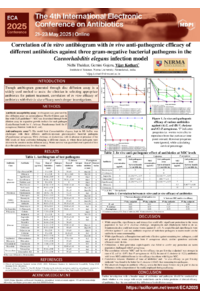
Introduction: Though antibiogram generated through disc diffusion assay is a widely used method to assist the clinician in selecting appropriate antibiotics for patient treatment, correlation of in vitro efficacy of antibiotics with their in vivo efficacy needs deeper investigations.
Methods: The model host Caenorhabditis elegans was challenged with three different antibiotic-resistant gram-negative bacterial pathogens (Pseudomonas aeruginosa, Vibrio cholerae, or Escherichia coli) in absence or presence of the MIC-levels of those antibiotics belonging to different classes, to whom these pathogens were shown to be sensitive in disc diffusion assay. Worm survival was quantified over a period of five days through microscopic live-dead count.
Results: While ampicillin, ciprofloxacin, and tetracycline could offer significant protection to the worm population in face of V. cholerae challenge, streptomycin and clindamycin failed to do so. Streptomycin also could not rescue worms against E. coli. As ampicillin and ciprofloxacin were effective against E. coli too, antibiotic-response of both these pathogens in worm model can be said to have some commonality. While ciprofloxacin, a fluroquinolone antibiotic effective against remaining two pathogens, could not protect the worm population from P. aeruginosa attack, another quinolone antibiotic ofloxacin could do this. Cefotaxime, a third-generation cephalosporin also failed to confer any protection on worm population challenged with P. aeruginosa. The correlation between ‘MIC’ and ‘in vivo efficacy (as per first-day endpoint)’ was stronger in case of E. coli (r: -0.97) than P. aeruginosa (r: -0.53). In case of V. cholerae (r: 0.23), antibiotics with lower MIC exhibited lesser in vivo efficacy than those with higher MIC. Correlation between ‘diameter of zone of inhibition’ and ‘in vivo efficacy (as per first-day endpoint)’ was found to be better for V. cholerae (r:0.62) than remaining two pathogens.
Conclusions: Further investigation with a broader range of antibiotics and pathogens should be conducted to check whether in vivo assays with simple model hosts can be a better predictor of clinical efficacy of antibiotics, than the conventional disc diffusion or broth dilution assays.
Keywords
Antibiogram
Caenorhabditis elegans
Antibiotic-resistance
Minimum Inhibitory Concentration (MIC)
Poster
Poster_ECA 2025_VK.pdf
Feasibility of 24 h Continuous Infusion of Cefiderocol Administered by Elastomeric Pump in Attaining an Aggressive Pharmacokinetic/Pharmacodynamic (PK/PD) Target in the Treatment of NDM-Producing Klebsiella Pneumoniae Otomastoiditis
Antibacterial Activity Screening Of an Imine Compound Synthesized Using a Cinnamaldehyde Derivative Against Staphylococcus Aureus Strains