Event submissions
Published
This submission belongs to the session S2. Antibiotics and One Health of the event The 4th International Electronic Conference on Antibiotics
Published date
19 May, 2025
Academic Editor
'%3e%3cpath%20d='M12.6657%2010.9104C12.4185%2010.325%2012.0599%209.79327%2011.6097%209.34482C11.1609%208.89508%2010.6293%208.5365%2010.0442%208.28888C10.0389%208.28626%2010.0337%208.28495%2010.0285%208.28233C10.8446%207.69279%2011.3752%206.73249%2011.3752%205.64904C11.3752%203.8542%209.92103%202.39999%208.1262%202.39999C6.33136%202.39999%204.87715%203.8542%204.87715%205.64904C4.87715%206.73249%205.40774%207.69279%206.22393%208.28364C6.21869%208.28626%206.21345%208.28757%206.20821%208.29019C5.62129%208.5378%205.09463%208.89284%204.64265%209.34613C4.1929%209.79493%203.83432%2010.3266%203.58671%2010.9117C3.34345%2011.4845%203.21226%2012.0987%203.20023%2012.7209C3.19988%2012.7349%203.20233%2012.7488%203.20744%2012.7619C3.21255%2012.7749%203.22022%2012.7867%203.22998%2012.7968C3.23975%2012.8068%203.25142%2012.8147%203.26431%2012.8202C3.2772%2012.8256%203.29105%2012.8284%203.30504%2012.8284H4.09109C4.14874%2012.8284%204.19459%2012.7825%204.1959%2012.7262C4.2221%2011.7148%204.62823%2010.7676%205.34617%2010.0497C6.08899%209.30683%207.0755%208.89808%208.1262%208.89808C9.17689%208.89808%2010.1634%209.30683%2010.9062%2010.0497C11.6242%2010.7676%2012.0303%2011.7148%2012.0565%2012.7262C12.0578%2012.7838%2012.1037%2012.8284%2012.1613%2012.8284H12.9474C12.9613%2012.8284%2012.9752%2012.8256%2012.9881%2012.8202C13.001%2012.8147%2013.0126%2012.8068%2013.0224%2012.7968C13.0322%2012.7867%2013.0398%2012.7749%2013.0449%2012.7619C13.0501%2012.7488%2013.0525%2012.7349%2013.0522%2012.7209C13.0391%2012.0947%2012.9094%2011.4855%2012.6657%2010.9104ZM8.1262%207.9024C7.52486%207.9024%206.9589%207.6679%206.53312%207.24211C6.10733%206.81633%205.87283%206.25037%205.87283%205.64904C5.87283%205.0477%206.10733%204.48174%206.53312%204.05596C6.9589%203.63018%207.52486%203.39567%208.1262%203.39567C8.72753%203.39567%209.29349%203.63018%209.71927%204.05596C10.1451%204.48174%2010.3796%205.0477%2010.3796%205.64904C10.3796%206.25037%2010.1451%206.81633%209.71927%207.24211C9.29349%207.6679%208.72753%207.9024%208.1262%207.9024Z'%20fill='%235D1EE1'/%3e%3c/g%3e%3c/svg%3e) Efstathios Giaouris
Efstathios GiaourisCitation
Andreia Garces, Isabel Pires, Wildlife and Antibiotic Resistance: Exploring the Case of Bears, in Proceedings of The 4th International Electronic Conference on Antibiotics, 21 May–23 May 2025, MDPI: Basel, Switzerland
Share
Email
Facebook
Twitter
LinkedIn
Wildlife and Antibiotic Resistance: Exploring the Case of Bears

Andreia Garces 1

Isabel Pires 2
1. Wildlife Rehabilitation Centre (CRAS), Veterinary Teaching Hospital, University of Trás-os-Montes e AltoDouro (UTAD), 5000-801 Vila Real, Portugal
2. Animal and Veterinary Research Center, University of Trás-os-Montes and Alto Douro, Vila Real, Portugal
Abstract
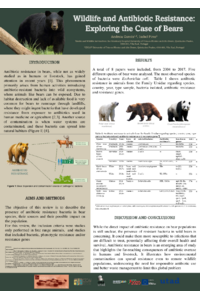
Antibiotic resistance in bears, while not as widely studied as in humans or livestock, has received increasing attention in recent years. This phenomenon primarily arises from human activities introducing antibiotic-resistant bacteria into wild ecosystems, where animals such as bears can be exposed. Due to habitat destruction and a lack of available food, it is very common for bears to rummage through landfills, where they might ingest bacteria that have developed resistance from exposure to antibiotics that are used in human medicine or agriculture. Another source of contamination is when water systems are contaminated, through which these bacteria can spread into natural habitats. The objective of this review is to describe the presence of antibiotic-resistant bacteria in bear species, their sources and their possible impact on the population. Concerning the available data, it is possible to observe that existing studies have focused on Sloth bears (Melursus ursinus), black bears (Ursus americanus), giant panda (Ailuropoda melanoleuca), polar bear (Ursus maritimus) and brown bear (Ursus arctos). The most observed species of bacteria were Escherichia coli. While the direct impact of antibiotic resistance on bear populations is still unclear, the presence of resistant bacteria in wild bears is concerning. It could make them more susceptible to infections that are difficult to treat, potentially affecting their overall health and survival. Antibiotic resistance in bears is an emerging area of study that highlights the far-reaching consequences of antibiotic overuse in humans and livestock. It illustrates how environmental contamination can spread resistance even to remote wildlife populations, underscoring the need for responsible antibiotic use and better waste management to limit this global problem.
Keywords
bears
polution
bacteria
resiatant
genes
Poster
poster_ABbear.pdf
Evaluation of Antimicrobial Resistance in Magdalena, Colombia: Findings from a Retrospective Descriptive Study
Clinical Validation of New Rapid Molecular Diagnostic Method for Bloodstream Infections