Event submissions
Published
This submission belongs to the session S3. Epidemiology, Prevalence and Mechanisms of Antibiotic Resistance and Cross-Resistance of the event The 4th International Electronic Conference on Antibiotics
Published date
19 May, 2025
Academic Editor
'%3e%3cpath%20d='M12.6657%2010.9104C12.4185%2010.325%2012.0599%209.79327%2011.6097%209.34482C11.1609%208.89508%2010.6293%208.5365%2010.0442%208.28888C10.0389%208.28626%2010.0337%208.28495%2010.0285%208.28233C10.8446%207.69279%2011.3752%206.73249%2011.3752%205.64904C11.3752%203.8542%209.92103%202.39999%208.1262%202.39999C6.33136%202.39999%204.87715%203.8542%204.87715%205.64904C4.87715%206.73249%205.40774%207.69279%206.22393%208.28364C6.21869%208.28626%206.21345%208.28757%206.20821%208.29019C5.62129%208.5378%205.09463%208.89284%204.64265%209.34613C4.1929%209.79493%203.83432%2010.3266%203.58671%2010.9117C3.34345%2011.4845%203.21226%2012.0987%203.20023%2012.7209C3.19988%2012.7349%203.20233%2012.7488%203.20744%2012.7619C3.21255%2012.7749%203.22022%2012.7867%203.22998%2012.7968C3.23975%2012.8068%203.25142%2012.8147%203.26431%2012.8202C3.2772%2012.8256%203.29105%2012.8284%203.30504%2012.8284H4.09109C4.14874%2012.8284%204.19459%2012.7825%204.1959%2012.7262C4.2221%2011.7148%204.62823%2010.7676%205.34617%2010.0497C6.08899%209.30683%207.0755%208.89808%208.1262%208.89808C9.17689%208.89808%2010.1634%209.30683%2010.9062%2010.0497C11.6242%2010.7676%2012.0303%2011.7148%2012.0565%2012.7262C12.0578%2012.7838%2012.1037%2012.8284%2012.1613%2012.8284H12.9474C12.9613%2012.8284%2012.9752%2012.8256%2012.9881%2012.8202C13.001%2012.8147%2013.0126%2012.8068%2013.0224%2012.7968C13.0322%2012.7867%2013.0398%2012.7749%2013.0449%2012.7619C13.0501%2012.7488%2013.0525%2012.7349%2013.0522%2012.7209C13.0391%2012.0947%2012.9094%2011.4855%2012.6657%2010.9104ZM8.1262%207.9024C7.52486%207.9024%206.9589%207.6679%206.53312%207.24211C6.10733%206.81633%205.87283%206.25037%205.87283%205.64904C5.87283%205.0477%206.10733%204.48174%206.53312%204.05596C6.9589%203.63018%207.52486%203.39567%208.1262%203.39567C8.72753%203.39567%209.29349%203.63018%209.71927%204.05596C10.1451%204.48174%2010.3796%205.0477%2010.3796%205.64904C10.3796%206.25037%2010.1451%206.81633%209.71927%207.24211C9.29349%207.6679%208.72753%207.9024%208.1262%207.9024Z'%20fill='%235D1EE1'/%3e%3c/g%3e%3c/svg%3e) Nicholas Dixon
Nicholas DixonCitation
Mateo Tićac, Maja Abram, Kristina Franjić, Marina Bubonja Šonje, Tanja Grubić Kezele, Clinical Validation of New Rapid Molecular Diagnostic Method for Bloodstream Infections, in Proceedings of The 4th International Electronic Conference on Antibiotics, 21 May–23 May 2025, MDPI: Basel, Switzerland
Share
Email
Facebook
Twitter
LinkedIn
Clinical Validation of New Rapid Molecular Diagnostic Method for Bloodstream Infections
'%3e%3cpath%20d='M12.6647%2010.9104C12.4176%2010.325%2012.0589%209.7933%2011.6088%209.34485C11.16%208.89511%2010.6283%208.53653%2010.0432%208.28891C10.038%208.28629%2010.0327%208.28498%2010.0275%208.28236C10.8437%207.69282%2011.3743%206.73252%2011.3743%205.64907C11.3743%203.85423%209.92005%202.40002%208.12522%202.40002C6.33038%202.40002%204.87618%203.85423%204.87618%205.64907C4.87618%206.73252%205.40677%207.69282%206.22296%208.28367C6.21772%208.28629%206.21248%208.2876%206.20724%208.29022C5.62031%208.53783%205.09365%208.89287%204.64167%209.34616C4.19192%209.79496%203.83334%2010.3266%203.58573%2010.9117C3.34247%2011.4846%203.21128%2012.0987%203.19925%2012.721C3.1989%2012.735%203.20135%2012.7489%203.20646%2012.7619C3.21157%2012.7749%203.21924%2012.7868%203.22901%2012.7968C3.23877%2012.8068%203.25045%2012.8148%203.26334%2012.8202C3.27623%2012.8256%203.29007%2012.8284%203.30406%2012.8284H4.09012C4.14776%2012.8284%204.19362%2012.7825%204.19493%2012.7262C4.22113%2011.7148%204.62726%2010.7676%205.34519%2010.0497C6.08802%209.30686%207.07452%208.89811%208.12522%208.89811C9.17592%208.89811%2010.1624%209.30686%2010.9052%2010.0497C11.6232%2010.7676%2012.0293%2011.7148%2012.0555%2012.7262C12.0568%2012.7839%2012.1027%2012.8284%2012.1603%2012.8284H12.9464C12.9604%2012.8284%2012.9742%2012.8256%2012.9871%2012.8202C13%2012.8148%2013.0117%2012.8068%2013.0214%2012.7968C13.0312%2012.7868%2013.0389%2012.7749%2013.044%2012.7619C13.0491%2012.7489%2013.0515%2012.735%2013.0512%2012.721C13.0381%2012.0947%2012.9084%2011.4856%2012.6647%2010.9104ZM8.12522%207.90243C7.52388%207.90243%206.95792%207.66793%206.53214%207.24215C6.10636%206.81636%205.87185%206.2504%205.87185%205.64907C5.87185%205.04773%206.10636%204.48177%206.53214%204.05599C6.95792%203.63021%207.52388%203.3957%208.12522%203.3957C8.72655%203.3957%209.29252%203.63021%209.7183%204.05599C10.1441%204.48177%2010.3786%205.04773%2010.3786%205.64907C10.3786%206.2504%2010.1441%206.81636%209.7183%207.24215C9.29252%207.66793%208.72655%207.90243%208.12522%207.90243Z'%20fill='%235D1EE1'/%3e%3c/g%3e%3c/svg%3e)
Mateo Tićac 1,2
Maja Abram 3,4
Kristina Franjić 3,4
Marina Bubonja Šonje 3,4

Tanja Grubić Kezele 3,5
1. Department of Anesthesiology and Intensive Care, Clinical Hospital Center Rijeka, 51000 Rijeka, Croatia
2. Department of Anesthesiology, Reanimatology, Intensive Care and Emergency Medicine, Faculty of Medicine, University of Rijeka, 51000 Rijeka, Croatia
3. Department of Clinical Microbiology, Clinical Hospital Center Rijeka, 51000 Rijeka, Croatia
4. Department of Microbiology and Parasitology, Faculty of Medicine, University of Rijeka, 51000 Rijeka, Croatia
5. Department of Physiology, Immunology and Pathophysiology, Faculty of Medicine, University of Rijeka, 51000 Rijeka, Croatia
Abstract
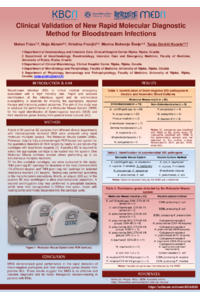
Introduction: Bloodstream infection (BSI) is critical medical emergency associated with a high mortality rate. Rapid and accurate identification of the infectious agent and antimicrobial susceptibility is critical to initiating the appropriate, targeted therapy and improving patient outcomes. The aim of this study was to evaluate the performance of a Molecular Mouse System (MMS) for the rapid identification of Gram-negative bacteria (GNB) and their resistance genes directly from a positive blood culture (BC). Methods: A total of 80 positive BC samples from different clinical departments with microscopically detected GNB were analyzed using rapid molecular multiplex assays. Results: Compared to the routine culture methods, the MMS achieved a sensitivity and specificity of 98% for GNB detection. Only 2 out of 80 GNB (Pseudomonas putida and Acinetobacter calcoaceticus) were not identified by the MMS, as they were off-panel bacteria, while Enterobacter aerogenes was identified at the genus level (Enterobacteriaceae). However, in 2 out of 80 BC samples, the MMS revealed GNB that were not identified using culture-based methods but were later confirmed using the FILMARRAYTM multiplex PCR panel. In one polymicrobial sample, the MMS detected multidrug-resistant Stenotrophomonas maltophilia, which was not detected by the routine culture. The type of extended-spectrum beta-lactamase resistance gene (ESẞL) detected using the MMS was mostly CTX-M-1/9 (n=19/20), alone or in combination with SHV-type β-lactamase or/and with one of the three different types of carbapenemase resistance genes (OXA-48, KPC, NDM). Furthermore, the MMS identified the resistance gene for the carbapenemase OXA-23 in an Acinetobacter baumannii-positive BC sample. Conclusion: These results suggest that the MMS is considered an effective and beneficial diagnostic method for faster therapeutic decision-making in patients with BSIs.
Keywords
antimicrobial resistance
blood culture
bloodstream infections
Molecular Mouse
resistance genes
Poster
Tanja Grubić Kezele Poster.pdf
Wildlife and Antibiotic Resistance: Exploring the Case of Bears
Antifungal Resistance Profile of Yeast Involved in Vulvovaginal Candidiasis Infections in Pregnant Women in the Buea Regional Hospital