Event submissions
Published
This submission belongs to the session S2. Antibiotics and One Health of the event The 4th International Electronic Conference on Antibiotics
Published date
19 May, 2025
Academic Editor
'%3e%3cpath%20d='M12.6657%2010.9104C12.4185%2010.325%2012.0599%209.79327%2011.6097%209.34482C11.1609%208.89508%2010.6293%208.5365%2010.0442%208.28888C10.0389%208.28626%2010.0337%208.28495%2010.0285%208.28233C10.8446%207.69279%2011.3752%206.73249%2011.3752%205.64904C11.3752%203.8542%209.92103%202.39999%208.1262%202.39999C6.33136%202.39999%204.87715%203.8542%204.87715%205.64904C4.87715%206.73249%205.40774%207.69279%206.22393%208.28364C6.21869%208.28626%206.21345%208.28757%206.20821%208.29019C5.62129%208.5378%205.09463%208.89284%204.64265%209.34613C4.1929%209.79493%203.83432%2010.3266%203.58671%2010.9117C3.34345%2011.4845%203.21226%2012.0987%203.20023%2012.7209C3.19988%2012.7349%203.20233%2012.7488%203.20744%2012.7619C3.21255%2012.7749%203.22022%2012.7867%203.22998%2012.7968C3.23975%2012.8068%203.25142%2012.8147%203.26431%2012.8202C3.2772%2012.8256%203.29105%2012.8284%203.30504%2012.8284H4.09109C4.14874%2012.8284%204.19459%2012.7825%204.1959%2012.7262C4.2221%2011.7148%204.62823%2010.7676%205.34617%2010.0497C6.08899%209.30683%207.0755%208.89808%208.1262%208.89808C9.17689%208.89808%2010.1634%209.30683%2010.9062%2010.0497C11.6242%2010.7676%2012.0303%2011.7148%2012.0565%2012.7262C12.0578%2012.7838%2012.1037%2012.8284%2012.1613%2012.8284H12.9474C12.9613%2012.8284%2012.9752%2012.8256%2012.9881%2012.8202C13.001%2012.8147%2013.0126%2012.8068%2013.0224%2012.7968C13.0322%2012.7867%2013.0398%2012.7749%2013.0449%2012.7619C13.0501%2012.7488%2013.0525%2012.7349%2013.0522%2012.7209C13.0391%2012.0947%2012.9094%2011.4855%2012.6657%2010.9104ZM8.1262%207.9024C7.52486%207.9024%206.9589%207.6679%206.53312%207.24211C6.10733%206.81633%205.87283%206.25037%205.87283%205.64904C5.87283%205.0477%206.10733%204.48174%206.53312%204.05596C6.9589%203.63018%207.52486%203.39567%208.1262%203.39567C8.72753%203.39567%209.29349%203.63018%209.71927%204.05596C10.1451%204.48174%2010.3796%205.0477%2010.3796%205.64904C10.3796%206.25037%2010.1451%206.81633%209.71927%207.24211C9.29349%207.6679%208.72753%207.9024%208.1262%207.9024Z'%20fill='%235D1EE1'/%3e%3c/g%3e%3c/svg%3e) Efstathios Giaouris
Efstathios GiaourisCitation
Babatunde Odetoyin, Timothy Bebe, Ezekiel Akinkumi, Prevalence and associated risk factors of Vancomycin-resistant Enterococcus faecium in well water used for domestic purposes in Ile-Ife, southwestern Nigeria, in Proceedings of The 4th International Electronic Conference on Antibiotics, 21 May–23 May 2025, MDPI: Basel, Switzerland
Share
Email
Facebook
Twitter
LinkedIn
Prevalence and associated risk factors of Vancomycin-resistant Enterococcus faecium in well water used for domestic purposes in Ile-Ife, southwestern Nigeria
'%3e%3cpath%20d='M12.6647%2010.9104C12.4176%2010.325%2012.0589%209.7933%2011.6088%209.34485C11.16%208.89511%2010.6283%208.53653%2010.0432%208.28891C10.038%208.28629%2010.0327%208.28498%2010.0275%208.28236C10.8437%207.69282%2011.3743%206.73252%2011.3743%205.64907C11.3743%203.85423%209.92005%202.40002%208.12522%202.40002C6.33038%202.40002%204.87618%203.85423%204.87618%205.64907C4.87618%206.73252%205.40677%207.69282%206.22296%208.28367C6.21772%208.28629%206.21248%208.2876%206.20724%208.29022C5.62031%208.53783%205.09365%208.89287%204.64167%209.34616C4.19192%209.79496%203.83334%2010.3266%203.58573%2010.9117C3.34247%2011.4846%203.21128%2012.0987%203.19925%2012.721C3.1989%2012.735%203.20135%2012.7489%203.20646%2012.7619C3.21157%2012.7749%203.21924%2012.7868%203.22901%2012.7968C3.23877%2012.8068%203.25045%2012.8148%203.26334%2012.8202C3.27623%2012.8256%203.29007%2012.8284%203.30406%2012.8284H4.09012C4.14776%2012.8284%204.19362%2012.7825%204.19493%2012.7262C4.22113%2011.7148%204.62726%2010.7676%205.34519%2010.0497C6.08802%209.30686%207.07452%208.89811%208.12522%208.89811C9.17592%208.89811%2010.1624%209.30686%2010.9052%2010.0497C11.6232%2010.7676%2012.0293%2011.7148%2012.0555%2012.7262C12.0568%2012.7839%2012.1027%2012.8284%2012.1603%2012.8284H12.9464C12.9604%2012.8284%2012.9742%2012.8256%2012.9871%2012.8202C13%2012.8148%2013.0117%2012.8068%2013.0214%2012.7968C13.0312%2012.7868%2013.0389%2012.7749%2013.044%2012.7619C13.0491%2012.7489%2013.0515%2012.735%2013.0512%2012.721C13.0381%2012.0947%2012.9084%2011.4856%2012.6647%2010.9104ZM8.12522%207.90243C7.52388%207.90243%206.95792%207.66793%206.53214%207.24215C6.10636%206.81636%205.87185%206.2504%205.87185%205.64907C5.87185%205.04773%206.10636%204.48177%206.53214%204.05599C6.95792%203.63021%207.52388%203.3957%208.12522%203.3957C8.72655%203.3957%209.29252%203.63021%209.7183%204.05599C10.1441%204.48177%2010.3786%205.04773%2010.3786%205.64907C10.3786%206.2504%2010.1441%206.81636%209.7183%207.24215C9.29252%207.66793%208.72655%207.90243%208.12522%207.90243Z'%20fill='%235D1EE1'/%3e%3c/g%3e%3c/svg%3e)
Babatunde Odetoyin 1
Timothy Bebe 1
Ezekiel Akinkumi 2
1. Department of Medical Microbiology and Parasitology, Obafemi Awolowo University, Ile-Ife, Nigeria
2. Department of Pharmaceutics, Obafemi Awolowo University, Ile-Ife, Nigeria
Abstract
Introduction:
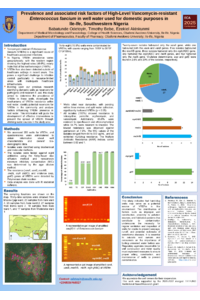
Vancomycin-resistant Enterococcus faecium (VREf) has become a major public health concern worldwide. Although hospital-based transmission is generally associated with outbreaks, contaminated water may play a role in the spread of VREf. This study determined the prevalence of VREf and identified associated risk factors in domestic wells in the study area.
Methods:
We assessed 350 wells for VREf, and questionnaires were administered to obtain information about well characteristics and owners' biodemographic data. Isolates were identified using biochemical and molecular methods. The isolates were tested against eight antibiotics using the Kirby–Bauer disc diffusion method, and the vancomycin minimum inhibitory concentration (MIC) was determined by the agar dilution method. The resistance (vanA, vanB, msrA/B, mefA, mph (ABC)) and virulence (esp, gelE, and hla) genes of VREf were detected by polymerase chain reaction. Data analysis was conducted with R statistical software.
Results:
Thirty-eight (10.9%) wells were contaminated by VREf, with counts ranging from 100 to 5000 CFU/mL. Wells sited near dumpsites, with ponding within three meters and split water collection, significantly harbored VREf (p < 0.05). All isolates (100%) exhibited resistance to tetracycline, linezolid, penicillin, erythromycin, and vancomycin. The vancomycin MIC of the isolates varied from 64 to 512 ug/ml. Twenty-seven of the thirty-eight isolates harbored only the vanA gene, while one harbored both the vanA and vanB genes. Five isolates harbored the msrA/B gene, three isolates harbored only the mph(ABC) gene, one harbored the mph(ABC) and mefA genes, and four harbored only the mefA gene. The virulence determinants esp, gelE, and hla were found in 2.6%, 29%, and 28.9% of the isolates, respectively.
Conclusion:
The presence of VREf in well water highlights the risk to human health associated with the use of untreated water. There is a need for periodic sanitation and inspection of wells to prevent ponding, split water collection, and possible outbreaks of waterborne diseases.
Keywords
Vancomycin resistance
Enterococcus faecium
dug wells
vanA
Poster
ECA poster 2025_Odetoyin et al.pdf
Antifungal Resistance Profile of Yeast Involved in Vulvovaginal Candidiasis Infections in Pregnant Women in the Buea Regional Hospital
Identification and Quantification of Mixed Antibiotics in Aqueous Solution Through Machine Learning Analysis of SERS Spectra