Event submissions
Published
This submission belongs to the session S3. Epidemiology, Prevalence and Mechanisms of Antibiotic Resistance and Cross-Resistance of the event The 4th International Electronic Conference on Antibiotics
Published date
19 May, 2025
Academic Editor
'%3e%3cpath%20d='M12.6657%2010.9104C12.4185%2010.325%2012.0599%209.79327%2011.6097%209.34482C11.1609%208.89508%2010.6293%208.5365%2010.0442%208.28888C10.0389%208.28626%2010.0337%208.28495%2010.0285%208.28233C10.8446%207.69279%2011.3752%206.73249%2011.3752%205.64904C11.3752%203.8542%209.92103%202.39999%208.1262%202.39999C6.33136%202.39999%204.87715%203.8542%204.87715%205.64904C4.87715%206.73249%205.40774%207.69279%206.22393%208.28364C6.21869%208.28626%206.21345%208.28757%206.20821%208.29019C5.62129%208.5378%205.09463%208.89284%204.64265%209.34613C4.1929%209.79493%203.83432%2010.3266%203.58671%2010.9117C3.34345%2011.4845%203.21226%2012.0987%203.20023%2012.7209C3.19988%2012.7349%203.20233%2012.7488%203.20744%2012.7619C3.21255%2012.7749%203.22022%2012.7867%203.22998%2012.7968C3.23975%2012.8068%203.25142%2012.8147%203.26431%2012.8202C3.2772%2012.8256%203.29105%2012.8284%203.30504%2012.8284H4.09109C4.14874%2012.8284%204.19459%2012.7825%204.1959%2012.7262C4.2221%2011.7148%204.62823%2010.7676%205.34617%2010.0497C6.08899%209.30683%207.0755%208.89808%208.1262%208.89808C9.17689%208.89808%2010.1634%209.30683%2010.9062%2010.0497C11.6242%2010.7676%2012.0303%2011.7148%2012.0565%2012.7262C12.0578%2012.7838%2012.1037%2012.8284%2012.1613%2012.8284H12.9474C12.9613%2012.8284%2012.9752%2012.8256%2012.9881%2012.8202C13.001%2012.8147%2013.0126%2012.8068%2013.0224%2012.7968C13.0322%2012.7867%2013.0398%2012.7749%2013.0449%2012.7619C13.0501%2012.7488%2013.0525%2012.7349%2013.0522%2012.7209C13.0391%2012.0947%2012.9094%2011.4855%2012.6657%2010.9104ZM8.1262%207.9024C7.52486%207.9024%206.9589%207.6679%206.53312%207.24211C6.10733%206.81633%205.87283%206.25037%205.87283%205.64904C5.87283%205.0477%206.10733%204.48174%206.53312%204.05596C6.9589%203.63018%207.52486%203.39567%208.1262%203.39567C8.72753%203.39567%209.29349%203.63018%209.71927%204.05596C10.1451%204.48174%2010.3796%205.0477%2010.3796%205.64904C10.3796%206.25037%2010.1451%206.81633%209.71927%207.24211C9.29349%207.6679%208.72753%207.9024%208.1262%207.9024Z'%20fill='%235D1EE1'/%3e%3c/g%3e%3c/svg%3e) Nicholas Dixon
Nicholas DixonCitation
Roxanna S.D. Mohammed, Eugene Y.H. Yeung, Antimicrobial Susceptibility Profiles of Neisseria Gonorrhoeae in British Columbia, Canada, 2023, in Proceedings of The 4th International Electronic Conference on Antibiotics, 21 May–23 May 2025, MDPI: Basel, Switzerland
Share
Email
Facebook
Twitter
LinkedIn
Antimicrobial Susceptibility Profiles of Neisseria Gonorrhoeae in British Columbia, Canada, 2023
'%3e%3cpath%20d='M12.6647%2010.9104C12.4176%2010.325%2012.0589%209.7933%2011.6088%209.34485C11.16%208.89511%2010.6283%208.53653%2010.0432%208.28891C10.038%208.28629%2010.0327%208.28498%2010.0275%208.28236C10.8437%207.69282%2011.3743%206.73252%2011.3743%205.64907C11.3743%203.85423%209.92005%202.40002%208.12522%202.40002C6.33038%202.40002%204.87618%203.85423%204.87618%205.64907C4.87618%206.73252%205.40677%207.69282%206.22296%208.28367C6.21772%208.28629%206.21248%208.2876%206.20724%208.29022C5.62031%208.53783%205.09365%208.89287%204.64167%209.34616C4.19192%209.79496%203.83334%2010.3266%203.58573%2010.9117C3.34247%2011.4846%203.21128%2012.0987%203.19925%2012.721C3.1989%2012.735%203.20135%2012.7489%203.20646%2012.7619C3.21157%2012.7749%203.21924%2012.7868%203.22901%2012.7968C3.23877%2012.8068%203.25045%2012.8148%203.26334%2012.8202C3.27623%2012.8256%203.29007%2012.8284%203.30406%2012.8284H4.09012C4.14776%2012.8284%204.19362%2012.7825%204.19493%2012.7262C4.22113%2011.7148%204.62726%2010.7676%205.34519%2010.0497C6.08802%209.30686%207.07452%208.89811%208.12522%208.89811C9.17592%208.89811%2010.1624%209.30686%2010.9052%2010.0497C11.6232%2010.7676%2012.0293%2011.7148%2012.0555%2012.7262C12.0568%2012.7839%2012.1027%2012.8284%2012.1603%2012.8284H12.9464C12.9604%2012.8284%2012.9742%2012.8256%2012.9871%2012.8202C13%2012.8148%2013.0117%2012.8068%2013.0214%2012.7968C13.0312%2012.7868%2013.0389%2012.7749%2013.044%2012.7619C13.0491%2012.7489%2013.0515%2012.735%2013.0512%2012.721C13.0381%2012.0947%2012.9084%2011.4856%2012.6647%2010.9104ZM8.12522%207.90243C7.52388%207.90243%206.95792%207.66793%206.53214%207.24215C6.10636%206.81636%205.87185%206.2504%205.87185%205.64907C5.87185%205.04773%206.10636%204.48177%206.53214%204.05599C6.95792%203.63021%207.52388%203.3957%208.12522%203.3957C8.72655%203.3957%209.29252%203.63021%209.7183%204.05599C10.1441%204.48177%2010.3786%205.04773%2010.3786%205.64907C10.3786%206.2504%2010.1441%206.81636%209.7183%207.24215C9.29252%207.66793%208.72655%207.90243%208.12522%207.90243Z'%20fill='%235D1EE1'/%3e%3c/g%3e%3c/svg%3e)
Roxanna S.D. Mohammed 1
Eugene Y.H. Yeung 1
1. Faculty of Medicine, University of British Columbia, Vancouver, V6T 1Z3, Canada
Abstract
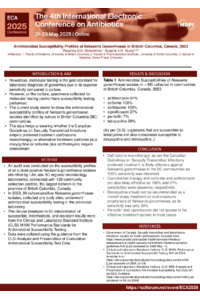
Introduction: Nowadays, molecular testing is the gold standard for laboratory diagnosis of gonorrhea due to its superior sensitivity compared to culture. However, unlike culture, specimens collected for molecular testing cannot have susceptibility testing performed. The current study aimed to show the antimicrobial susceptibility profiles of Neisseria gonorrhoeae isolates identified by culture in British Columbia (BC) communities. The data helps answering whether the Canadian Guidelines on Sexually Transmitted Infections empiric preferred treatment (ceftriaxone monotherapy) or alternative treatment (cefixime plus doxycycline or cefixime plus azithromycin) require amendment.
Methods: An audit was conducted on the susceptibility profiles of all culture-positive Neisseria gonorrhoeae isolates identified by LifeLabs BC regional microbiology laboratories, connected with 129 community collection centres, the largest network in the province of British Columbia, Canada. In 2023, 98 culture-positive Neisseria gonorrhoeae isolates underwent antimicrobial susceptibility testing in the provincial laboratory. Their results were interpreted using the Clinical and Laboratory Standard Institute (CLSI) M100 guidance.
Results: The susceptibilities of Neisseria gonorrhoeae isolates were as follows: azithromycin 97%, cefixime 100%, ceftriaxone 100%, ciprofloxacin 27%, penicillin 7%, and tetracycline 39%. As per CLSI, organisms that are susceptible to tetracycline are also considered susceptible to doxycycline and minocycline.
Conclusion: The preferred treatment of ceftriaxone with monotherapy is likely effective against Neisseria gonorrhoeae in the BC communities as 100% sensitivity was observed. Combination therapy with cefixime and azithromycin are also likely effective as 100% and 97% sensitivities were observed, respectively. Doxycycline should not be recommended as a monotherapy treatment or post-exposure prophylaxis of Neisseria gonorrhoeae, as its sensitivity was only 39%. Penicillin and ciprofloxacin did not appear to be effective treatment options in most cases.
Keywords
Neisseria gonorrhoeae
Gonorrhea
Canadian Guidelines on Sexually Transmitted Infections
Antimicrobial susceptibility
azithromycin
cefixime
ceftriaxone
ciprofloxacin
penicillin
tetracycline
Clinical and Laboratory Standard Institute (CLSI)
Poster
sciforum poster Neisseria Gonorrhoeae.pdf
Prevalence And Antibiotic Sensitivity Pattern Of Extended-Spectrum Beta-Lactamase-Producing Salmonella Spp. In Poultry Meat From Selected Processing Plants In Ibadan, Nigeria
Fourier Transform Infrared Spectroscopy-Based Detection of Amoxicillin and Ampicillin for Advancing Antibiotic Monitoring with Optical Techniques