Event submissions
Published
This submission belongs to the session S4. Novel Antimicrobial Agents: Discovery, Design, Synthesis and Action of the event The 4th International Electronic Conference on Antibiotics
Published date
19 May, 2025
Academic Editor
'%3e%3cpath%20d='M12.6657%2010.9104C12.4185%2010.325%2012.0599%209.79327%2011.6097%209.34482C11.1609%208.89508%2010.6293%208.5365%2010.0442%208.28888C10.0389%208.28626%2010.0337%208.28495%2010.0285%208.28233C10.8446%207.69279%2011.3752%206.73249%2011.3752%205.64904C11.3752%203.8542%209.92103%202.39999%208.1262%202.39999C6.33136%202.39999%204.87715%203.8542%204.87715%205.64904C4.87715%206.73249%205.40774%207.69279%206.22393%208.28364C6.21869%208.28626%206.21345%208.28757%206.20821%208.29019C5.62129%208.5378%205.09463%208.89284%204.64265%209.34613C4.1929%209.79493%203.83432%2010.3266%203.58671%2010.9117C3.34345%2011.4845%203.21226%2012.0987%203.20023%2012.7209C3.19988%2012.7349%203.20233%2012.7488%203.20744%2012.7619C3.21255%2012.7749%203.22022%2012.7867%203.22998%2012.7968C3.23975%2012.8068%203.25142%2012.8147%203.26431%2012.8202C3.2772%2012.8256%203.29105%2012.8284%203.30504%2012.8284H4.09109C4.14874%2012.8284%204.19459%2012.7825%204.1959%2012.7262C4.2221%2011.7148%204.62823%2010.7676%205.34617%2010.0497C6.08899%209.30683%207.0755%208.89808%208.1262%208.89808C9.17689%208.89808%2010.1634%209.30683%2010.9062%2010.0497C11.6242%2010.7676%2012.0303%2011.7148%2012.0565%2012.7262C12.0578%2012.7838%2012.1037%2012.8284%2012.1613%2012.8284H12.9474C12.9613%2012.8284%2012.9752%2012.8256%2012.9881%2012.8202C13.001%2012.8147%2013.0126%2012.8068%2013.0224%2012.7968C13.0322%2012.7867%2013.0398%2012.7749%2013.0449%2012.7619C13.0501%2012.7488%2013.0525%2012.7349%2013.0522%2012.7209C13.0391%2012.0947%2012.9094%2011.4855%2012.6657%2010.9104ZM8.1262%207.9024C7.52486%207.9024%206.9589%207.6679%206.53312%207.24211C6.10733%206.81633%205.87283%206.25037%205.87283%205.64904C5.87283%205.0477%206.10733%204.48174%206.53312%204.05596C6.9589%203.63018%207.52486%203.39567%208.1262%203.39567C8.72753%203.39567%209.29349%203.63018%209.71927%204.05596C10.1451%204.48174%2010.3796%205.0477%2010.3796%205.64904C10.3796%206.25037%2010.1451%206.81633%209.71927%207.24211C9.29349%207.6679%208.72753%207.9024%208.1262%207.9024Z'%20fill='%235D1EE1'/%3e%3c/g%3e%3c/svg%3e) Jordi Vila
Jordi VilaCitation
Manuel Böhmann, Julia Werner, Stefan Zimmermann, Walter Mier, Gert Fricker, Philipp Uhl, Targeting Enterococci—How to Overcome β-Lactam Resistance, in Proceedings of The 4th International Electronic Conference on Antibiotics, 21 May–23 May 2025, MDPI: Basel, Switzerland
Share
Email
Facebook
Twitter
LinkedIn
Targeting Enterococci—How to Overcome β-Lactam Resistance
'%3e%3cpath%20d='M12.6647%2010.9104C12.4176%2010.325%2012.0589%209.7933%2011.6088%209.34485C11.16%208.89511%2010.6283%208.53653%2010.0432%208.28891C10.038%208.28629%2010.0327%208.28498%2010.0275%208.28236C10.8437%207.69282%2011.3743%206.73252%2011.3743%205.64907C11.3743%203.85423%209.92005%202.40002%208.12522%202.40002C6.33038%202.40002%204.87618%203.85423%204.87618%205.64907C4.87618%206.73252%205.40677%207.69282%206.22296%208.28367C6.21772%208.28629%206.21248%208.2876%206.20724%208.29022C5.62031%208.53783%205.09365%208.89287%204.64167%209.34616C4.19192%209.79496%203.83334%2010.3266%203.58573%2010.9117C3.34247%2011.4846%203.21128%2012.0987%203.19925%2012.721C3.1989%2012.735%203.20135%2012.7489%203.20646%2012.7619C3.21157%2012.7749%203.21924%2012.7868%203.22901%2012.7968C3.23877%2012.8068%203.25045%2012.8148%203.26334%2012.8202C3.27623%2012.8256%203.29007%2012.8284%203.30406%2012.8284H4.09012C4.14776%2012.8284%204.19362%2012.7825%204.19493%2012.7262C4.22113%2011.7148%204.62726%2010.7676%205.34519%2010.0497C6.08802%209.30686%207.07452%208.89811%208.12522%208.89811C9.17592%208.89811%2010.1624%209.30686%2010.9052%2010.0497C11.6232%2010.7676%2012.0293%2011.7148%2012.0555%2012.7262C12.0568%2012.7839%2012.1027%2012.8284%2012.1603%2012.8284H12.9464C12.9604%2012.8284%2012.9742%2012.8256%2012.9871%2012.8202C13%2012.8148%2013.0117%2012.8068%2013.0214%2012.7968C13.0312%2012.7868%2013.0389%2012.7749%2013.044%2012.7619C13.0491%2012.7489%2013.0515%2012.735%2013.0512%2012.721C13.0381%2012.0947%2012.9084%2011.4856%2012.6647%2010.9104ZM8.12522%207.90243C7.52388%207.90243%206.95792%207.66793%206.53214%207.24215C6.10636%206.81636%205.87185%206.2504%205.87185%205.64907C5.87185%205.04773%206.10636%204.48177%206.53214%204.05599C6.95792%203.63021%207.52388%203.3957%208.12522%203.3957C8.72655%203.3957%209.29252%203.63021%209.7183%204.05599C10.1441%204.48177%2010.3786%205.04773%2010.3786%205.64907C10.3786%206.2504%2010.1441%206.81636%209.7183%207.24215C9.29252%207.66793%208.72655%207.90243%208.12522%207.90243Z'%20fill='%235D1EE1'/%3e%3c/g%3e%3c/svg%3e)
Manuel Böhmann 1
Julia Werner 2

Stefan Zimmermann 3
Walter Mier 2

Gert Fricker 1
Philipp Uhl 1
1. Department of Pharmaceutical Technology and Biopharmacy, Heidelberg University, 69120, Germany
2. Department of Nuclear Medicine, Heidelberg University Hospital, 69120, Germany
3. Department of Infectious Diseases, Heidelberg University Hospital, 69120, Germany
Abstract
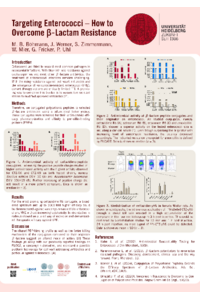
Enterococci are the third to second most common pathogens in nosocomial infections. With their intrinsic resistance against cephalosporines and most other β-lactam antibiotics, the treatment of enterococcal infections remains challenging. With the rising resistance against last-resort antibiotics and the emergence of vancomycin-resistant enterococci (VRE), current therapy options are critically limited [1]. A promising way to overcome this burden is to re-sensitize resistant strains to modified approved antibiotics [2]. Therefore, we conjugated polycationic peptides to select β-lactam antibiotics using a bifunctional linker moiety. These conjugates were screened for their antimicrobial efficacy, pharmacokinetics and affinity to penicillin-binding proteins (PBPs). For the most promising ceftazidime-R6 conjugate, a broadened spectrum and up to 1000-fold-higher efficacy could be demonstrated against vancomycin-susceptible enterococci and VRE without increasing cytotoxicity. In vivo studies in rodents showed an altered way of excretion and demonstrated therapeutic efficacy against VRE. The altered PBP-binding profile as well as the faster killing mechanism of the conjugates compared to their parent β-lactam suggest an altered mode of action [3]. These findings go along with our previously reported findings on FU002, a vancomycin derivative, and represent a possible platform technology for cell-wall addressing antibiotics and particular against enterococci [4].
References:
1. Kahn A. et al. (2022), Antimicrobial Susceptibility Testing for Enterococci. J. Clin Microbil., 60(9).
2. Narendrakumar L. et al. (2023), β-Lactam potentiators to re-sensitize resistant pathogens: Discovery, development, clinical use and the way forward. Front. Microbiol., 13.
3. Werner J. et al. (2024), Conjugation of Polycationic Peptides Extends the Efficacy Spectrum of β-Lactam Antibiotics. Adv. Sci. (Weinh), e2411406.
4. Umstätter F. et al. (2020), Vancomycin Resistance Is Overcome by Conjuagtion of Poylcationic Peptides. Angew Chem Int Ed Engl., 59(23).
Keywords
Enterococci
Resistance
β-Lactam
platform technology
Poster
Poster_ECA2025_Boehmann.pdf
Prevalence And Antibiotic Sensitivity Patterns Of Extended-Spectrum Beta-Lactamase-Producing Escherichia Coli In Selected Chicken Processing Plants In Ibadan.
ESBL-Producing E.coli in Ready-to-Eat Stuffed Mussels