Event submissions
Published
This submission belongs to the session S1. Antibiotics Stewardship and Antimicrobial Use in Healthcare Settings of the event The 4th International Electronic Conference on Antibiotics
Published date
19 May, 2025
Academic Editor
'%3e%3cpath%20d='M12.6657%2010.9104C12.4185%2010.325%2012.0599%209.79327%2011.6097%209.34482C11.1609%208.89508%2010.6293%208.5365%2010.0442%208.28888C10.0389%208.28626%2010.0337%208.28495%2010.0285%208.28233C10.8446%207.69279%2011.3752%206.73249%2011.3752%205.64904C11.3752%203.8542%209.92103%202.39999%208.1262%202.39999C6.33136%202.39999%204.87715%203.8542%204.87715%205.64904C4.87715%206.73249%205.40774%207.69279%206.22393%208.28364C6.21869%208.28626%206.21345%208.28757%206.20821%208.29019C5.62129%208.5378%205.09463%208.89284%204.64265%209.34613C4.1929%209.79493%203.83432%2010.3266%203.58671%2010.9117C3.34345%2011.4845%203.21226%2012.0987%203.20023%2012.7209C3.19988%2012.7349%203.20233%2012.7488%203.20744%2012.7619C3.21255%2012.7749%203.22022%2012.7867%203.22998%2012.7968C3.23975%2012.8068%203.25142%2012.8147%203.26431%2012.8202C3.2772%2012.8256%203.29105%2012.8284%203.30504%2012.8284H4.09109C4.14874%2012.8284%204.19459%2012.7825%204.1959%2012.7262C4.2221%2011.7148%204.62823%2010.7676%205.34617%2010.0497C6.08899%209.30683%207.0755%208.89808%208.1262%208.89808C9.17689%208.89808%2010.1634%209.30683%2010.9062%2010.0497C11.6242%2010.7676%2012.0303%2011.7148%2012.0565%2012.7262C12.0578%2012.7838%2012.1037%2012.8284%2012.1613%2012.8284H12.9474C12.9613%2012.8284%2012.9752%2012.8256%2012.9881%2012.8202C13.001%2012.8147%2013.0126%2012.8068%2013.0224%2012.7968C13.0322%2012.7867%2013.0398%2012.7749%2013.0449%2012.7619C13.0501%2012.7488%2013.0525%2012.7349%2013.0522%2012.7209C13.0391%2012.0947%2012.9094%2011.4855%2012.6657%2010.9104ZM8.1262%207.9024C7.52486%207.9024%206.9589%207.6679%206.53312%207.24211C6.10733%206.81633%205.87283%206.25037%205.87283%205.64904C5.87283%205.0477%206.10733%204.48174%206.53312%204.05596C6.9589%203.63018%207.52486%203.39567%208.1262%203.39567C8.72753%203.39567%209.29349%203.63018%209.71927%204.05596C10.1451%204.48174%2010.3796%205.0477%2010.3796%205.64904C10.3796%206.25037%2010.1451%206.81633%209.71927%207.24211C9.29349%207.6679%208.72753%207.9024%208.1262%207.9024Z'%20fill='%235D1EE1'/%3e%3c/g%3e%3c/svg%3e) Manuel Simões
Manuel SimõesCitation
Felipe Henrique da Silva, Rafael Miguel Batista, Elton Gonçalves de Oliveira, Igor de Sousa Oliveira, Andreza Guedes Barbosa Ramos, Sávio Benvindo Ferreira, Antibiotic Therapy in Patients with Bacteremia Caused by Escherichia Coli or Staphylococcus Aureus, in Proceedings of The 4th International Electronic Conference on Antibiotics, 21 May–23 May 2025, MDPI: Basel, Switzerland
Share
Email
Facebook
Twitter
LinkedIn
Antibiotic Therapy in Patients with Bacteremia Caused by Escherichia Coli or Staphylococcus Aureus
'%3e%3cpath%20d='M12.6647%2010.9104C12.4176%2010.325%2012.0589%209.7933%2011.6088%209.34485C11.16%208.89511%2010.6283%208.53653%2010.0432%208.28891C10.038%208.28629%2010.0327%208.28498%2010.0275%208.28236C10.8437%207.69282%2011.3743%206.73252%2011.3743%205.64907C11.3743%203.85423%209.92005%202.40002%208.12522%202.40002C6.33038%202.40002%204.87618%203.85423%204.87618%205.64907C4.87618%206.73252%205.40677%207.69282%206.22296%208.28367C6.21772%208.28629%206.21248%208.2876%206.20724%208.29022C5.62031%208.53783%205.09365%208.89287%204.64167%209.34616C4.19192%209.79496%203.83334%2010.3266%203.58573%2010.9117C3.34247%2011.4846%203.21128%2012.0987%203.19925%2012.721C3.1989%2012.735%203.20135%2012.7489%203.20646%2012.7619C3.21157%2012.7749%203.21924%2012.7868%203.22901%2012.7968C3.23877%2012.8068%203.25045%2012.8148%203.26334%2012.8202C3.27623%2012.8256%203.29007%2012.8284%203.30406%2012.8284H4.09012C4.14776%2012.8284%204.19362%2012.7825%204.19493%2012.7262C4.22113%2011.7148%204.62726%2010.7676%205.34519%2010.0497C6.08802%209.30686%207.07452%208.89811%208.12522%208.89811C9.17592%208.89811%2010.1624%209.30686%2010.9052%2010.0497C11.6232%2010.7676%2012.0293%2011.7148%2012.0555%2012.7262C12.0568%2012.7839%2012.1027%2012.8284%2012.1603%2012.8284H12.9464C12.9604%2012.8284%2012.9742%2012.8256%2012.9871%2012.8202C13%2012.8148%2013.0117%2012.8068%2013.0214%2012.7968C13.0312%2012.7868%2013.0389%2012.7749%2013.044%2012.7619C13.0491%2012.7489%2013.0515%2012.735%2013.0512%2012.721C13.0381%2012.0947%2012.9084%2011.4856%2012.6647%2010.9104ZM8.12522%207.90243C7.52388%207.90243%206.95792%207.66793%206.53214%207.24215C6.10636%206.81636%205.87185%206.2504%205.87185%205.64907C5.87185%205.04773%206.10636%204.48177%206.53214%204.05599C6.95792%203.63021%207.52388%203.3957%208.12522%203.3957C8.72655%203.3957%209.29252%203.63021%209.7183%204.05599C10.1441%204.48177%2010.3786%205.04773%2010.3786%205.64907C10.3786%206.2504%2010.1441%206.81636%209.7183%207.24215C9.29252%207.66793%208.72655%207.90243%208.12522%207.90243Z'%20fill='%235D1EE1'/%3e%3c/g%3e%3c/svg%3e)
Felipe Henrique da Silva 1
Rafael Miguel Batista 2
Elton Gonçalves de Oliveira 1
Igor de Sousa Oliveira 1
Andreza Guedes Barbosa Ramos 3
Sávio Benvindo Ferreira 4
1. Academic Unit of Life (UACV), Teacher Training Center (CFP), Federal University of Campina Grande (UFCG), Cajazeiras, PB, Brazil.
2. Nursing Academic Unit (UAENF), Teacher Training Center (CFP), Federal University of Campina Grande (UFCG), Cajazeiras, PB, Brazil.
3. Academic Unit of Life Sciences (UACV), Teacher Training Center (CFP), Federal University of Campina Grande (UFCG), Cajazeiras, PB, Brazil.
4. Academic University of Life Sciences, Teacher Training Center, Federal University of Campina Grande, Cajazeiras campus, Rua Sérgio Moreira de Figueiredo, Populares, 58900-000, Cajazeiras, Paraíba, Brazil.
Abstract
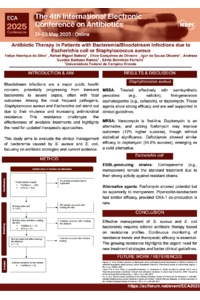
Introduction: Infections involving bacteria in the bloodstream pose a significant public health risk, potentially progressing to sepsis, which is often fatal. Staphylococcus aureus and Escherichia coli are recurrent pathogens in these infections, and effective treatment depends on the proper choice of antibiotics due to the growing issue of antimicrobial resistance. Objectives: The aim of this study was to evaluate the clinical management of bacteremias caused by E. coli and S. aureus. Methodology: This is a literature review study that used the PubMed and Virtual Health Library (VHL) databases, employing the following descriptors: bacteremia AND antibiotics AND Staphylococcus aureus OR Escherichia coli. Results: The search yielded a total of 394 articles, and after applying the selection and exclusion criteria, 9 articles were deemed eligible. It was observed that the treatment for methicillin-sensitive S. aureus includes penicillinase-resistant semi-synthetic penicillins, first-generation cephalosporins, and daptomycin. Beta-lactam anti-staphylococcal therapy is effective for methicillin-sensitive S. aureus, but combining it with daptomycin did not show additional benefits, as it did not reduce mortality or recurrence. For methicillin-resistant S. aureus cases, vancomycin or daptomycin is recommended. The combination of daptomycin with fosfomycin showed a 12% higher success rate, but without statistical significance. Ceftobiprole showed efficacy similar to that of daptomycin in treating complicated S. aureus bacteremias, with a success rate of 69.8%, making it an effective alternative. In bacteremias caused by E. coli producing extended-spectrum β-lactamases, carbapenems such as meropenem are the standard treatment. Fosfomycin is an alternative, but it is not superior to meropenem. Piperacillin–tazobactam demonstrated comparable efficacy to carbapenems, provided that the co-production of OXA-1 by E. coli was rare. Conclusions: The management of bacteremias caused by S. aureus and E. coli requires continuous monitoring of antimicrobial resistance and therapeutic efficacy. New treatments and approaches are crucial to address the growing threat of these infections.
Keywords
Bacteremia
antibiotics
Staphylococcus aureus
Escherichia coli.
Poster
Poster.pdf
Prevalence and phenotypic and genotypic characteristics of Staphylococcus aureus isolated from small ruminants with mastitis in Sardinia, Italy
Fosfomycin Sensitivity Among Enterobacterales and Enterococci in Urine Culture in British Columbia, Canada, 2023-2024