Event submissions
Published
This submission belongs to the session S3. Epidemiology, Prevalence and Mechanisms of Antibiotic Resistance and Cross-Resistance of the event The 4th International Electronic Conference on Antibiotics
Published date
19 May, 2025
Academic Editor
'%3e%3cpath%20d='M12.6657%2010.9104C12.4185%2010.325%2012.0599%209.79327%2011.6097%209.34482C11.1609%208.89508%2010.6293%208.5365%2010.0442%208.28888C10.0389%208.28626%2010.0337%208.28495%2010.0285%208.28233C10.8446%207.69279%2011.3752%206.73249%2011.3752%205.64904C11.3752%203.8542%209.92103%202.39999%208.1262%202.39999C6.33136%202.39999%204.87715%203.8542%204.87715%205.64904C4.87715%206.73249%205.40774%207.69279%206.22393%208.28364C6.21869%208.28626%206.21345%208.28757%206.20821%208.29019C5.62129%208.5378%205.09463%208.89284%204.64265%209.34613C4.1929%209.79493%203.83432%2010.3266%203.58671%2010.9117C3.34345%2011.4845%203.21226%2012.0987%203.20023%2012.7209C3.19988%2012.7349%203.20233%2012.7488%203.20744%2012.7619C3.21255%2012.7749%203.22022%2012.7867%203.22998%2012.7968C3.23975%2012.8068%203.25142%2012.8147%203.26431%2012.8202C3.2772%2012.8256%203.29105%2012.8284%203.30504%2012.8284H4.09109C4.14874%2012.8284%204.19459%2012.7825%204.1959%2012.7262C4.2221%2011.7148%204.62823%2010.7676%205.34617%2010.0497C6.08899%209.30683%207.0755%208.89808%208.1262%208.89808C9.17689%208.89808%2010.1634%209.30683%2010.9062%2010.0497C11.6242%2010.7676%2012.0303%2011.7148%2012.0565%2012.7262C12.0578%2012.7838%2012.1037%2012.8284%2012.1613%2012.8284H12.9474C12.9613%2012.8284%2012.9752%2012.8256%2012.9881%2012.8202C13.001%2012.8147%2013.0126%2012.8068%2013.0224%2012.7968C13.0322%2012.7867%2013.0398%2012.7749%2013.0449%2012.7619C13.0501%2012.7488%2013.0525%2012.7349%2013.0522%2012.7209C13.0391%2012.0947%2012.9094%2011.4855%2012.6657%2010.9104ZM8.1262%207.9024C7.52486%207.9024%206.9589%207.6679%206.53312%207.24211C6.10733%206.81633%205.87283%206.25037%205.87283%205.64904C5.87283%205.0477%206.10733%204.48174%206.53312%204.05596C6.9589%203.63018%207.52486%203.39567%208.1262%203.39567C8.72753%203.39567%209.29349%203.63018%209.71927%204.05596C10.1451%204.48174%2010.3796%205.0477%2010.3796%205.64904C10.3796%206.25037%2010.1451%206.81633%209.71927%207.24211C9.29349%207.6679%208.72753%207.9024%208.1262%207.9024Z'%20fill='%235D1EE1'/%3e%3c/g%3e%3c/svg%3e) Nicholas Dixon
Nicholas DixonCitation
Emmanuel Adekunmi Olayiwola, Victoria O. Adetunji, Oluwatobi Stephen Fasiku, Peace Olubukola Ojeade, Precious Oladipo, Olayemi Okunlade, Adebayo Adedamola Awoyele, Temidayo Omobowale, Prevalence and Antibiotic Sensitivity Patterns of Methicillin-resistant and Methicillin-sensitive Staphylococcus aureus in Dogs in Ibadan, Nigeria, in Proceedings of The 4th International Electronic Conference on Antibiotics, 21 May–23 May 2025, MDPI: Basel, Switzerland
Share
Email
Facebook
Twitter
LinkedIn
Prevalence and Antibiotic Sensitivity Patterns of Methicillin-resistant and Methicillin-sensitive Staphylococcus aureus in Dogs in Ibadan, Nigeria
'%3e%3cpath%20d='M12.6647%2010.9104C12.4176%2010.325%2012.0589%209.7933%2011.6088%209.34485C11.16%208.89511%2010.6283%208.53653%2010.0432%208.28891C10.038%208.28629%2010.0327%208.28498%2010.0275%208.28236C10.8437%207.69282%2011.3743%206.73252%2011.3743%205.64907C11.3743%203.85423%209.92005%202.40002%208.12522%202.40002C6.33038%202.40002%204.87618%203.85423%204.87618%205.64907C4.87618%206.73252%205.40677%207.69282%206.22296%208.28367C6.21772%208.28629%206.21248%208.2876%206.20724%208.29022C5.62031%208.53783%205.09365%208.89287%204.64167%209.34616C4.19192%209.79496%203.83334%2010.3266%203.58573%2010.9117C3.34247%2011.4846%203.21128%2012.0987%203.19925%2012.721C3.1989%2012.735%203.20135%2012.7489%203.20646%2012.7619C3.21157%2012.7749%203.21924%2012.7868%203.22901%2012.7968C3.23877%2012.8068%203.25045%2012.8148%203.26334%2012.8202C3.27623%2012.8256%203.29007%2012.8284%203.30406%2012.8284H4.09012C4.14776%2012.8284%204.19362%2012.7825%204.19493%2012.7262C4.22113%2011.7148%204.62726%2010.7676%205.34519%2010.0497C6.08802%209.30686%207.07452%208.89811%208.12522%208.89811C9.17592%208.89811%2010.1624%209.30686%2010.9052%2010.0497C11.6232%2010.7676%2012.0293%2011.7148%2012.0555%2012.7262C12.0568%2012.7839%2012.1027%2012.8284%2012.1603%2012.8284H12.9464C12.9604%2012.8284%2012.9742%2012.8256%2012.9871%2012.8202C13%2012.8148%2013.0117%2012.8068%2013.0214%2012.7968C13.0312%2012.7868%2013.0389%2012.7749%2013.044%2012.7619C13.0491%2012.7489%2013.0515%2012.735%2013.0512%2012.721C13.0381%2012.0947%2012.9084%2011.4856%2012.6647%2010.9104ZM8.12522%207.90243C7.52388%207.90243%206.95792%207.66793%206.53214%207.24215C6.10636%206.81636%205.87185%206.2504%205.87185%205.64907C5.87185%205.04773%206.10636%204.48177%206.53214%204.05599C6.95792%203.63021%207.52388%203.3957%208.12522%203.3957C8.72655%203.3957%209.29252%203.63021%209.7183%204.05599C10.1441%204.48177%2010.3786%205.04773%2010.3786%205.64907C10.3786%206.2504%2010.1441%206.81636%209.7183%207.24215C9.29252%207.66793%208.72655%207.90243%208.12522%207.90243Z'%20fill='%235D1EE1'/%3e%3c/g%3e%3c/svg%3e)
Emmanuel Adekunmi Olayiwola 1
Victoria O. Adetunji 1

Oluwatobi Stephen Fasiku 1
Peace Olubukola Ojeade 1
Precious Oladipo 1
Olayemi Okunlade 1

Adebayo Adedamola Awoyele 1
Temidayo Omobowale 2
1. Department of Veterinary Public Health and Preventive Medicine, University of Ibadan, Ibadan 200001, Oyo, Nigeria
2. Department of Veterinary Medicine, University of Ibadan, Ibadan 200001, Oyo, Nigeria
Abstract
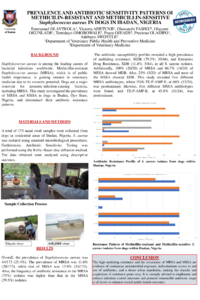
Background: Staphylococcus aureus is among the leading causes of bacterial infections worldwide. Methicillin-resistant Staphylococcus aureus (MRSA), which is of public health importance, is gaining interest in veterinary medicine due to its zoonotic potential. Dogs are a major reservoir for zoonotic-infection-causing bacteria, including MRSA. This study investigated the prevalence of MRSA and MSSA in dogs in Ibadan, Oyo State, Nigeria, and determined their antibiotic resistance patterns.
Methods: A total of 173 nasal swab samples were collected from dogs in residential areas of Ibadan, Nigeria. S. aureus was isolated using standard microbiological procedures. Furthermore, Antibiotic Sensitivity Testing was performed using the Kirby–Bauer disc diffusion method. The data obtained were analysed using descriptive statistics.
Results: Overall, the prevalence of Staphylococcus aureus was 44/173 (25.4%). The prevalence of MRSA was 11.6% (20/173), while that of MSSA was 13.9% (24/173). Also, the frequency of antibiotic resistance in the MRSA (75%) isolates was higher than that in the MSSA (59.5%) isolates. The antibiotic susceptibility profiles revealed a high prevalence of multidrug resistance, MDR (79.5%; 35/44), and Extensive Drug Resistance, XDR (11.4%; 5/44), in all S. aureus isolates. Additionally, 100% (20/20) of MRSA and 66.7% (16/24) of MSSA showed MDR. Also, 25% (5/20) of MRSA and none of the MSSA showed XDR. This study revealed five different MRSA antibiotypes, where FOX-TE-P-AMP-E, at 60% (12/20), was predominant; likewise, five different MSSA antibiotypes were found, and TE-P-AMP-E, at 45.8% (11/24), was predominant.
Conclusion: The high multidrug resistance and the occurrence of MRSA and MSSA are evidence of continuous antimicrobial exposure, indiscriminate access to and use of antibiotics, and a dense urban population, making the transfer and acquisition of resistance genes easy. It is strongly advised to implement and enforce infection control measures and promote responsible antibiotic usage at all levels to enhance overall public health outcomes.
Keywords
Antibiotype
Methicillin-resistant Staphylococcus aureus
Methicillin-sensitive Staphylococcus aureus
Dogs
Antibiotic sensitivity testing.
Poster
Emmanuel_Olayiwola's_Poster_Sciforum.pdf
Surviving the Greek Gift: Gallium Resistance