Event submissions
Published
This submission belongs to the session S2. Abiotic and Biotic Stress of the event The 2nd International Electronic Conference on Horticulturae
Published date
23 May, 2025
Academic Editor
'%3e%3cpath%20d='M12.6657%2010.9104C12.4185%2010.325%2012.0599%209.79327%2011.6097%209.34482C11.1609%208.89508%2010.6293%208.5365%2010.0442%208.28888C10.0389%208.28626%2010.0337%208.28495%2010.0285%208.28233C10.8446%207.69279%2011.3752%206.73249%2011.3752%205.64904C11.3752%203.8542%209.92103%202.39999%208.1262%202.39999C6.33136%202.39999%204.87715%203.8542%204.87715%205.64904C4.87715%206.73249%205.40774%207.69279%206.22393%208.28364C6.21869%208.28626%206.21345%208.28757%206.20821%208.29019C5.62129%208.5378%205.09463%208.89284%204.64265%209.34613C4.1929%209.79493%203.83432%2010.3266%203.58671%2010.9117C3.34345%2011.4845%203.21226%2012.0987%203.20023%2012.7209C3.19988%2012.7349%203.20233%2012.7488%203.20744%2012.7619C3.21255%2012.7749%203.22022%2012.7867%203.22998%2012.7968C3.23975%2012.8068%203.25142%2012.8147%203.26431%2012.8202C3.2772%2012.8256%203.29105%2012.8284%203.30504%2012.8284H4.09109C4.14874%2012.8284%204.19459%2012.7825%204.1959%2012.7262C4.2221%2011.7148%204.62823%2010.7676%205.34617%2010.0497C6.08899%209.30683%207.0755%208.89808%208.1262%208.89808C9.17689%208.89808%2010.1634%209.30683%2010.9062%2010.0497C11.6242%2010.7676%2012.0303%2011.7148%2012.0565%2012.7262C12.0578%2012.7838%2012.1037%2012.8284%2012.1613%2012.8284H12.9474C12.9613%2012.8284%2012.9752%2012.8256%2012.9881%2012.8202C13.001%2012.8147%2013.0126%2012.8068%2013.0224%2012.7968C13.0322%2012.7867%2013.0398%2012.7749%2013.0449%2012.7619C13.0501%2012.7488%2013.0525%2012.7349%2013.0522%2012.7209C13.0391%2012.0947%2012.9094%2011.4855%2012.6657%2010.9104ZM8.1262%207.9024C7.52486%207.9024%206.9589%207.6679%206.53312%207.24211C6.10733%206.81633%205.87283%206.25037%205.87283%205.64904C5.87283%205.0477%206.10733%204.48174%206.53312%204.05596C6.9589%203.63018%207.52486%203.39567%208.1262%203.39567C8.72753%203.39567%209.29349%203.63018%209.71927%204.05596C10.1451%204.48174%2010.3796%205.0477%2010.3796%205.64904C10.3796%206.25037%2010.1451%206.81633%209.71927%207.24211C9.29349%207.6679%208.72753%207.9024%208.1262%207.9024Z'%20fill='%235D1EE1'/%3e%3c/g%3e%3c/svg%3e) Alessandra Francini
Alessandra FranciniCitation
Dario Gaudioso, Luca Calamai, Chiara Pastacaldi, Cosimo Beltrami, Leone Boatto, Stefania Tegli, Volatile Organic Compounds as Diagnostic Biomarkers for Seed-Borne Pathogens: a Sustainable Approach to Legume Crop Health Management, in Proceedings of The 2nd International Electronic Conference on Horticulturae, 27 May–29 May 2025, MDPI: Basel, Switzerland
Share
Email
Facebook
Twitter
LinkedIn
Volatile Organic Compounds as Diagnostic Biomarkers for Seed-Borne Pathogens: a Sustainable Approach to Legume Crop Health Management

Dario Gaudioso 1
'%3e%3cpath%20d='M12.6647%2010.9104C12.4176%2010.325%2012.0589%209.7933%2011.6088%209.34485C11.16%208.89511%2010.6283%208.53653%2010.0432%208.28891C10.038%208.28629%2010.0327%208.28498%2010.0275%208.28236C10.8437%207.69282%2011.3743%206.73252%2011.3743%205.64907C11.3743%203.85423%209.92005%202.40002%208.12522%202.40002C6.33038%202.40002%204.87618%203.85423%204.87618%205.64907C4.87618%206.73252%205.40677%207.69282%206.22296%208.28367C6.21772%208.28629%206.21248%208.2876%206.20724%208.29022C5.62031%208.53783%205.09365%208.89287%204.64167%209.34616C4.19192%209.79496%203.83334%2010.3266%203.58573%2010.9117C3.34247%2011.4846%203.21128%2012.0987%203.19925%2012.721C3.1989%2012.735%203.20135%2012.7489%203.20646%2012.7619C3.21157%2012.7749%203.21924%2012.7868%203.22901%2012.7968C3.23877%2012.8068%203.25045%2012.8148%203.26334%2012.8202C3.27623%2012.8256%203.29007%2012.8284%203.30406%2012.8284H4.09012C4.14776%2012.8284%204.19362%2012.7825%204.19493%2012.7262C4.22113%2011.7148%204.62726%2010.7676%205.34519%2010.0497C6.08802%209.30686%207.07452%208.89811%208.12522%208.89811C9.17592%208.89811%2010.1624%209.30686%2010.9052%2010.0497C11.6232%2010.7676%2012.0293%2011.7148%2012.0555%2012.7262C12.0568%2012.7839%2012.1027%2012.8284%2012.1603%2012.8284H12.9464C12.9604%2012.8284%2012.9742%2012.8256%2012.9871%2012.8202C13%2012.8148%2013.0117%2012.8068%2013.0214%2012.7968C13.0312%2012.7868%2013.0389%2012.7749%2013.044%2012.7619C13.0491%2012.7489%2013.0515%2012.735%2013.0512%2012.721C13.0381%2012.0947%2012.9084%2011.4856%2012.6647%2010.9104ZM8.12522%207.90243C7.52388%207.90243%206.95792%207.66793%206.53214%207.24215C6.10636%206.81636%205.87185%206.2504%205.87185%205.64907C5.87185%205.04773%206.10636%204.48177%206.53214%204.05599C6.95792%203.63021%207.52388%203.3957%208.12522%203.3957C8.72655%203.3957%209.29252%203.63021%209.7183%204.05599C10.1441%204.48177%2010.3786%205.04773%2010.3786%205.64907C10.3786%206.2504%2010.1441%206.81636%209.7183%207.24215C9.29252%207.66793%208.72655%207.90243%208.12522%207.90243Z'%20fill='%235D1EE1'/%3e%3c/g%3e%3c/svg%3e)
Luca Calamai 1
Chiara Pastacaldi 1
Cosimo Beltrami 1
Leone Boatto 1

Stefania Tegli 1
1. Laboratorio di Patologia Vegetale Molecolare, Dipartimento di Scienze e Tecnologie Agrarie, Alimentari Ambientali e Forestali (DAGRI), Università degli Studi di Firenze, Florence, Italy
Abstract
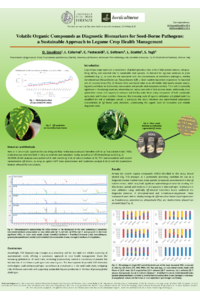
Leguminous crops are a cornerstone of global agriculture, valued for their high protein content, nitrogen-fixing capabilities, and contribution to sustainable food systems. As global demand for legumes rises, so does the risk of spreading seed-borne pathogens, including Curtobacterium flaccumfaciens pv. flaccumfaciens (Cff), a Gram-positive bacterium causing the "bacterial wilt of common beans". Legumes not only provide a low-cost, high-quality source of proteins but also play a crucial role in biodiversity conservation and ecosystem services. They contribute significantly to global diets, particularly in emerging countries, where they account for over 60% of protein intake. Their ability to improve soil fertility and their gluten-free nature further enhance their value in sustainable agriculture and human nutrition. Despite these benefits, the expansion of legume cultivation and trade has heightened the risk of spreading seed-borne pathogens. The latent nature of Cff infections and its systemic colonization of xylem tissues complicate early detection, highlighting the need for innovative diagnostic strategies.
The potential of volatile organic compounds (VOCs) as biomarkers for non-invasive pathogen detection was explored through the characterization of VOC profiles emitted by different Cff strains in vitro. More than 100 VOCs were identified, with five major compounds—2-methyl-1-butanol/3-methyl-1-butanol, phenylmethanol, 6,10-dimethyl-5,9-undecadien-2-one, and 2-methoxy-4-vinylphenol—produced by Cff strains in legume flours. These compounds were chosen based on statistically significant differences in production or degradation between Cff-inoculated and non-inoculated samples. VOCs were analyzed using HS-SPME-GC-MS (headspace solid-phase microextraction coupled with gas chromatography–mass spectrometry). Samples were incubated at 60°C for 10 minutes before exposing the SPME fiber to the headspace for 30 minutes. Further in vivo validation on artificially Cff-infected Cannellino beans confirmed the diagnostic relevance of phenylmethanol and 2-methoxy-4-vinylphenol, which uniquely differentiate Cff from other bacterial pathogens, including Pseudomonas savastanoi pv. phaseolicola and Xanthomonas phaseoli pv. phaseoli. Additionally, VOC profiles produced by Cff strains varied significantly when grown on legume flours compared to synthetic media, reinforcing the potential of substrate-specific VOCs for pathogen identification.
Accordingly, VOC fingerprinting emerges as a promising tool for the rapid and reliable screening of asymptomatic seeds, offering a sustainable approach to seed health management. Given the increasing globalization of seed trade, improving phytosanitary control is mandatory to prevent the introduction of seed-borne pathogens into new regions. The development of portable VOC-detection technologies could enhance pathogen surveillance at critical points in the seed trade chain, mitigating risks of disease outbreaks and supporting sustainable legume production in the face of growing global challenges.
Keywords
Leguminous crop
Seed-borne pathogen
Curtobacterium flaccumfaciens pv. flaccumfaciens
Poster
20250522_Poster_IECHo2025_Dario_Gaudioso.pdf
Waterlogging-Induced Stress and Its Synergistic Effects on Peach Gummosis: Mechanisms and Mitigation Strategies
Exploring the Diverse Functions of Acyl-CoA-Binding Proteins in the Chinese Gutta Percha Tree: Insights into Developmental Processes and Drought Stress Adaptation