Event submissions
Published
This submission belongs to the session S2. Abiotic and Biotic Stress of the event The 2nd International Electronic Conference on Horticulturae
Published date
23 May, 2025
Academic Editor
'%3e%3cpath%20d='M12.6657%2010.9104C12.4185%2010.325%2012.0599%209.79327%2011.6097%209.34482C11.1609%208.89508%2010.6293%208.5365%2010.0442%208.28888C10.0389%208.28626%2010.0337%208.28495%2010.0285%208.28233C10.8446%207.69279%2011.3752%206.73249%2011.3752%205.64904C11.3752%203.8542%209.92103%202.39999%208.1262%202.39999C6.33136%202.39999%204.87715%203.8542%204.87715%205.64904C4.87715%206.73249%205.40774%207.69279%206.22393%208.28364C6.21869%208.28626%206.21345%208.28757%206.20821%208.29019C5.62129%208.5378%205.09463%208.89284%204.64265%209.34613C4.1929%209.79493%203.83432%2010.3266%203.58671%2010.9117C3.34345%2011.4845%203.21226%2012.0987%203.20023%2012.7209C3.19988%2012.7349%203.20233%2012.7488%203.20744%2012.7619C3.21255%2012.7749%203.22022%2012.7867%203.22998%2012.7968C3.23975%2012.8068%203.25142%2012.8147%203.26431%2012.8202C3.2772%2012.8256%203.29105%2012.8284%203.30504%2012.8284H4.09109C4.14874%2012.8284%204.19459%2012.7825%204.1959%2012.7262C4.2221%2011.7148%204.62823%2010.7676%205.34617%2010.0497C6.08899%209.30683%207.0755%208.89808%208.1262%208.89808C9.17689%208.89808%2010.1634%209.30683%2010.9062%2010.0497C11.6242%2010.7676%2012.0303%2011.7148%2012.0565%2012.7262C12.0578%2012.7838%2012.1037%2012.8284%2012.1613%2012.8284H12.9474C12.9613%2012.8284%2012.9752%2012.8256%2012.9881%2012.8202C13.001%2012.8147%2013.0126%2012.8068%2013.0224%2012.7968C13.0322%2012.7867%2013.0398%2012.7749%2013.0449%2012.7619C13.0501%2012.7488%2013.0525%2012.7349%2013.0522%2012.7209C13.0391%2012.0947%2012.9094%2011.4855%2012.6657%2010.9104ZM8.1262%207.9024C7.52486%207.9024%206.9589%207.6679%206.53312%207.24211C6.10733%206.81633%205.87283%206.25037%205.87283%205.64904C5.87283%205.0477%206.10733%204.48174%206.53312%204.05596C6.9589%203.63018%207.52486%203.39567%208.1262%203.39567C8.72753%203.39567%209.29349%203.63018%209.71927%204.05596C10.1451%204.48174%2010.3796%205.0477%2010.3796%205.64904C10.3796%206.25037%2010.1451%206.81633%209.71927%207.24211C9.29349%207.6679%208.72753%207.9024%208.1262%207.9024Z'%20fill='%235D1EE1'/%3e%3c/g%3e%3c/svg%3e) Gianfranco Romanazzi
Gianfranco RomanazziCitation
Monika Cioć, Barbara Prokopiuk, Explant type as a key factor in adventitious organogenesis success of Galanthus nivalis in vitro, in Proceedings of The 2nd International Electronic Conference on Horticulturae, 27 May–29 May 2025, MDPI: Basel, Switzerland
Share
Email
Facebook
Twitter
LinkedIn
Explant type as a key factor in adventitious organogenesis success of Galanthus nivalis in vitro

Monika Cioć 1
'%3e%3cpath%20d='M12.6647%2010.9104C12.4176%2010.325%2012.0589%209.7933%2011.6088%209.34485C11.16%208.89511%2010.6283%208.53653%2010.0432%208.28891C10.038%208.28629%2010.0327%208.28498%2010.0275%208.28236C10.8437%207.69282%2011.3743%206.73252%2011.3743%205.64907C11.3743%203.85423%209.92005%202.40002%208.12522%202.40002C6.33038%202.40002%204.87618%203.85423%204.87618%205.64907C4.87618%206.73252%205.40677%207.69282%206.22296%208.28367C6.21772%208.28629%206.21248%208.2876%206.20724%208.29022C5.62031%208.53783%205.09365%208.89287%204.64167%209.34616C4.19192%209.79496%203.83334%2010.3266%203.58573%2010.9117C3.34247%2011.4846%203.21128%2012.0987%203.19925%2012.721C3.1989%2012.735%203.20135%2012.7489%203.20646%2012.7619C3.21157%2012.7749%203.21924%2012.7868%203.22901%2012.7968C3.23877%2012.8068%203.25045%2012.8148%203.26334%2012.8202C3.27623%2012.8256%203.29007%2012.8284%203.30406%2012.8284H4.09012C4.14776%2012.8284%204.19362%2012.7825%204.19493%2012.7262C4.22113%2011.7148%204.62726%2010.7676%205.34519%2010.0497C6.08802%209.30686%207.07452%208.89811%208.12522%208.89811C9.17592%208.89811%2010.1624%209.30686%2010.9052%2010.0497C11.6232%2010.7676%2012.0293%2011.7148%2012.0555%2012.7262C12.0568%2012.7839%2012.1027%2012.8284%2012.1603%2012.8284H12.9464C12.9604%2012.8284%2012.9742%2012.8256%2012.9871%2012.8202C13%2012.8148%2013.0117%2012.8068%2013.0214%2012.7968C13.0312%2012.7868%2013.0389%2012.7749%2013.044%2012.7619C13.0491%2012.7489%2013.0515%2012.735%2013.0512%2012.721C13.0381%2012.0947%2012.9084%2011.4856%2012.6647%2010.9104ZM8.12522%207.90243C7.52388%207.90243%206.95792%207.66793%206.53214%207.24215C6.10636%206.81636%205.87185%206.2504%205.87185%205.64907C5.87185%205.04773%206.10636%204.48177%206.53214%204.05599C6.95792%203.63021%207.52388%203.3957%208.12522%203.3957C8.72655%203.3957%209.29252%203.63021%209.7183%204.05599C10.1441%204.48177%2010.3786%205.04773%2010.3786%205.64907C10.3786%206.2504%2010.1441%206.81636%209.7183%207.24215C9.29252%207.66793%208.72655%207.90243%208.12522%207.90243Z'%20fill='%235D1EE1'/%3e%3c/g%3e%3c/svg%3e)
Barbara Prokopiuk 1
1. Department of Ornamental Plants and Garden Art, Faculty of Biotechnology and Horticulture, University of Agriculture in Krakow, 29 Listopada 54, 31-425 Kraków, Poland
Abstract
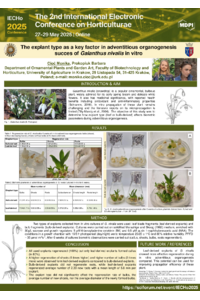
Galanthus nivalis (snowdrop) is a popular ornamental, bulbous plant, widely admired for its early spring bloom and delicate white flowers. It also has medicinal significance, with reported health benefits including antioxidant and anti-inflammatory properties. The in vitro propagation of this plant remains challenging, and reports on its micropropagation in the literature are limited.
This study investigated the impact of explant type on biometric parameters during adventitious organogenesis. Two types of explants collected from in vitro cultures of G. nivalis were used: leaf blade fragments (leaf-derived explants) and bulb fragments (bulb-derived explants). Culture was carried out on solidified Murashige and Skoog medium enriched with 30g/L sucrose and the following growth regulators: 5 μM 6-benzyladenine cytokinin (BA) and 0,5 μM auxin 1-naphthaleneacetic acid (NAA). The conditions in the growth chamber, with a 16/8 h photoperiod (day/night), were as follows: temperature 25/23 ± 1°C, 80% relative humidity, PPFD ~ 35 µmol m-2s-1. After 6 weeks of culture, biometric observations were carried out. All explants used regenerated (100%), but only leaf-derived explants formed calluses (80%). A higher regeneration of shoots (developing leaves without bulbs at the base) was observed form leaf-derived explants (regeneration rate of 1.00) compared to bulb-derived explants (0.21). Explant type did not significantly affect the regeneration rate of bulbs (closed bulbs without developing leaves). However, the number of bulbs was higher from leaf-derived explants (mean of 7.04 per one explant) compared to bulb-derived explants (2.33). Bulb-derived explants did not regenerate roots, while leaf-derived explants regenerated roots with a rate of 0.94, producing an average of 2.33 new roots with a mean length of 5.8 mm per explant. Explant type did not affect the average number of new shoots (mean of 6.4), nor the average diameter of newly formed bulbs (2.6 mm).
Leaf-derived explants of G. nivalis showed more effective regeneration during in vitro adventitious organogenesis compared to bulb-derived explants, with higher shoot and root formation, as well as a greater number of new bulbs. This potential can be used for improving the propagation efficiency of these plants.
Keywords
snowdrop
micropropagation
plant tissue culture
bulb regeneration
biometric observations
Poster
poster_cioć_prokopiuk_IECHo25.pdf
Meta-analysis of available transcriptomic datasets reveals core pathways in the high-light stress response of Arabidopsis thaliana
Metabolic changes in Brassica rapa L. subsp. sylvestris during postharvest storage