Event submissions
Published
This submission belongs to the session S4. Greenhouse and Indoor Farms of the event The 2nd International Electronic Conference on Horticulturae
Published date
23 May, 2025
Academic Editor
'%3e%3cpath%20d='M12.6657%2010.9104C12.4185%2010.325%2012.0599%209.79327%2011.6097%209.34482C11.1609%208.89508%2010.6293%208.5365%2010.0442%208.28888C10.0389%208.28626%2010.0337%208.28495%2010.0285%208.28233C10.8446%207.69279%2011.3752%206.73249%2011.3752%205.64904C11.3752%203.8542%209.92103%202.39999%208.1262%202.39999C6.33136%202.39999%204.87715%203.8542%204.87715%205.64904C4.87715%206.73249%205.40774%207.69279%206.22393%208.28364C6.21869%208.28626%206.21345%208.28757%206.20821%208.29019C5.62129%208.5378%205.09463%208.89284%204.64265%209.34613C4.1929%209.79493%203.83432%2010.3266%203.58671%2010.9117C3.34345%2011.4845%203.21226%2012.0987%203.20023%2012.7209C3.19988%2012.7349%203.20233%2012.7488%203.20744%2012.7619C3.21255%2012.7749%203.22022%2012.7867%203.22998%2012.7968C3.23975%2012.8068%203.25142%2012.8147%203.26431%2012.8202C3.2772%2012.8256%203.29105%2012.8284%203.30504%2012.8284H4.09109C4.14874%2012.8284%204.19459%2012.7825%204.1959%2012.7262C4.2221%2011.7148%204.62823%2010.7676%205.34617%2010.0497C6.08899%209.30683%207.0755%208.89808%208.1262%208.89808C9.17689%208.89808%2010.1634%209.30683%2010.9062%2010.0497C11.6242%2010.7676%2012.0303%2011.7148%2012.0565%2012.7262C12.0578%2012.7838%2012.1037%2012.8284%2012.1613%2012.8284H12.9474C12.9613%2012.8284%2012.9752%2012.8256%2012.9881%2012.8202C13.001%2012.8147%2013.0126%2012.8068%2013.0224%2012.7968C13.0322%2012.7867%2013.0398%2012.7749%2013.0449%2012.7619C13.0501%2012.7488%2013.0525%2012.7349%2013.0522%2012.7209C13.0391%2012.0947%2012.9094%2011.4855%2012.6657%2010.9104ZM8.1262%207.9024C7.52486%207.9024%206.9589%207.6679%206.53312%207.24211C6.10733%206.81633%205.87283%206.25037%205.87283%205.64904C5.87283%205.0477%206.10733%204.48174%206.53312%204.05596C6.9589%203.63018%207.52486%203.39567%208.1262%203.39567C8.72753%203.39567%209.29349%203.63018%209.71927%204.05596C10.1451%204.48174%2010.3796%205.0477%2010.3796%205.64904C10.3796%206.25037%2010.1451%206.81633%209.71927%207.24211C9.29349%207.6679%208.72753%207.9024%208.1262%207.9024Z'%20fill='%235D1EE1'/%3e%3c/g%3e%3c/svg%3e) Konstantina Argyropoulou
Konstantina ArgyropoulouCitation
Antonio Manzano Torres, Israel Guerrero Cozar, Maria del Carmen Garcia Garcia, Francisco Miguel De Cara Garcia, Dirk Janssen, Maria Leticia Ruiz Garcia, Commercially available resistant cultivars that reduce the impact of diseases in courgette and pumpkin, in Proceedings of The 2nd International Electronic Conference on Horticulturae, 27 May–29 May 2025, MDPI: Basel, Switzerland
Share
Email
Facebook
Twitter
LinkedIn
Commercially available resistant cultivars that reduce the impact of diseases in courgette and pumpkin
'%3e%3cpath%20d='M12.6647%2010.9104C12.4176%2010.325%2012.0589%209.7933%2011.6088%209.34485C11.16%208.89511%2010.6283%208.53653%2010.0432%208.28891C10.038%208.28629%2010.0327%208.28498%2010.0275%208.28236C10.8437%207.69282%2011.3743%206.73252%2011.3743%205.64907C11.3743%203.85423%209.92005%202.40002%208.12522%202.40002C6.33038%202.40002%204.87618%203.85423%204.87618%205.64907C4.87618%206.73252%205.40677%207.69282%206.22296%208.28367C6.21772%208.28629%206.21248%208.2876%206.20724%208.29022C5.62031%208.53783%205.09365%208.89287%204.64167%209.34616C4.19192%209.79496%203.83334%2010.3266%203.58573%2010.9117C3.34247%2011.4846%203.21128%2012.0987%203.19925%2012.721C3.1989%2012.735%203.20135%2012.7489%203.20646%2012.7619C3.21157%2012.7749%203.21924%2012.7868%203.22901%2012.7968C3.23877%2012.8068%203.25045%2012.8148%203.26334%2012.8202C3.27623%2012.8256%203.29007%2012.8284%203.30406%2012.8284H4.09012C4.14776%2012.8284%204.19362%2012.7825%204.19493%2012.7262C4.22113%2011.7148%204.62726%2010.7676%205.34519%2010.0497C6.08802%209.30686%207.07452%208.89811%208.12522%208.89811C9.17592%208.89811%2010.1624%209.30686%2010.9052%2010.0497C11.6232%2010.7676%2012.0293%2011.7148%2012.0555%2012.7262C12.0568%2012.7839%2012.1027%2012.8284%2012.1603%2012.8284H12.9464C12.9604%2012.8284%2012.9742%2012.8256%2012.9871%2012.8202C13%2012.8148%2013.0117%2012.8068%2013.0214%2012.7968C13.0312%2012.7868%2013.0389%2012.7749%2013.044%2012.7619C13.0491%2012.7489%2013.0515%2012.735%2013.0512%2012.721C13.0381%2012.0947%2012.9084%2011.4856%2012.6647%2010.9104ZM8.12522%207.90243C7.52388%207.90243%206.95792%207.66793%206.53214%207.24215C6.10636%206.81636%205.87185%206.2504%205.87185%205.64907C5.87185%205.04773%206.10636%204.48177%206.53214%204.05599C6.95792%203.63021%207.52388%203.3957%208.12522%203.3957C8.72655%203.3957%209.29252%203.63021%209.7183%204.05599C10.1441%204.48177%2010.3786%205.04773%2010.3786%205.64907C10.3786%206.2504%2010.1441%206.81636%209.7183%207.24215C9.29252%207.66793%208.72655%207.90243%208.12522%207.90243Z'%20fill='%235D1EE1'/%3e%3c/g%3e%3c/svg%3e)
Antonio Manzano Torres 1
Israel Guerrero Cozar 1
Maria del Carmen Garcia Garcia 1

Francisco Miguel De Cara Garcia 1

Dirk Janssen 1

Maria Leticia Ruiz Garcia 1
1. IFAPA Centro La Mojonera, Almería
Abstract
The genus Cucurbita includes fourteen species, of which only three are cultivated on a global scale: Cucurbita maxima and C. moschata, commonly referred to as ‘pumpkins’, and C. pepo, known as courgettes. It is estimated that approximately 40% of global agricultural food production losses are due to pests and diseases. Among these, viruses, fungi, and nematodes are the most prevalent emerging threats worldwide.
The objective of this study was to analyse the commercial cultivars of the Cucurbita genus, focusing on quantifying their resistance to diseases caused by viruses and pests. Additionally, this analysis connected these resistance levels to the specific diseases that limit their production. To achieve this, data were collected from the 2023 edition of the Portagrano manual.
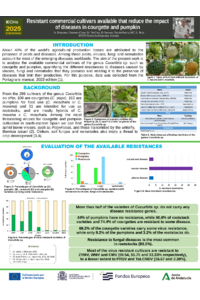
According to our analysis, 56% of the varieties of Cucurbita sp. that are available on the market do not have resistance to any disease. Based on typology, squash varieties that are destined for consumption have the highest number of cultivars with no genetic resistance (84%), while 90.6% of rootstock varieties and 74.4% of courgettes are resistant to some disease. Of all the commercially available courgette varieties, 69.2% have resistance to one or more viruses, while this percentage decreases considerably for pumpkins (9.2%) and rootstocks (3.2%). Resistance to fungal diseases is found in the majority in commercial rootstock varieties (93.3%). Fungal resistance is present in 55.2% of courgettes and 7.5% of pumpkins, but in the case of courgettes, it is mainly intermediate resistance to powdery mildew. Resistance to nematodes of the genus Meloidogyne is only found in 6.5% of the cultivars of Cucurbita sp. intended for use as rootstocks.
Among the virus-resistant cultivars, the majority are resistant to zucchini yellow mosaic virus (ZYMV), watermelon mosaic virus (WMV), and cucumber mosaic virus (CMV), with resistance rates of 69.54%, 55.75%, and 33.33%, respectively. Resistance to papaya ring spot virus (PRSV) and tomato yellow curl leaf virus (ToLCNDV) is less common, at 16.67% and 2.30%, respectively. Developing resistant varieties is a crucial strategy for crop improvement. Breeding for virus resistance can significantly mitigate the impact of diseases on cucurbit crops, leading to higher yields and enhanced sustainability. This approach also fosters a more resilient agricultural system, particularly in the face of changing environmental conditions. Our findings underscore the urgent need for increased investment in the improvement of courgettes and pumpkins to promote sustainable crop development.
Acknowledgements: This work was supported by project AVA2023.019, co‐financed by FEDER .
Keywords
Cucurbita sp
resistances
viruses
fungi
nematodes
Poster
Resistant commercial cultivars available that reduce the impact of diseases in courgette and pumpkin.pdf
Aeroponic system vs pot-grown sweet basil (Ocimum basilicum L.), an all-year-round comparison of their intensive production and quality in a greenhouse in Tuscany (Italy)
Effects of Root-Zone Temperature Regulation on Early Growth and Heat Stress Response in Papaya (Carica papaya L.) Seedlings: A Preliminary Assessment