Event submissions
Published
This submission belongs to the session S4. Greenhouse and Indoor Farms of the event The 2nd International Electronic Conference on Horticulturae
Published date
23 May, 2025
Academic Editor
'%3e%3cpath%20d='M12.6657%2010.9104C12.4185%2010.325%2012.0599%209.79327%2011.6097%209.34482C11.1609%208.89508%2010.6293%208.5365%2010.0442%208.28888C10.0389%208.28626%2010.0337%208.28495%2010.0285%208.28233C10.8446%207.69279%2011.3752%206.73249%2011.3752%205.64904C11.3752%203.8542%209.92103%202.39999%208.1262%202.39999C6.33136%202.39999%204.87715%203.8542%204.87715%205.64904C4.87715%206.73249%205.40774%207.69279%206.22393%208.28364C6.21869%208.28626%206.21345%208.28757%206.20821%208.29019C5.62129%208.5378%205.09463%208.89284%204.64265%209.34613C4.1929%209.79493%203.83432%2010.3266%203.58671%2010.9117C3.34345%2011.4845%203.21226%2012.0987%203.20023%2012.7209C3.19988%2012.7349%203.20233%2012.7488%203.20744%2012.7619C3.21255%2012.7749%203.22022%2012.7867%203.22998%2012.7968C3.23975%2012.8068%203.25142%2012.8147%203.26431%2012.8202C3.2772%2012.8256%203.29105%2012.8284%203.30504%2012.8284H4.09109C4.14874%2012.8284%204.19459%2012.7825%204.1959%2012.7262C4.2221%2011.7148%204.62823%2010.7676%205.34617%2010.0497C6.08899%209.30683%207.0755%208.89808%208.1262%208.89808C9.17689%208.89808%2010.1634%209.30683%2010.9062%2010.0497C11.6242%2010.7676%2012.0303%2011.7148%2012.0565%2012.7262C12.0578%2012.7838%2012.1037%2012.8284%2012.1613%2012.8284H12.9474C12.9613%2012.8284%2012.9752%2012.8256%2012.9881%2012.8202C13.001%2012.8147%2013.0126%2012.8068%2013.0224%2012.7968C13.0322%2012.7867%2013.0398%2012.7749%2013.0449%2012.7619C13.0501%2012.7488%2013.0525%2012.7349%2013.0522%2012.7209C13.0391%2012.0947%2012.9094%2011.4855%2012.6657%2010.9104ZM8.1262%207.9024C7.52486%207.9024%206.9589%207.6679%206.53312%207.24211C6.10733%206.81633%205.87283%206.25037%205.87283%205.64904C5.87283%205.0477%206.10733%204.48174%206.53312%204.05596C6.9589%203.63018%207.52486%203.39567%208.1262%203.39567C8.72753%203.39567%209.29349%203.63018%209.71927%204.05596C10.1451%204.48174%2010.3796%205.0477%2010.3796%205.64904C10.3796%206.25037%2010.1451%206.81633%209.71927%207.24211C9.29349%207.6679%208.72753%207.9024%208.1262%207.9024Z'%20fill='%235D1EE1'/%3e%3c/g%3e%3c/svg%3e) Konstantina Argyropoulou
Konstantina ArgyropoulouCitation
Manuel Felipe Lopez Mora, María Lorena Solano Betancourt, Calina Borgovan, Carlos Alberto Gonzalez Murillo, Maria Fernanda Quintero Castellanos, José Miguel Guzmán, Resource Efficiency of Swiss Chard Crop in Vertical Hydroponic Towers under Greenhouse Conditions, in Proceedings of The 2nd International Electronic Conference on Horticulturae, 27 May–29 May 2025, MDPI: Basel, Switzerland
Share
Email
Facebook
Twitter
LinkedIn
Resource Efficiency of Swiss Chard Crop in Vertical Hydroponic Towers under Greenhouse Conditions

Manuel Felipe Lopez Mora 1
'%3e%3cpath%20d='M12.6647%2010.9104C12.4176%2010.325%2012.0589%209.7933%2011.6088%209.34485C11.16%208.89511%2010.6283%208.53653%2010.0432%208.28891C10.038%208.28629%2010.0327%208.28498%2010.0275%208.28236C10.8437%207.69282%2011.3743%206.73252%2011.3743%205.64907C11.3743%203.85423%209.92005%202.40002%208.12522%202.40002C6.33038%202.40002%204.87618%203.85423%204.87618%205.64907C4.87618%206.73252%205.40677%207.69282%206.22296%208.28367C6.21772%208.28629%206.21248%208.2876%206.20724%208.29022C5.62031%208.53783%205.09365%208.89287%204.64167%209.34616C4.19192%209.79496%203.83334%2010.3266%203.58573%2010.9117C3.34247%2011.4846%203.21128%2012.0987%203.19925%2012.721C3.1989%2012.735%203.20135%2012.7489%203.20646%2012.7619C3.21157%2012.7749%203.21924%2012.7868%203.22901%2012.7968C3.23877%2012.8068%203.25045%2012.8148%203.26334%2012.8202C3.27623%2012.8256%203.29007%2012.8284%203.30406%2012.8284H4.09012C4.14776%2012.8284%204.19362%2012.7825%204.19493%2012.7262C4.22113%2011.7148%204.62726%2010.7676%205.34519%2010.0497C6.08802%209.30686%207.07452%208.89811%208.12522%208.89811C9.17592%208.89811%2010.1624%209.30686%2010.9052%2010.0497C11.6232%2010.7676%2012.0293%2011.7148%2012.0555%2012.7262C12.0568%2012.7839%2012.1027%2012.8284%2012.1603%2012.8284H12.9464C12.9604%2012.8284%2012.9742%2012.8256%2012.9871%2012.8202C13%2012.8148%2013.0117%2012.8068%2013.0214%2012.7968C13.0312%2012.7868%2013.0389%2012.7749%2013.044%2012.7619C13.0491%2012.7489%2013.0515%2012.735%2013.0512%2012.721C13.0381%2012.0947%2012.9084%2011.4856%2012.6647%2010.9104ZM8.12522%207.90243C7.52388%207.90243%206.95792%207.66793%206.53214%207.24215C6.10636%206.81636%205.87185%206.2504%205.87185%205.64907C5.87185%205.04773%206.10636%204.48177%206.53214%204.05599C6.95792%203.63021%207.52388%203.3957%208.12522%203.3957C8.72655%203.3957%209.29252%203.63021%209.7183%204.05599C10.1441%204.48177%2010.3786%205.04773%2010.3786%205.64907C10.3786%206.2504%2010.1441%206.81636%209.7183%207.24215C9.29252%207.66793%208.72655%207.90243%208.12522%207.90243Z'%20fill='%235D1EE1'/%3e%3c/g%3e%3c/svg%3e)
María Lorena Solano Betancourt 1
Calina Borgovan 2
Carlos Alberto Gonzalez Murillo 3

Maria Fernanda Quintero Castellanos 1

José Miguel Guzmán 4
1. Faculty of Agronomy & Veterinary, Autonomous University of San Luis Potosi, San Luis Potosi, Mexico
2. Deparment of Agronomy, University of Almeria, CeiA3, CIAIMBITAL, Almeria, Spain
3. Department of Civil and Agricultural Engineering, National University of Colombia, Bogota, Colombia.
4. Almería University
Abstract
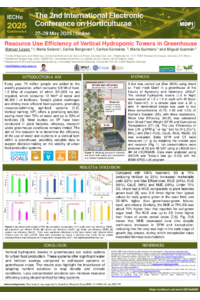
Resource efficiency is essential in today's approach to horticulture. The global problems of water scarcity, soil pollution, biodiversity loss, and rapid growth of the global population require increased food production with fewer resources. Resource efficiency is an index that allows us to define how much biomass an agri-food system is capable of producing per unit of the resource used. Closed hydroponic systems such as vertical towers (VHTs) have high resource use efficiency. In these systems, the water use efficiency (WUE) and the nutrient use efficiency (NUE) can be calculated in terms of the water lost through transpiration (T) and the concentration of the fertigation solution. The objective of this research was to determine the WUE and NUE for chard crops in VHT under greenhouse conditions and to evaluate its feasibility as an urban and peri-urban system for leafy vegetable production. The trials were carried out with chard in the late fall of 2024 in a tunnel-type greenhouse on the outskirts of the city of San Luis Potos. The VHTs were built with a 20 L square lower tank on which a cylindrical pipeline of 115 cm in diameter and 1.6 m in height was placed. Each pipe had 45 growing containers distributed on 15 levels of three containers spaced vertically 9 cm apart and a growing density of 25 plants·m-2. The experimental design was completely randomized with three treatments (75, 100, and 125% of Steiner's universal nutrient solution) and three replications. The transpiration (T) of the crop (recording weight loss in the water tank) and the fresh weight (FW) of the plants (nine plants per VT) were measured daily using a precision scale. An ANOVA and Tukey's test for mean differentiation were performed with p < 0.05. Significant differences were found between treatments for FW, T, and WUE, obtaining the best results at 75% using Steiner's nutrient solution. These results are equal to or superior to those obtained in horizontal hydroponic systems or vertical farms reported to date. The data show water savings of more than 70% and up to a 30% reduction in the fertilizers used compared to the conventional agricultural systems of chard crops. Vertical hydroponic towers in greenhouses are an optimal horticultural production system that uses resources very efficiently, so their implementation is feasible in areas where water scarcity is critical or areas that are densely populated.
Keywords
Urban agriculture
Vertical crops
Transpiration
WUE
NUE.
Poster
116240 2nd IECHo 2025.pdf
Warming and water deficit alter the sporoderm and starch content in the Stylosanthes capitata pollen grain
Application of Iron Oxide Nanoparticles and Indole-3-Acetic Acid in Synthetic Seed Technology: Effects on Chrysanthemum Generative Growth, Metabolism, and Genetic Stability