Event submissions
Published
This submission belongs to the session S4. Greenhouse and Indoor Farms of the event The 2nd International Electronic Conference on Horticulturae
Published date
23 May, 2025
Academic Editor
'%3e%3cpath%20d='M12.6657%2010.9104C12.4185%2010.325%2012.0599%209.79327%2011.6097%209.34482C11.1609%208.89508%2010.6293%208.5365%2010.0442%208.28888C10.0389%208.28626%2010.0337%208.28495%2010.0285%208.28233C10.8446%207.69279%2011.3752%206.73249%2011.3752%205.64904C11.3752%203.8542%209.92103%202.39999%208.1262%202.39999C6.33136%202.39999%204.87715%203.8542%204.87715%205.64904C4.87715%206.73249%205.40774%207.69279%206.22393%208.28364C6.21869%208.28626%206.21345%208.28757%206.20821%208.29019C5.62129%208.5378%205.09463%208.89284%204.64265%209.34613C4.1929%209.79493%203.83432%2010.3266%203.58671%2010.9117C3.34345%2011.4845%203.21226%2012.0987%203.20023%2012.7209C3.19988%2012.7349%203.20233%2012.7488%203.20744%2012.7619C3.21255%2012.7749%203.22022%2012.7867%203.22998%2012.7968C3.23975%2012.8068%203.25142%2012.8147%203.26431%2012.8202C3.2772%2012.8256%203.29105%2012.8284%203.30504%2012.8284H4.09109C4.14874%2012.8284%204.19459%2012.7825%204.1959%2012.7262C4.2221%2011.7148%204.62823%2010.7676%205.34617%2010.0497C6.08899%209.30683%207.0755%208.89808%208.1262%208.89808C9.17689%208.89808%2010.1634%209.30683%2010.9062%2010.0497C11.6242%2010.7676%2012.0303%2011.7148%2012.0565%2012.7262C12.0578%2012.7838%2012.1037%2012.8284%2012.1613%2012.8284H12.9474C12.9613%2012.8284%2012.9752%2012.8256%2012.9881%2012.8202C13.001%2012.8147%2013.0126%2012.8068%2013.0224%2012.7968C13.0322%2012.7867%2013.0398%2012.7749%2013.0449%2012.7619C13.0501%2012.7488%2013.0525%2012.7349%2013.0522%2012.7209C13.0391%2012.0947%2012.9094%2011.4855%2012.6657%2010.9104ZM8.1262%207.9024C7.52486%207.9024%206.9589%207.6679%206.53312%207.24211C6.10733%206.81633%205.87283%206.25037%205.87283%205.64904C5.87283%205.0477%206.10733%204.48174%206.53312%204.05596C6.9589%203.63018%207.52486%203.39567%208.1262%203.39567C8.72753%203.39567%209.29349%203.63018%209.71927%204.05596C10.1451%204.48174%2010.3796%205.0477%2010.3796%205.64904C10.3796%206.25037%2010.1451%206.81633%209.71927%207.24211C9.29349%207.6679%208.72753%207.9024%208.1262%207.9024Z'%20fill='%235D1EE1'/%3e%3c/g%3e%3c/svg%3e) Konstantina Argyropoulou
Konstantina ArgyropoulouCitation
Alessandro Esposito, Alessandro Miceli, Alessandra Moncada, Filippo Vetrano, Citrulline spray treatments affect tomato and lettuce transplant production, in Proceedings of The 2nd International Electronic Conference on Horticulturae, 27 May–29 May 2025, MDPI: Basel, Switzerland
Share
Email
Facebook
Twitter
LinkedIn
Citrulline spray treatments affect tomato and lettuce transplant production
'%3e%3cpath%20d='M12.6647%2010.9104C12.4176%2010.325%2012.0589%209.7933%2011.6088%209.34485C11.16%208.89511%2010.6283%208.53653%2010.0432%208.28891C10.038%208.28629%2010.0327%208.28498%2010.0275%208.28236C10.8437%207.69282%2011.3743%206.73252%2011.3743%205.64907C11.3743%203.85423%209.92005%202.40002%208.12522%202.40002C6.33038%202.40002%204.87618%203.85423%204.87618%205.64907C4.87618%206.73252%205.40677%207.69282%206.22296%208.28367C6.21772%208.28629%206.21248%208.2876%206.20724%208.29022C5.62031%208.53783%205.09365%208.89287%204.64167%209.34616C4.19192%209.79496%203.83334%2010.3266%203.58573%2010.9117C3.34247%2011.4846%203.21128%2012.0987%203.19925%2012.721C3.1989%2012.735%203.20135%2012.7489%203.20646%2012.7619C3.21157%2012.7749%203.21924%2012.7868%203.22901%2012.7968C3.23877%2012.8068%203.25045%2012.8148%203.26334%2012.8202C3.27623%2012.8256%203.29007%2012.8284%203.30406%2012.8284H4.09012C4.14776%2012.8284%204.19362%2012.7825%204.19493%2012.7262C4.22113%2011.7148%204.62726%2010.7676%205.34519%2010.0497C6.08802%209.30686%207.07452%208.89811%208.12522%208.89811C9.17592%208.89811%2010.1624%209.30686%2010.9052%2010.0497C11.6232%2010.7676%2012.0293%2011.7148%2012.0555%2012.7262C12.0568%2012.7839%2012.1027%2012.8284%2012.1603%2012.8284H12.9464C12.9604%2012.8284%2012.9742%2012.8256%2012.9871%2012.8202C13%2012.8148%2013.0117%2012.8068%2013.0214%2012.7968C13.0312%2012.7868%2013.0389%2012.7749%2013.044%2012.7619C13.0491%2012.7489%2013.0515%2012.735%2013.0512%2012.721C13.0381%2012.0947%2012.9084%2011.4856%2012.6647%2010.9104ZM8.12522%207.90243C7.52388%207.90243%206.95792%207.66793%206.53214%207.24215C6.10636%206.81636%205.87185%206.2504%205.87185%205.64907C5.87185%205.04773%206.10636%204.48177%206.53214%204.05599C6.95792%203.63021%207.52388%203.3957%208.12522%203.3957C8.72655%203.3957%209.29252%203.63021%209.7183%204.05599C10.1441%204.48177%2010.3786%205.04773%2010.3786%205.64907C10.3786%206.2504%2010.1441%206.81636%209.7183%207.24215C9.29252%207.66793%208.72655%207.90243%208.12522%207.90243Z'%20fill='%235D1EE1'/%3e%3c/g%3e%3c/svg%3e)
Alessandro Esposito 1
Alessandro Miceli 2
Alessandra Moncada 2
Filippo Vetrano 2
1. Dipartimento Scienze Agrarie, Alimentari e Forestali, Università di Palermo
2. Dipartimento Scienze Agrarie, Alimentari e Forestali, Università di Palermo, Viale delle Scienze 4, 90128 Palermo, Italy
Abstract
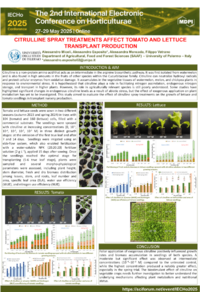
Citrulline is a non-protein amino acid intermediate in the arginine biosynthetic pathway. It has been observed to accumulate in plants such as watermelon, melon, and chickpea under environmental stress. It has also been demonstrated that this amino acid has the capacity to neutralise hydroxyl radicals and protect cellular enzymes from oxidative damage. It has been hypothesised that endogenous citrulline plays a role in facilitating nitrogen assimilation, deposition, and transport in higher plants. However, there is limited information on the effect of exogenous citrulline supplementation on crop plants. This study aimed to evaluate the effect of citrulline spray treatments on the growth of lettuce and tomato seedlings in transplant nursery production. The experiment was repeated over two production cycles during autumn and spring. The seeds of lettuce and tomato were sown in trays filled with a commercial substrate, and the plants were then grown in a greenhouse with an ebb-and-flow system supplementing a complete nutrient solution. The seedlings were sprayed with citrulline at increasing concentrations (0, 10-5, 10-4, 10-3, 10-2, 10-1 M) in three distinct growth stages: at the emission of the first true leaf and after 7 and 14 days. Some morpho-physiological and chemical parameters (height, stem size, fresh and dry biomass, number of leaves, leaf area, SLA, WUE, NUE) were evaluated when the seedlings were ready for transplant (5-6-true-leaf stage). The supply of exogenous citrulline via foliar application had a positive effect on the growth rates and biomass accumulation of the seedlings of both species, with some differences according to the citrulline concentration and growth season. The intermediate doses of citrulline (10-4-10-3 M) produced a moderate positive effect on these parameters compared with the untreated control (0 M), whereas the highest growth-promoting effect was found at the highest dose of citrulline (10-1 M), especially during spring. Citrulline also positively affected the contents of mineral elements in the vegetable seedlings. Citrulline foliar treatments were found to exert a growth-promoting effect on tomato and lettuce plants, but further studies are necessary to fully understand its effect on plant growth and metabolism.
Keywords
Biostimulant
Citrulline
Foliar treatment
Greenhouse
Transplant nursery production
Poster
Poster IECHo 2025 CITRULLINE SPRAY TREATMENTS AFFECT TOMATO AND LETTUCE TRANSPLANT PRODUCTION.pdf
Suitability of Apium graveolens var. secalinum for hydroponic cultivation in baby leaf production.
Volatile compounds released by chocolate mint (Mentha × piperita var. chocolate) leaves after different post-harvest procedures