Event submissions
Published
This submission belongs to the session S5. Postharvest Physiology and Technology of the event The 2nd International Electronic Conference on Horticulturae
Published date
23 May, 2025
Academic Editor
'%3e%3cpath%20d='M12.6657%2010.9104C12.4185%2010.325%2012.0599%209.79327%2011.6097%209.34482C11.1609%208.89508%2010.6293%208.5365%2010.0442%208.28888C10.0389%208.28626%2010.0337%208.28495%2010.0285%208.28233C10.8446%207.69279%2011.3752%206.73249%2011.3752%205.64904C11.3752%203.8542%209.92103%202.39999%208.1262%202.39999C6.33136%202.39999%204.87715%203.8542%204.87715%205.64904C4.87715%206.73249%205.40774%207.69279%206.22393%208.28364C6.21869%208.28626%206.21345%208.28757%206.20821%208.29019C5.62129%208.5378%205.09463%208.89284%204.64265%209.34613C4.1929%209.79493%203.83432%2010.3266%203.58671%2010.9117C3.34345%2011.4845%203.21226%2012.0987%203.20023%2012.7209C3.19988%2012.7349%203.20233%2012.7488%203.20744%2012.7619C3.21255%2012.7749%203.22022%2012.7867%203.22998%2012.7968C3.23975%2012.8068%203.25142%2012.8147%203.26431%2012.8202C3.2772%2012.8256%203.29105%2012.8284%203.30504%2012.8284H4.09109C4.14874%2012.8284%204.19459%2012.7825%204.1959%2012.7262C4.2221%2011.7148%204.62823%2010.7676%205.34617%2010.0497C6.08899%209.30683%207.0755%208.89808%208.1262%208.89808C9.17689%208.89808%2010.1634%209.30683%2010.9062%2010.0497C11.6242%2010.7676%2012.0303%2011.7148%2012.0565%2012.7262C12.0578%2012.7838%2012.1037%2012.8284%2012.1613%2012.8284H12.9474C12.9613%2012.8284%2012.9752%2012.8256%2012.9881%2012.8202C13.001%2012.8147%2013.0126%2012.8068%2013.0224%2012.7968C13.0322%2012.7867%2013.0398%2012.7749%2013.0449%2012.7619C13.0501%2012.7488%2013.0525%2012.7349%2013.0522%2012.7209C13.0391%2012.0947%2012.9094%2011.4855%2012.6657%2010.9104ZM8.1262%207.9024C7.52486%207.9024%206.9589%207.6679%206.53312%207.24211C6.10733%206.81633%205.87283%206.25037%205.87283%205.64904C5.87283%205.0477%206.10733%204.48174%206.53312%204.05596C6.9589%203.63018%207.52486%203.39567%208.1262%203.39567C8.72753%203.39567%209.29349%203.63018%209.71927%204.05596C10.1451%204.48174%2010.3796%205.0477%2010.3796%205.64904C10.3796%206.25037%2010.1451%206.81633%209.71927%207.24211C9.29349%207.6679%208.72753%207.9024%208.1262%207.9024Z'%20fill='%235D1EE1'/%3e%3c/g%3e%3c/svg%3e) Isabel Lara
Isabel LaraCitation
Alessandro Frontini, Carmine Negro, Andrea Luvisi, Samar Min Allah, Marina De Filippi, Luigi De Bellis, Volatile compounds released by chocolate mint (Mentha × piperita var. chocolate) leaves after different post-harvest procedures, in Proceedings of The 2nd International Electronic Conference on Horticulturae, 27 May–29 May 2025, MDPI: Basel, Switzerland
Share
Email
Facebook
Twitter
LinkedIn
Volatile compounds released by chocolate mint (Mentha × piperita var. chocolate) leaves after different post-harvest procedures
'%3e%3cpath%20d='M12.6647%2010.9104C12.4176%2010.325%2012.0589%209.7933%2011.6088%209.34485C11.16%208.89511%2010.6283%208.53653%2010.0432%208.28891C10.038%208.28629%2010.0327%208.28498%2010.0275%208.28236C10.8437%207.69282%2011.3743%206.73252%2011.3743%205.64907C11.3743%203.85423%209.92005%202.40002%208.12522%202.40002C6.33038%202.40002%204.87618%203.85423%204.87618%205.64907C4.87618%206.73252%205.40677%207.69282%206.22296%208.28367C6.21772%208.28629%206.21248%208.2876%206.20724%208.29022C5.62031%208.53783%205.09365%208.89287%204.64167%209.34616C4.19192%209.79496%203.83334%2010.3266%203.58573%2010.9117C3.34247%2011.4846%203.21128%2012.0987%203.19925%2012.721C3.1989%2012.735%203.20135%2012.7489%203.20646%2012.7619C3.21157%2012.7749%203.21924%2012.7868%203.22901%2012.7968C3.23877%2012.8068%203.25045%2012.8148%203.26334%2012.8202C3.27623%2012.8256%203.29007%2012.8284%203.30406%2012.8284H4.09012C4.14776%2012.8284%204.19362%2012.7825%204.19493%2012.7262C4.22113%2011.7148%204.62726%2010.7676%205.34519%2010.0497C6.08802%209.30686%207.07452%208.89811%208.12522%208.89811C9.17592%208.89811%2010.1624%209.30686%2010.9052%2010.0497C11.6232%2010.7676%2012.0293%2011.7148%2012.0555%2012.7262C12.0568%2012.7839%2012.1027%2012.8284%2012.1603%2012.8284H12.9464C12.9604%2012.8284%2012.9742%2012.8256%2012.9871%2012.8202C13%2012.8148%2013.0117%2012.8068%2013.0214%2012.7968C13.0312%2012.7868%2013.0389%2012.7749%2013.044%2012.7619C13.0491%2012.7489%2013.0515%2012.735%2013.0512%2012.721C13.0381%2012.0947%2012.9084%2011.4856%2012.6647%2010.9104ZM8.12522%207.90243C7.52388%207.90243%206.95792%207.66793%206.53214%207.24215C6.10636%206.81636%205.87185%206.2504%205.87185%205.64907C5.87185%205.04773%206.10636%204.48177%206.53214%204.05599C6.95792%203.63021%207.52388%203.3957%208.12522%203.3957C8.72655%203.3957%209.29252%203.63021%209.7183%204.05599C10.1441%204.48177%2010.3786%205.04773%2010.3786%205.64907C10.3786%206.2504%2010.1441%206.81636%209.7183%207.24215C9.29252%207.66793%208.72655%207.90243%208.12522%207.90243Z'%20fill='%235D1EE1'/%3e%3c/g%3e%3c/svg%3e)
Alessandro Frontini 1

Carmine Negro 1

Andrea Luvisi 1
Samar Min Allah 1
Marina De Filippi 1

Luigi De Bellis 1
1. Department of Biological and Environmental Sciences and Technologies (DiSTeBA), Salento University, Via Prov.le Lecce-Monteroni, 73100 Lecce, Italy
Abstract
Background
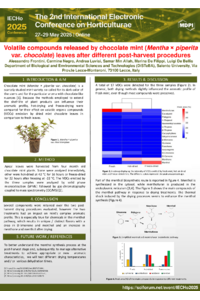
Chocolate mint (Mentha × piperita var. chocolate) is a peppermint variety which owes its name to a chocolate-like scent and dark-red staining of the stems. It is a medicinal and ornamental plant, spread throughout the world due to nursery activities. Chocolate mint essential oil was previously characterized, while the aroma of the whole leaves has been scarcely studied. Indeed, though essential oils are commonly used in cosmetics and perfumery, whole mint leaves are broadly consumed as food products.
Goals
Fresh mint leaves were compared with hot and freeze-dried leaves with the aim of observing the differences between the volatile organic compounds (VOCs) of mint leaves subjected to different post-harvest treatments, and assessing the best method to preserve the quality of the final product.
Methodology
Chocolate mint plants (Mentha × piperita var. chocolate) were grown in 10 cm pots at the botanical garden of the University of Salento. After 4 months from planting, 3-4 apical leaves were harvested from plants and mixed in stock. Some of them were analyzed immediately (fresh sample), while others were hot-dried at 42 °C for 16 hours (hot-dried sample) or freeze-dried for 22 hours after freezing at -22 °C for two hours (freeze-dried sample). The three samples were sealed in a 20 ml vial, and a solid phase microextraction (SPME) fiber was exposed to headspace to capture the emitted VOCs. The compounds were then analyzed by gas-chromatography coupled with mass spectrometry (GC/MS).
Results
A total of 17 VOCs were detected among the three samples, with monoterpenes being the most represented category. Most of the compounds found in fresh leaves were preserved after drying, while, interestingly, some compounds occurring in dried leaves were scarcely emitted by fresh leaves. Some differences were also observed for compounds included in the menthol synthesis pathway.
Conclusions
Both hot-drying and freeze-drying preserved the characteristic aroma of chocolate peppermint leaves, proving to be effective methods for post-harvest treatments, allowing for long-term product storage. Furthermore, the data demonstrated a variable presence of chemicals part of the menthol pathway as a result of the various treatments.
Keywords
Volatile organic compounds
Peppermint
Post-harvest technology
Poster
Poster IECHo 2025.pdf
Citrulline spray treatments affect tomato and lettuce transplant production
Photosynthetic damage in citrus leaves under freezing stress revealed by OJIP chlorophyll fluorescence kinetics