Event submissions
Published
This submission belongs to the session S4. Greenhouse and Indoor Farms of the event The 2nd International Electronic Conference on Horticulturae
Published date
23 May, 2025
Academic Editor
'%3e%3cpath%20d='M12.6657%2010.9104C12.4185%2010.325%2012.0599%209.79327%2011.6097%209.34482C11.1609%208.89508%2010.6293%208.5365%2010.0442%208.28888C10.0389%208.28626%2010.0337%208.28495%2010.0285%208.28233C10.8446%207.69279%2011.3752%206.73249%2011.3752%205.64904C11.3752%203.8542%209.92103%202.39999%208.1262%202.39999C6.33136%202.39999%204.87715%203.8542%204.87715%205.64904C4.87715%206.73249%205.40774%207.69279%206.22393%208.28364C6.21869%208.28626%206.21345%208.28757%206.20821%208.29019C5.62129%208.5378%205.09463%208.89284%204.64265%209.34613C4.1929%209.79493%203.83432%2010.3266%203.58671%2010.9117C3.34345%2011.4845%203.21226%2012.0987%203.20023%2012.7209C3.19988%2012.7349%203.20233%2012.7488%203.20744%2012.7619C3.21255%2012.7749%203.22022%2012.7867%203.22998%2012.7968C3.23975%2012.8068%203.25142%2012.8147%203.26431%2012.8202C3.2772%2012.8256%203.29105%2012.8284%203.30504%2012.8284H4.09109C4.14874%2012.8284%204.19459%2012.7825%204.1959%2012.7262C4.2221%2011.7148%204.62823%2010.7676%205.34617%2010.0497C6.08899%209.30683%207.0755%208.89808%208.1262%208.89808C9.17689%208.89808%2010.1634%209.30683%2010.9062%2010.0497C11.6242%2010.7676%2012.0303%2011.7148%2012.0565%2012.7262C12.0578%2012.7838%2012.1037%2012.8284%2012.1613%2012.8284H12.9474C12.9613%2012.8284%2012.9752%2012.8256%2012.9881%2012.8202C13.001%2012.8147%2013.0126%2012.8068%2013.0224%2012.7968C13.0322%2012.7867%2013.0398%2012.7749%2013.0449%2012.7619C13.0501%2012.7488%2013.0525%2012.7349%2013.0522%2012.7209C13.0391%2012.0947%2012.9094%2011.4855%2012.6657%2010.9104ZM8.1262%207.9024C7.52486%207.9024%206.9589%207.6679%206.53312%207.24211C6.10733%206.81633%205.87283%206.25037%205.87283%205.64904C5.87283%205.0477%206.10733%204.48174%206.53312%204.05596C6.9589%203.63018%207.52486%203.39567%208.1262%203.39567C8.72753%203.39567%209.29349%203.63018%209.71927%204.05596C10.1451%204.48174%2010.3796%205.0477%2010.3796%205.64904C10.3796%206.25037%2010.1451%206.81633%209.71927%207.24211C9.29349%207.6679%208.72753%207.9024%208.1262%207.9024Z'%20fill='%235D1EE1'/%3e%3c/g%3e%3c/svg%3e) Konstantina Argyropoulou
Konstantina ArgyropoulouCitation
Emilio Martín-Expósito, Montserrat Cano, María Medrán, María Esmeralda Delgado, Fernando Pascual, María del Carmen García-García, IMPACT OF REDUCED FERTIGATION ON FIG YIELD AND QUALITY, in Proceedings of The 2nd International Electronic Conference on Horticulturae, 27 May–29 May 2025, MDPI: Basel, Switzerland
Share
Email
Facebook
Twitter
LinkedIn
IMPACT OF REDUCED FERTIGATION ON FIG YIELD AND QUALITY
'%3e%3cpath%20d='M12.6647%2010.9104C12.4176%2010.325%2012.0589%209.7933%2011.6088%209.34485C11.16%208.89511%2010.6283%208.53653%2010.0432%208.28891C10.038%208.28629%2010.0327%208.28498%2010.0275%208.28236C10.8437%207.69282%2011.3743%206.73252%2011.3743%205.64907C11.3743%203.85423%209.92005%202.40002%208.12522%202.40002C6.33038%202.40002%204.87618%203.85423%204.87618%205.64907C4.87618%206.73252%205.40677%207.69282%206.22296%208.28367C6.21772%208.28629%206.21248%208.2876%206.20724%208.29022C5.62031%208.53783%205.09365%208.89287%204.64167%209.34616C4.19192%209.79496%203.83334%2010.3266%203.58573%2010.9117C3.34247%2011.4846%203.21128%2012.0987%203.19925%2012.721C3.1989%2012.735%203.20135%2012.7489%203.20646%2012.7619C3.21157%2012.7749%203.21924%2012.7868%203.22901%2012.7968C3.23877%2012.8068%203.25045%2012.8148%203.26334%2012.8202C3.27623%2012.8256%203.29007%2012.8284%203.30406%2012.8284H4.09012C4.14776%2012.8284%204.19362%2012.7825%204.19493%2012.7262C4.22113%2011.7148%204.62726%2010.7676%205.34519%2010.0497C6.08802%209.30686%207.07452%208.89811%208.12522%208.89811C9.17592%208.89811%2010.1624%209.30686%2010.9052%2010.0497C11.6232%2010.7676%2012.0293%2011.7148%2012.0555%2012.7262C12.0568%2012.7839%2012.1027%2012.8284%2012.1603%2012.8284H12.9464C12.9604%2012.8284%2012.9742%2012.8256%2012.9871%2012.8202C13%2012.8148%2013.0117%2012.8068%2013.0214%2012.7968C13.0312%2012.7868%2013.0389%2012.7749%2013.044%2012.7619C13.0491%2012.7489%2013.0515%2012.735%2013.0512%2012.721C13.0381%2012.0947%2012.9084%2011.4856%2012.6647%2010.9104ZM8.12522%207.90243C7.52388%207.90243%206.95792%207.66793%206.53214%207.24215C6.10636%206.81636%205.87185%206.2504%205.87185%205.64907C5.87185%205.04773%206.10636%204.48177%206.53214%204.05599C6.95792%203.63021%207.52388%203.3957%208.12522%203.3957C8.72655%203.3957%209.29252%203.63021%209.7183%204.05599C10.1441%204.48177%2010.3786%205.04773%2010.3786%205.64907C10.3786%206.2504%2010.1441%206.81636%209.7183%207.24215C9.29252%207.66793%208.72655%207.90243%208.12522%207.90243Z'%20fill='%235D1EE1'/%3e%3c/g%3e%3c/svg%3e)
Emilio Martín-Expósito 1
Montserrat Cano 1
María Medrán 1
María Esmeralda Delgado 1
Fernando Pascual 1
María del Carmen García-García 1
1. IFAPA La Mojonera (Almería). Andalusian Institute for Agricultural, Fisheries, Food and Organic Production Research and Training. CAPADR, Regional Government of Andalusia.
Abstract
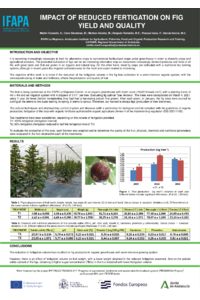
It is becoming increasingly necessary to look for alternative crops to conventional horticultural crops in greenhouses in order to diversify crops and agricultural products. The protected cultivation of figs can be an interesting alternative crop as consumers increasingly demand products and fruits of all kinds, which have great taste and are grown in an organic and natural way. In addition, demand is increasing in the United States and Europe for fresh, dried and frozen figs. On the other hand, most fig crops are cultivated with a traditional dry farming system, although in recent years the irrigated cultivation area for the fresh and export market is increasing. In recent years, the IFAPA La Mojonera Center has been working on the development of the protected cultivation of fig trees, achieving very good yields. However, the tests carried out in the intensive cultivation of fig trees in greenhouses seem to determine that water consumption is high.
The objective of this work is to find out if the reduction in fertigation volume in fig tree cultivation in a semi-intensive organic system, with consequent savings in water and fertilizers, affects the production and quality of the fruit. For this purpose, the cultivar “San Antonio” was tested in an organic greenhouse with mesh cover, with a planting frame of 4m x 4m and an irrigation system with four drippers of 3 l h-1 per tree. Two treatments were established, depending on the volume of fertigation provided, with one treatment fertigating for half the time of the other. To evaluate the production of the crop, each harvest was weighed and to determine the quality of the fruit, morphological parameters and chemical and nutritional parameters such as soluble solids, pH, citric acid, vitamin C, carotenes and phenolics were evaluated in the fruit obtained in each of the treatments.
In our growing conditions, the reduction in fertigation volume had no effect on fig production; however, it did affect the soluble solids of the figs, with a higher sugar concentration observed in fruits obtained with a lower fertigation volume.
Keywords
Ficus carica
mesh greenhouse
organic
productivity
quality.
Poster
Poster IECHo2025. Emilio Martín. Sciforum-116432.pdf
Analysis of Sustainable Practices in Greenhouse Horticulture in Almeria (Spain)
Traditional fig trees cultivated in a mesh greenhouse: characterization of five varieties