Event submissions
Published
This submission belongs to the session S2. Abiotic and Biotic Stress of the event The 2nd International Electronic Conference on Horticulturae
Published date
23 May, 2025
Academic Editor
'%3e%3cpath%20d='M12.6657%2010.9104C12.4185%2010.325%2012.0599%209.79327%2011.6097%209.34482C11.1609%208.89508%2010.6293%208.5365%2010.0442%208.28888C10.0389%208.28626%2010.0337%208.28495%2010.0285%208.28233C10.8446%207.69279%2011.3752%206.73249%2011.3752%205.64904C11.3752%203.8542%209.92103%202.39999%208.1262%202.39999C6.33136%202.39999%204.87715%203.8542%204.87715%205.64904C4.87715%206.73249%205.40774%207.69279%206.22393%208.28364C6.21869%208.28626%206.21345%208.28757%206.20821%208.29019C5.62129%208.5378%205.09463%208.89284%204.64265%209.34613C4.1929%209.79493%203.83432%2010.3266%203.58671%2010.9117C3.34345%2011.4845%203.21226%2012.0987%203.20023%2012.7209C3.19988%2012.7349%203.20233%2012.7488%203.20744%2012.7619C3.21255%2012.7749%203.22022%2012.7867%203.22998%2012.7968C3.23975%2012.8068%203.25142%2012.8147%203.26431%2012.8202C3.2772%2012.8256%203.29105%2012.8284%203.30504%2012.8284H4.09109C4.14874%2012.8284%204.19459%2012.7825%204.1959%2012.7262C4.2221%2011.7148%204.62823%2010.7676%205.34617%2010.0497C6.08899%209.30683%207.0755%208.89808%208.1262%208.89808C9.17689%208.89808%2010.1634%209.30683%2010.9062%2010.0497C11.6242%2010.7676%2012.0303%2011.7148%2012.0565%2012.7262C12.0578%2012.7838%2012.1037%2012.8284%2012.1613%2012.8284H12.9474C12.9613%2012.8284%2012.9752%2012.8256%2012.9881%2012.8202C13.001%2012.8147%2013.0126%2012.8068%2013.0224%2012.7968C13.0322%2012.7867%2013.0398%2012.7749%2013.0449%2012.7619C13.0501%2012.7488%2013.0525%2012.7349%2013.0522%2012.7209C13.0391%2012.0947%2012.9094%2011.4855%2012.6657%2010.9104ZM8.1262%207.9024C7.52486%207.9024%206.9589%207.6679%206.53312%207.24211C6.10733%206.81633%205.87283%206.25037%205.87283%205.64904C5.87283%205.0477%206.10733%204.48174%206.53312%204.05596C6.9589%203.63018%207.52486%203.39567%208.1262%203.39567C8.72753%203.39567%209.29349%203.63018%209.71927%204.05596C10.1451%204.48174%2010.3796%205.0477%2010.3796%205.64904C10.3796%206.25037%2010.1451%206.81633%209.71927%207.24211C9.29349%207.6679%208.72753%207.9024%208.1262%207.9024Z'%20fill='%235D1EE1'/%3e%3c/g%3e%3c/svg%3e) Antonio Ferrante
Antonio FerranteCitation
Eva Sánchez-Hernández, Rubén Celada-Caminero, Alberto Santiago-Aliste, Vicente González-García, Jesús Martín-Gil, José Luis Marcos-Robles, Pablo Martín-Ramos, Smart Delivery of Biorationals: A Novel Strategy Against Root Crop Pathogens, in Proceedings of The 2nd International Electronic Conference on Horticulturae, 27 May–29 May 2025, MDPI: Basel, Switzerland
Share
Email
Facebook
Twitter
LinkedIn
Smart Delivery of Biorationals: A Novel Strategy Against Root Crop Pathogens

Eva Sánchez-Hernández 1
'%3e%3cpath%20d='M12.6647%2010.9104C12.4176%2010.325%2012.0589%209.7933%2011.6088%209.34485C11.16%208.89511%2010.6283%208.53653%2010.0432%208.28891C10.038%208.28629%2010.0327%208.28498%2010.0275%208.28236C10.8437%207.69282%2011.3743%206.73252%2011.3743%205.64907C11.3743%203.85423%209.92005%202.40002%208.12522%202.40002C6.33038%202.40002%204.87618%203.85423%204.87618%205.64907C4.87618%206.73252%205.40677%207.69282%206.22296%208.28367C6.21772%208.28629%206.21248%208.2876%206.20724%208.29022C5.62031%208.53783%205.09365%208.89287%204.64167%209.34616C4.19192%209.79496%203.83334%2010.3266%203.58573%2010.9117C3.34247%2011.4846%203.21128%2012.0987%203.19925%2012.721C3.1989%2012.735%203.20135%2012.7489%203.20646%2012.7619C3.21157%2012.7749%203.21924%2012.7868%203.22901%2012.7968C3.23877%2012.8068%203.25045%2012.8148%203.26334%2012.8202C3.27623%2012.8256%203.29007%2012.8284%203.30406%2012.8284H4.09012C4.14776%2012.8284%204.19362%2012.7825%204.19493%2012.7262C4.22113%2011.7148%204.62726%2010.7676%205.34519%2010.0497C6.08802%209.30686%207.07452%208.89811%208.12522%208.89811C9.17592%208.89811%2010.1624%209.30686%2010.9052%2010.0497C11.6232%2010.7676%2012.0293%2011.7148%2012.0555%2012.7262C12.0568%2012.7839%2012.1027%2012.8284%2012.1603%2012.8284H12.9464C12.9604%2012.8284%2012.9742%2012.8256%2012.9871%2012.8202C13%2012.8148%2013.0117%2012.8068%2013.0214%2012.7968C13.0312%2012.7868%2013.0389%2012.7749%2013.044%2012.7619C13.0491%2012.7489%2013.0515%2012.735%2013.0512%2012.721C13.0381%2012.0947%2012.9084%2011.4856%2012.6647%2010.9104ZM8.12522%207.90243C7.52388%207.90243%206.95792%207.66793%206.53214%207.24215C6.10636%206.81636%205.87185%206.2504%205.87185%205.64907C5.87185%205.04773%206.10636%204.48177%206.53214%204.05599C6.95792%203.63021%207.52388%203.3957%208.12522%203.3957C8.72655%203.3957%209.29252%203.63021%209.7183%204.05599C10.1441%204.48177%2010.3786%205.04773%2010.3786%205.64907C10.3786%206.2504%2010.1441%206.81636%209.7183%207.24215C9.29252%207.66793%208.72655%207.90243%208.12522%207.90243Z'%20fill='%235D1EE1'/%3e%3c/g%3e%3c/svg%3e)
Rubén Celada-Caminero 1,2
Alberto Santiago-Aliste 3
Vicente González-García 4

Jesús Martín-Gil 1
José Luis Marcos-Robles 5

Pablo Martín-Ramos 1
1. Department of Agricultural and Forestry Engineering, ETSIIAA, University of Valladolid, Avenida de Madrid 44, 34004 Palencia, Spain
2. AIMCRA, Association for the Improvement of Sugar Beet Cultivation, Calle de Villabañez 201, 47017 Valladolid, Spain
3. Department of Construction and Agronomy, E. Politécnica Superior de Zamora, University of Salamanca, Av. de Requejo 33, 49029 Zamora, Spain
4. Biopesticides Group, Instituto de Ciencias Agrarias-CSIC, C/ Serrano 115 dpdo, 28006 Madrid, Spain
5. Department of Materials Science and Metallurgical Engineering, Graphic Engineering, Cartographic Engineering, Geodesy and Photogrammetry, Mechanical Engineering, and Manufacturing Process Engineering, ETSIIAA, University of Valladolid, Avenida de Madrid 4
Abstract
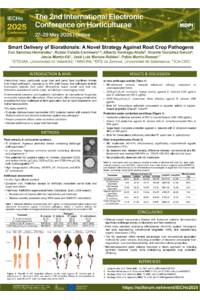
Background/Introduction: Sustainable disease management in horticultural crops, particularly root vegetables, faces significant challenges due to the dependence on synthetic fungicides. Nanotechnology presents promising applications in agriculture, offering solutions to increase crop production while reducing environmental impact. Nanocarriers (NCs) enable the efficient transport of biologically active molecules, minimizing the required amount of bioactive compounds and allowing for controlled release over time. However, the integration of biorational products with nanotechnology for root crop protection remains largely unexplored.
Goals: This study aimed to develop and evaluate chitosan-based NCs loaded with biorational compounds from Dyer's madder (Rubia tinctorum L.) and cat's claw (Uncaria tomentosa (Willd. ex Schult.) DC.) extracts for the sustainable control of major root crop pathogens.
Methodology: The research encompassed laboratory experiments, controlled environment in vivo tests, and field studies. In vitro experiments evaluated efficacy against Botrytis cinerea Pers., Cercospora beticola Sacc., Rhizoctonia solani J.G.Kühn, and Sclerotinia sclerotiorum (Lib.) de Bary. Artificial inoculation in vivo trials were conducted on sugar beet and carrot plants under controlled conditions. Field validation was performed during the 2024 growing season at AIMCRA's (Asociación de Investigación para la Mejora del Cultivo de la Remolacha Azucarera) testing plots in Villafranca de Duero (Valladolid, Spain), specifically focusing on Cercospora beticola control.
Results: Laboratory studies demonstrated significant mycelial growth inhibition, with effective concentrations ranging from 187.5 to 375 µg/mL for R. tinctorum-loaded NCs and 187.5 to 500 µg/mL for U. tomentosa-loaded NCs. Controlled environment trials achieved complete plant protection at doses between 187.5 and 500 µg/mL, varying by pathogen. Field trials showed superior control of C. beticola compared to other non-synthetic fungicides, with no observed phytotoxicity symptoms.
Conclusions: The developed biorational-loaded nanocarriers demonstrate significant potential as sustainable alternatives to conventional fungicides in root crop production. This approach offers an effective pathway for reducing synthetic chemical inputs while maintaining robust crop protection, particularly for sugar beet disease management.
Keywords
horticultural root crops
nanotechnology
natural products
sugar beet
carrot
Poster
sciforum-116350.pdf
Preharvest conditions for better postharvest apples
Yield components of sweet corn in greenhouse depending on the method of production and genotype