Event submissions
Published
This submission belongs to the session S2. Abiotic and Biotic Stress of the event The 2nd International Electronic Conference on Horticulturae
Published date
23 May, 2025
Academic Editor
'%3e%3cpath%20d='M12.6657%2010.9104C12.4185%2010.325%2012.0599%209.79327%2011.6097%209.34482C11.1609%208.89508%2010.6293%208.5365%2010.0442%208.28888C10.0389%208.28626%2010.0337%208.28495%2010.0285%208.28233C10.8446%207.69279%2011.3752%206.73249%2011.3752%205.64904C11.3752%203.8542%209.92103%202.39999%208.1262%202.39999C6.33136%202.39999%204.87715%203.8542%204.87715%205.64904C4.87715%206.73249%205.40774%207.69279%206.22393%208.28364C6.21869%208.28626%206.21345%208.28757%206.20821%208.29019C5.62129%208.5378%205.09463%208.89284%204.64265%209.34613C4.1929%209.79493%203.83432%2010.3266%203.58671%2010.9117C3.34345%2011.4845%203.21226%2012.0987%203.20023%2012.7209C3.19988%2012.7349%203.20233%2012.7488%203.20744%2012.7619C3.21255%2012.7749%203.22022%2012.7867%203.22998%2012.7968C3.23975%2012.8068%203.25142%2012.8147%203.26431%2012.8202C3.2772%2012.8256%203.29105%2012.8284%203.30504%2012.8284H4.09109C4.14874%2012.8284%204.19459%2012.7825%204.1959%2012.7262C4.2221%2011.7148%204.62823%2010.7676%205.34617%2010.0497C6.08899%209.30683%207.0755%208.89808%208.1262%208.89808C9.17689%208.89808%2010.1634%209.30683%2010.9062%2010.0497C11.6242%2010.7676%2012.0303%2011.7148%2012.0565%2012.7262C12.0578%2012.7838%2012.1037%2012.8284%2012.1613%2012.8284H12.9474C12.9613%2012.8284%2012.9752%2012.8256%2012.9881%2012.8202C13.001%2012.8147%2013.0126%2012.8068%2013.0224%2012.7968C13.0322%2012.7867%2013.0398%2012.7749%2013.0449%2012.7619C13.0501%2012.7488%2013.0525%2012.7349%2013.0522%2012.7209C13.0391%2012.0947%2012.9094%2011.4855%2012.6657%2010.9104ZM8.1262%207.9024C7.52486%207.9024%206.9589%207.6679%206.53312%207.24211C6.10733%206.81633%205.87283%206.25037%205.87283%205.64904C5.87283%205.0477%206.10733%204.48174%206.53312%204.05596C6.9589%203.63018%207.52486%203.39567%208.1262%203.39567C8.72753%203.39567%209.29349%203.63018%209.71927%204.05596C10.1451%204.48174%2010.3796%205.0477%2010.3796%205.64904C10.3796%206.25037%2010.1451%206.81633%209.71927%207.24211C9.29349%207.6679%208.72753%207.9024%208.1262%207.9024Z'%20fill='%235D1EE1'/%3e%3c/g%3e%3c/svg%3e) Gianfranco Romanazzi
Gianfranco RomanazziCitation
Letizia Scarabattoli, Giulia Franzoni, Antonio Ferrante, Giovanna Speranza, Effectiveness of a soy protein hydrolysate on lettuce growth and quality, in Proceedings of The 2nd International Electronic Conference on Horticulturae, 27 May–29 May 2025, MDPI: Basel, Switzerland
Share
Email
Facebook
Twitter
LinkedIn
Effectiveness of a soy protein hydrolysate on lettuce growth and quality
'%3e%3cpath%20d='M12.6647%2010.9104C12.4176%2010.325%2012.0589%209.7933%2011.6088%209.34485C11.16%208.89511%2010.6283%208.53653%2010.0432%208.28891C10.038%208.28629%2010.0327%208.28498%2010.0275%208.28236C10.8437%207.69282%2011.3743%206.73252%2011.3743%205.64907C11.3743%203.85423%209.92005%202.40002%208.12522%202.40002C6.33038%202.40002%204.87618%203.85423%204.87618%205.64907C4.87618%206.73252%205.40677%207.69282%206.22296%208.28367C6.21772%208.28629%206.21248%208.2876%206.20724%208.29022C5.62031%208.53783%205.09365%208.89287%204.64167%209.34616C4.19192%209.79496%203.83334%2010.3266%203.58573%2010.9117C3.34247%2011.4846%203.21128%2012.0987%203.19925%2012.721C3.1989%2012.735%203.20135%2012.7489%203.20646%2012.7619C3.21157%2012.7749%203.21924%2012.7868%203.22901%2012.7968C3.23877%2012.8068%203.25045%2012.8148%203.26334%2012.8202C3.27623%2012.8256%203.29007%2012.8284%203.30406%2012.8284H4.09012C4.14776%2012.8284%204.19362%2012.7825%204.19493%2012.7262C4.22113%2011.7148%204.62726%2010.7676%205.34519%2010.0497C6.08802%209.30686%207.07452%208.89811%208.12522%208.89811C9.17592%208.89811%2010.1624%209.30686%2010.9052%2010.0497C11.6232%2010.7676%2012.0293%2011.7148%2012.0555%2012.7262C12.0568%2012.7839%2012.1027%2012.8284%2012.1603%2012.8284H12.9464C12.9604%2012.8284%2012.9742%2012.8256%2012.9871%2012.8202C13%2012.8148%2013.0117%2012.8068%2013.0214%2012.7968C13.0312%2012.7868%2013.0389%2012.7749%2013.044%2012.7619C13.0491%2012.7489%2013.0515%2012.735%2013.0512%2012.721C13.0381%2012.0947%2012.9084%2011.4856%2012.6647%2010.9104ZM8.12522%207.90243C7.52388%207.90243%206.95792%207.66793%206.53214%207.24215C6.10636%206.81636%205.87185%206.2504%205.87185%205.64907C5.87185%205.04773%206.10636%204.48177%206.53214%204.05599C6.95792%203.63021%207.52388%203.3957%208.12522%203.3957C8.72655%203.3957%209.29252%203.63021%209.7183%204.05599C10.1441%204.48177%2010.3786%205.04773%2010.3786%205.64907C10.3786%206.2504%2010.1441%206.81636%209.7183%207.24215C9.29252%207.66793%208.72655%207.90243%208.12522%207.90243Z'%20fill='%235D1EE1'/%3e%3c/g%3e%3c/svg%3e)
Letizia Scarabattoli 1

Giulia Franzoni 2
Antonio Ferrante 3

Giovanna Speranza 1
1. Università degli Studi di Milano, Dipartimento di Chimica, Via Golgi 19, 20133, Milano
2. Università degli Studi di Milano, Dipartimento di Scienze Agrarie e Ambientali, Via Celoria 2, 20133, Milano
3. Sant'Anna, School of Advanced Studies, Pisa, 56127 Pisa PI, Italy
Abstract
Background/Introduction
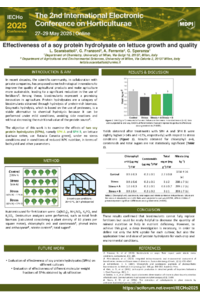
In recent decades, the scientific community, in collaboration with private companies, has proposed some technological innovations to improve the quality of agricultural products and make agriculture more sustainable, leading to a significant reduction in the use of fertilizers. Among these, biostimulants represent a promising innovation in agriculture. Protein hydrolysates are a category of biostimulants obtained through the hydrolysis of protein-rich biomass. Enzymatic hydrolysis, which is based on the use of proteases, is a viable alternative to chemical hydrolysis because it can be performed under mild conditions, avoiding side reactions without decreasing the nutritional value of the protein source.
Goals
The objective of this work is to examine the effects of two soy protein hydrolysates, namely SPH A and SPH B, on lettuce (Lactuca sativa, var. Batavia Canasta green) under no stress and in conditions of reduced NPK nutrition, in terms of both yield and other parameters.
Methodology
Lettuce plants were grown in an experimental greenhouse, under monitored conditions (25 ± 3 °C, 16 h photoperiod). The first group of plants (thesis 1, standard fertilization, 5 replicates) received complete fertilization (100% N). In the second group, mineral fertilization was reduced to 50% N (thesis 2, reduced fertilization, 5 replicates); the third and fourth groups of plants with 50% N fertilization received SPH A and SPH B, respectively. The nutrients used for fertilization were as follows: Ca(NO3)2, NH4NO3, K3PO4 and K2SO4. Destructive analyses were performed, such as total fresh biomass, chlorophylls a+b and carotenoids, the phenol index and anthocyanin, nitrate content, and total and reducing sugars.
Results
Significant differences between the control and stress plants were observed in lettuce yield. Moreover, yields obtained after treatments with SPH A and SPH B were slightly higher (+14% and +17%, respectively) with respect to the stress conditions. The results obtained for chlorophyll a+b, carotenoids and total sugar were not statistically significant. However, plants grown under optimal fertilization conditions showed the highest nitrate levels, while stress resulted in a significant drop regardless of whether treatment A or B was applied.
Conclusions
These results confirm that biostimulants cannot fully replace fertilizers but could be helpful in decreasing the quantity of mineral nutrition or aiding in nutrient deficiency. However, to achieve this goal, a thorough investigation is necessary in order to define not only the NPK uptake for each cultivar but also the application time and dose of protein hydrolysate for each crop and the environmental conditions.
Keywords
Biostimulants
protein-rich biomass
enzymatic hydrolysis
proteases
Poster
Scarabattoli Letizia_Poster IECHo 2025 Conference.pdf
Pulsed LED Lighting effects on the cultivation of green and red lettuce cultivars in vertical farming
Metabolomic and transcriptomic profiling of Red Delicious apple stored under static (CA) and dynamic controlled atmosphere (DCA)