Event submissions
Published
This submission belongs to the session S4. Greenhouse and Indoor Farms of the event The 2nd International Electronic Conference on Horticulturae
Published date
23 May, 2025
Academic Editor
'%3e%3cpath%20d='M12.6657%2010.9104C12.4185%2010.325%2012.0599%209.79327%2011.6097%209.34482C11.1609%208.89508%2010.6293%208.5365%2010.0442%208.28888C10.0389%208.28626%2010.0337%208.28495%2010.0285%208.28233C10.8446%207.69279%2011.3752%206.73249%2011.3752%205.64904C11.3752%203.8542%209.92103%202.39999%208.1262%202.39999C6.33136%202.39999%204.87715%203.8542%204.87715%205.64904C4.87715%206.73249%205.40774%207.69279%206.22393%208.28364C6.21869%208.28626%206.21345%208.28757%206.20821%208.29019C5.62129%208.5378%205.09463%208.89284%204.64265%209.34613C4.1929%209.79493%203.83432%2010.3266%203.58671%2010.9117C3.34345%2011.4845%203.21226%2012.0987%203.20023%2012.7209C3.19988%2012.7349%203.20233%2012.7488%203.20744%2012.7619C3.21255%2012.7749%203.22022%2012.7867%203.22998%2012.7968C3.23975%2012.8068%203.25142%2012.8147%203.26431%2012.8202C3.2772%2012.8256%203.29105%2012.8284%203.30504%2012.8284H4.09109C4.14874%2012.8284%204.19459%2012.7825%204.1959%2012.7262C4.2221%2011.7148%204.62823%2010.7676%205.34617%2010.0497C6.08899%209.30683%207.0755%208.89808%208.1262%208.89808C9.17689%208.89808%2010.1634%209.30683%2010.9062%2010.0497C11.6242%2010.7676%2012.0303%2011.7148%2012.0565%2012.7262C12.0578%2012.7838%2012.1037%2012.8284%2012.1613%2012.8284H12.9474C12.9613%2012.8284%2012.9752%2012.8256%2012.9881%2012.8202C13.001%2012.8147%2013.0126%2012.8068%2013.0224%2012.7968C13.0322%2012.7867%2013.0398%2012.7749%2013.0449%2012.7619C13.0501%2012.7488%2013.0525%2012.7349%2013.0522%2012.7209C13.0391%2012.0947%2012.9094%2011.4855%2012.6657%2010.9104ZM8.1262%207.9024C7.52486%207.9024%206.9589%207.6679%206.53312%207.24211C6.10733%206.81633%205.87283%206.25037%205.87283%205.64904C5.87283%205.0477%206.10733%204.48174%206.53312%204.05596C6.9589%203.63018%207.52486%203.39567%208.1262%203.39567C8.72753%203.39567%209.29349%203.63018%209.71927%204.05596C10.1451%204.48174%2010.3796%205.0477%2010.3796%205.64904C10.3796%206.25037%2010.1451%206.81633%209.71927%207.24211C9.29349%207.6679%208.72753%207.9024%208.1262%207.9024Z'%20fill='%235D1EE1'/%3e%3c/g%3e%3c/svg%3e) Konstantina Argyropoulou
Konstantina ArgyropoulouCitation
Luis Puente-Diaz, Devansh Patel, Malinda S. Thilakarathna, M. S. Roopesh, Effect of Plasma-Activated Water Application on the Growth of Canola and Barley Microgreens, in Proceedings of The 2nd International Electronic Conference on Horticulturae, 27 May–29 May 2025, MDPI: Basel, Switzerland
Share
Email
Facebook
Twitter
LinkedIn
Effect of Plasma-Activated Water Application on the Growth of Canola and Barley Microgreens

Luis Puente-Diaz 1,2
'%3e%3cpath%20d='M12.6647%2010.9104C12.4176%2010.325%2012.0589%209.7933%2011.6088%209.34485C11.16%208.89511%2010.6283%208.53653%2010.0432%208.28891C10.038%208.28629%2010.0327%208.28498%2010.0275%208.28236C10.8437%207.69282%2011.3743%206.73252%2011.3743%205.64907C11.3743%203.85423%209.92005%202.40002%208.12522%202.40002C6.33038%202.40002%204.87618%203.85423%204.87618%205.64907C4.87618%206.73252%205.40677%207.69282%206.22296%208.28367C6.21772%208.28629%206.21248%208.2876%206.20724%208.29022C5.62031%208.53783%205.09365%208.89287%204.64167%209.34616C4.19192%209.79496%203.83334%2010.3266%203.58573%2010.9117C3.34247%2011.4846%203.21128%2012.0987%203.19925%2012.721C3.1989%2012.735%203.20135%2012.7489%203.20646%2012.7619C3.21157%2012.7749%203.21924%2012.7868%203.22901%2012.7968C3.23877%2012.8068%203.25045%2012.8148%203.26334%2012.8202C3.27623%2012.8256%203.29007%2012.8284%203.30406%2012.8284H4.09012C4.14776%2012.8284%204.19362%2012.7825%204.19493%2012.7262C4.22113%2011.7148%204.62726%2010.7676%205.34519%2010.0497C6.08802%209.30686%207.07452%208.89811%208.12522%208.89811C9.17592%208.89811%2010.1624%209.30686%2010.9052%2010.0497C11.6232%2010.7676%2012.0293%2011.7148%2012.0555%2012.7262C12.0568%2012.7839%2012.1027%2012.8284%2012.1603%2012.8284H12.9464C12.9604%2012.8284%2012.9742%2012.8256%2012.9871%2012.8202C13%2012.8148%2013.0117%2012.8068%2013.0214%2012.7968C13.0312%2012.7868%2013.0389%2012.7749%2013.044%2012.7619C13.0491%2012.7489%2013.0515%2012.735%2013.0512%2012.721C13.0381%2012.0947%2012.9084%2011.4856%2012.6647%2010.9104ZM8.12522%207.90243C7.52388%207.90243%206.95792%207.66793%206.53214%207.24215C6.10636%206.81636%205.87185%206.2504%205.87185%205.64907C5.87185%205.04773%206.10636%204.48177%206.53214%204.05599C6.95792%203.63021%207.52388%203.3957%208.12522%203.3957C8.72655%203.3957%209.29252%203.63021%209.7183%204.05599C10.1441%204.48177%2010.3786%205.04773%2010.3786%205.64907C10.3786%206.2504%2010.1441%206.81636%209.7183%207.24215C9.29252%207.66793%208.72655%207.90243%208.12522%207.90243Z'%20fill='%235D1EE1'/%3e%3c/g%3e%3c/svg%3e)
Devansh Patel 2
Malinda S. Thilakarathna 2
M. S. Roopesh 2
1. Department of Food Science and Chemical Technology, Faculty of Chemical Sciences and Pharmaceutical, Universidad de Chile, St. Dr. Carlos Lorca Tobar 964, Independencia, Santiago 8380000, Chile
2. Department of Agricultural, Food and Nutritional Science, University of Alberta, Edmonton, AB T6G 2P5, Canada
Abstract
Cold plasma technology is an innovative tool with diverse applications, ranging from the food and agriculture industry to medicine and materials science. One of the most notable uses of cold plasma and plasma-activated water (PAW) in agriculture and plant sciences is the treatment of seeds and the enhancement of plant nutrition, due to the activity of the highly reactive species present in it. This study aimed at evaluating the impact of PAW on the growth of barley and canola microgreens. PAW was generated by injecting plasma reactive species into distilled water using a plasma jet that operated with air as the feed gas. Pre-germinated barley and canola seedlings treated with PAW were compared to those treated with Hoagland's nutrient solution based on several physiological and growth parameters. Root diameter, root surface area, root length, and root volume were measured using WinRHIZO software. Additionally, SPAD (Soil-plant Analysis Development) and LEF (Linear Electron Flow) were assessed using PhotosynQ and Multispeq V2.0. The results indicated no significant differences between PAW and Hoagland’s solution in terms of growth characteristics for both plant systems. For barley, Hoagland’s solution resulted in higher mean values for root length, root surface area, and light intensity, while PAW showed superior values for root volume, root diameter, and SPAD measurements. When Hoagland’s solution was treated with the plasma jet, it yielded higher mean values for root length, root surface area, and light intensity compared to both the standard Hoagland’s solution and PAW. In the case of canola, Hoagland’s solution exhibited higher mean values for root length, root surface area, root volume, SPAD, and photosynthetically active radiation (PAR) values. In conclusion, for enhanced growth performance in barley, the use of plasma jet is recommended, while Hoagland’s solution is preferable for canola samples. Since no significant difference was found between PAW and Hoagland’s solution, PAW can be considered an alternative to Hoagland’s solution; however, further studies on the effects of reactive oxygen and nitrogen species (RONS) on plant growth are needed.
Keywords
Cold Plasma
Microgreens
Plasma Activated Water
Plant growth
Poster
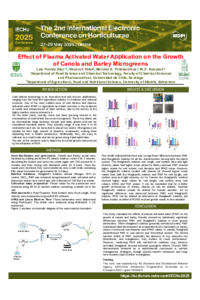
Poster Canola and Barley IECHo 2025 final.pdf
The Spectrum of Productivity: Exploring the Impact of Red–Blue and Red–Blue–Green LED Light on the Growth and Reproductive Stages in 'Festival' Strawberry
Real-Time Data Analytics and Smart Technologies for Advancing Indoor Farming