Event submissions
Published
This submission belongs to the session S6. Climatology of the event The 7th International Electronic Conference on Atmospheric Sciences
Published date
30 May, 2025
Academic Editor
'%3e%3cpath%20d='M12.6657%2010.9104C12.4185%2010.325%2012.0599%209.79327%2011.6097%209.34482C11.1609%208.89508%2010.6293%208.5365%2010.0442%208.28888C10.0389%208.28626%2010.0337%208.28495%2010.0285%208.28233C10.8446%207.69279%2011.3752%206.73249%2011.3752%205.64904C11.3752%203.8542%209.92103%202.39999%208.1262%202.39999C6.33136%202.39999%204.87715%203.8542%204.87715%205.64904C4.87715%206.73249%205.40774%207.69279%206.22393%208.28364C6.21869%208.28626%206.21345%208.28757%206.20821%208.29019C5.62129%208.5378%205.09463%208.89284%204.64265%209.34613C4.1929%209.79493%203.83432%2010.3266%203.58671%2010.9117C3.34345%2011.4845%203.21226%2012.0987%203.20023%2012.7209C3.19988%2012.7349%203.20233%2012.7488%203.20744%2012.7619C3.21255%2012.7749%203.22022%2012.7867%203.22998%2012.7968C3.23975%2012.8068%203.25142%2012.8147%203.26431%2012.8202C3.2772%2012.8256%203.29105%2012.8284%203.30504%2012.8284H4.09109C4.14874%2012.8284%204.19459%2012.7825%204.1959%2012.7262C4.2221%2011.7148%204.62823%2010.7676%205.34617%2010.0497C6.08899%209.30683%207.0755%208.89808%208.1262%208.89808C9.17689%208.89808%2010.1634%209.30683%2010.9062%2010.0497C11.6242%2010.7676%2012.0303%2011.7148%2012.0565%2012.7262C12.0578%2012.7838%2012.1037%2012.8284%2012.1613%2012.8284H12.9474C12.9613%2012.8284%2012.9752%2012.8256%2012.9881%2012.8202C13.001%2012.8147%2013.0126%2012.8068%2013.0224%2012.7968C13.0322%2012.7867%2013.0398%2012.7749%2013.0449%2012.7619C13.0501%2012.7488%2013.0525%2012.7349%2013.0522%2012.7209C13.0391%2012.0947%2012.9094%2011.4855%2012.6657%2010.9104ZM8.1262%207.9024C7.52486%207.9024%206.9589%207.6679%206.53312%207.24211C6.10733%206.81633%205.87283%206.25037%205.87283%205.64904C5.87283%205.0477%206.10733%204.48174%206.53312%204.05596C6.9589%203.63018%207.52486%203.39567%208.1262%203.39567C8.72753%203.39567%209.29349%203.63018%209.71927%204.05596C10.1451%204.48174%2010.3796%205.0477%2010.3796%205.64904C10.3796%206.25037%2010.1451%206.81633%209.71927%207.24211C9.29349%207.6679%208.72753%207.9024%208.1262%207.9024Z'%20fill='%235D1EE1'/%3e%3c/g%3e%3c/svg%3e) Eugene Rozanov
Eugene RozanovCitation
Daniel Milano Costa de Lima, Helber Barros Gomes, Maria Cristina Lemos da Silva, Katyelle Ferreira da Silva Bezerra, Paulo Vítor de Albuquerque Mendes, Assessment of Climate Variability and Trends in Water Availability in South America, in Proceedings of The 7th International Electronic Conference on Atmospheric Sciences, 4 June–6 June 2025, MDPI: Basel, Switzerland
Share
Email
Facebook
Twitter
LinkedIn
Assessment of Climate Variability and Trends in Water Availability in South America
'%3e%3cpath%20d='M12.6647%2010.9104C12.4176%2010.325%2012.0589%209.7933%2011.6088%209.34485C11.16%208.89511%2010.6283%208.53653%2010.0432%208.28891C10.038%208.28629%2010.0327%208.28498%2010.0275%208.28236C10.8437%207.69282%2011.3743%206.73252%2011.3743%205.64907C11.3743%203.85423%209.92005%202.40002%208.12522%202.40002C6.33038%202.40002%204.87618%203.85423%204.87618%205.64907C4.87618%206.73252%205.40677%207.69282%206.22296%208.28367C6.21772%208.28629%206.21248%208.2876%206.20724%208.29022C5.62031%208.53783%205.09365%208.89287%204.64167%209.34616C4.19192%209.79496%203.83334%2010.3266%203.58573%2010.9117C3.34247%2011.4846%203.21128%2012.0987%203.19925%2012.721C3.1989%2012.735%203.20135%2012.7489%203.20646%2012.7619C3.21157%2012.7749%203.21924%2012.7868%203.22901%2012.7968C3.23877%2012.8068%203.25045%2012.8148%203.26334%2012.8202C3.27623%2012.8256%203.29007%2012.8284%203.30406%2012.8284H4.09012C4.14776%2012.8284%204.19362%2012.7825%204.19493%2012.7262C4.22113%2011.7148%204.62726%2010.7676%205.34519%2010.0497C6.08802%209.30686%207.07452%208.89811%208.12522%208.89811C9.17592%208.89811%2010.1624%209.30686%2010.9052%2010.0497C11.6232%2010.7676%2012.0293%2011.7148%2012.0555%2012.7262C12.0568%2012.7839%2012.1027%2012.8284%2012.1603%2012.8284H12.9464C12.9604%2012.8284%2012.9742%2012.8256%2012.9871%2012.8202C13%2012.8148%2013.0117%2012.8068%2013.0214%2012.7968C13.0312%2012.7868%2013.0389%2012.7749%2013.044%2012.7619C13.0491%2012.7489%2013.0515%2012.735%2013.0512%2012.721C13.0381%2012.0947%2012.9084%2011.4856%2012.6647%2010.9104ZM8.12522%207.90243C7.52388%207.90243%206.95792%207.66793%206.53214%207.24215C6.10636%206.81636%205.87185%206.2504%205.87185%205.64907C5.87185%205.04773%206.10636%204.48177%206.53214%204.05599C6.95792%203.63021%207.52388%203.3957%208.12522%203.3957C8.72655%203.3957%209.29252%203.63021%209.7183%204.05599C10.1441%204.48177%2010.3786%205.04773%2010.3786%205.64907C10.3786%206.2504%2010.1441%206.81636%209.7183%207.24215C9.29252%207.66793%208.72655%207.90243%208.12522%207.90243Z'%20fill='%235D1EE1'/%3e%3c/g%3e%3c/svg%3e)
Daniel Milano Costa de Lima 1

Helber Barros Gomes 1,2,3,4,5
Maria Cristina Lemos da Silva 2,6
Katyelle Ferreira da Silva Bezerra 2
Paulo Vítor de Albuquerque Mendes 2
1. Universidade Federal de Campina Grande, UFCG
2. Universidade Federal de Alagoas, UFAL
3. Max Planck Institute for Meteorology, MPI-M
4. University of Connecticut, UConn
5. TEMPO OK TECNOLOGIA EM METEOROLOGIA LTDA, TOK
6. Instituto Nacional de Pesquisas Espaciais, INPE
Abstract
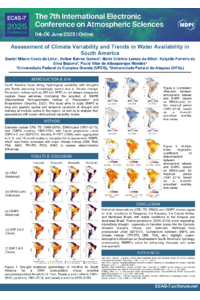
This study examines the climatic water availability, defined as precipitation minus potential evapotranspiration (PET), in continental South America during historical (1960–2014) and future (2015–2100) periods. Observed (CRU TS, ERA5) and modeled (CMIP6) data were used, with future projections under the SSP2-4.5 and SSP5-8.5 scenarios derived from an ensemble of five models best representing the continent. To improve the drought analysis, the SNIPE (Standardized Nonparametric Indices of Precipitation and Evaporation) methodology was applied. This method aggregates the data over multiple time scales (1, 3, 6, and 12 months) and uses nonparametric rescaling to produce standardized indices (zero mean, unit variance). Unlike the SPI and SPEI indices, which rely on parametric assumptions that may bias the results if the data deviate from the assumed distributions, SNIPE uses a distribution-free approach, making it a robust tool for drought assessment. Historical data from both the observed and modeled sources show similar water availability patterns: drought in Patagonia, the Atacama, the Central Andes, and the Brazilian northeast and high availability in the Amazon and southeast Brazil. Future projections indicate an expansion and intensification of drought, mainly affecting transition zones such as the Brazilian Cerrado, the edges of the Amazon, the Chaco, and the semiarid areas of the Brazilian northeast, with more pronounced changes under SSP5-8.5. Correlation analyses between SNIPE and various climate indices (AMO, ONI, PDO, SAM, TNA, TSA, and TPI-IPO) reveal that indices such as TPI-IPO, ONI, and TSA play key roles in the water regime dynamics in southeastern South America (including the areas of southern/southeastern Brazil, Paraguay, Uruguay, and northeastern Argentina), a region frequently impacted by floods. These findings underscore SNIPE’s potential to enhance forecasting systems and water resource management strategies.
Keywords
Water Availability
South America
Future Projections
SNIPE
CMIP6
Climate Change
Poster
poster.pdf
Assessment of Urban Air Quality in Salé, Morocco: An In-Depth Analysis of PM2.5 Seasonal Variations, Elemental Composition, and Enrichment Factors