Event submissions
Published
This submission belongs to the session S2. Air Quality and Human Health of the event The 7th International Electronic Conference on Atmospheric Sciences
Published date
30 May, 2025
Academic Editor
'%3e%3cpath%20d='M12.6657%2010.9104C12.4185%2010.325%2012.0599%209.79327%2011.6097%209.34482C11.1609%208.89508%2010.6293%208.5365%2010.0442%208.28888C10.0389%208.28626%2010.0337%208.28495%2010.0285%208.28233C10.8446%207.69279%2011.3752%206.73249%2011.3752%205.64904C11.3752%203.8542%209.92103%202.39999%208.1262%202.39999C6.33136%202.39999%204.87715%203.8542%204.87715%205.64904C4.87715%206.73249%205.40774%207.69279%206.22393%208.28364C6.21869%208.28626%206.21345%208.28757%206.20821%208.29019C5.62129%208.5378%205.09463%208.89284%204.64265%209.34613C4.1929%209.79493%203.83432%2010.3266%203.58671%2010.9117C3.34345%2011.4845%203.21226%2012.0987%203.20023%2012.7209C3.19988%2012.7349%203.20233%2012.7488%203.20744%2012.7619C3.21255%2012.7749%203.22022%2012.7867%203.22998%2012.7968C3.23975%2012.8068%203.25142%2012.8147%203.26431%2012.8202C3.2772%2012.8256%203.29105%2012.8284%203.30504%2012.8284H4.09109C4.14874%2012.8284%204.19459%2012.7825%204.1959%2012.7262C4.2221%2011.7148%204.62823%2010.7676%205.34617%2010.0497C6.08899%209.30683%207.0755%208.89808%208.1262%208.89808C9.17689%208.89808%2010.1634%209.30683%2010.9062%2010.0497C11.6242%2010.7676%2012.0303%2011.7148%2012.0565%2012.7262C12.0578%2012.7838%2012.1037%2012.8284%2012.1613%2012.8284H12.9474C12.9613%2012.8284%2012.9752%2012.8256%2012.9881%2012.8202C13.001%2012.8147%2013.0126%2012.8068%2013.0224%2012.7968C13.0322%2012.7867%2013.0398%2012.7749%2013.0449%2012.7619C13.0501%2012.7488%2013.0525%2012.7349%2013.0522%2012.7209C13.0391%2012.0947%2012.9094%2011.4855%2012.6657%2010.9104ZM8.1262%207.9024C7.52486%207.9024%206.9589%207.6679%206.53312%207.24211C6.10733%206.81633%205.87283%206.25037%205.87283%205.64904C5.87283%205.0477%206.10733%204.48174%206.53312%204.05596C6.9589%203.63018%207.52486%203.39567%208.1262%203.39567C8.72753%203.39567%209.29349%203.63018%209.71927%204.05596C10.1451%204.48174%2010.3796%205.0477%2010.3796%205.64904C10.3796%206.25037%2010.1451%206.81633%209.71927%207.24211C9.29349%207.6679%208.72753%207.9024%208.1262%207.9024Z'%20fill='%235D1EE1'/%3e%3c/g%3e%3c/svg%3e) Muhammad Ibrahim
Muhammad IbrahimCitation
Sergio Passarella, Sonia Ganassi, Alessia Iannone, Fabiana Carriera, Ivan Notardonato, Antonio De Cristofaro, Pasquale Avino, Occurrence of persistent chemical pollutants, heavy metals, in regions influenced by different human activities by means honey matrix., in Proceedings of The 7th International Electronic Conference on Atmospheric Sciences, 4 June–6 June 2025, MDPI: Basel, Switzerland
Share
Email
Facebook
Twitter
LinkedIn
Occurrence of persistent chemical pollutants, heavy metals, in regions influenced by different human activities by means honey matrix.
'%3e%3cpath%20d='M12.6647%2010.9104C12.4176%2010.325%2012.0589%209.7933%2011.6088%209.34485C11.16%208.89511%2010.6283%208.53653%2010.0432%208.28891C10.038%208.28629%2010.0327%208.28498%2010.0275%208.28236C10.8437%207.69282%2011.3743%206.73252%2011.3743%205.64907C11.3743%203.85423%209.92005%202.40002%208.12522%202.40002C6.33038%202.40002%204.87618%203.85423%204.87618%205.64907C4.87618%206.73252%205.40677%207.69282%206.22296%208.28367C6.21772%208.28629%206.21248%208.2876%206.20724%208.29022C5.62031%208.53783%205.09365%208.89287%204.64167%209.34616C4.19192%209.79496%203.83334%2010.3266%203.58573%2010.9117C3.34247%2011.4846%203.21128%2012.0987%203.19925%2012.721C3.1989%2012.735%203.20135%2012.7489%203.20646%2012.7619C3.21157%2012.7749%203.21924%2012.7868%203.22901%2012.7968C3.23877%2012.8068%203.25045%2012.8148%203.26334%2012.8202C3.27623%2012.8256%203.29007%2012.8284%203.30406%2012.8284H4.09012C4.14776%2012.8284%204.19362%2012.7825%204.19493%2012.7262C4.22113%2011.7148%204.62726%2010.7676%205.34519%2010.0497C6.08802%209.30686%207.07452%208.89811%208.12522%208.89811C9.17592%208.89811%2010.1624%209.30686%2010.9052%2010.0497C11.6232%2010.7676%2012.0293%2011.7148%2012.0555%2012.7262C12.0568%2012.7839%2012.1027%2012.8284%2012.1603%2012.8284H12.9464C12.9604%2012.8284%2012.9742%2012.8256%2012.9871%2012.8202C13%2012.8148%2013.0117%2012.8068%2013.0214%2012.7968C13.0312%2012.7868%2013.0389%2012.7749%2013.044%2012.7619C13.0491%2012.7489%2013.0515%2012.735%2013.0512%2012.721C13.0381%2012.0947%2012.9084%2011.4856%2012.6647%2010.9104ZM8.12522%207.90243C7.52388%207.90243%206.95792%207.66793%206.53214%207.24215C6.10636%206.81636%205.87185%206.2504%205.87185%205.64907C5.87185%205.04773%206.10636%204.48177%206.53214%204.05599C6.95792%203.63021%207.52388%203.3957%208.12522%203.3957C8.72655%203.3957%209.29252%203.63021%209.7183%204.05599C10.1441%204.48177%2010.3786%205.04773%2010.3786%205.64907C10.3786%206.2504%2010.1441%206.81636%209.7183%207.24215C9.29252%207.66793%208.72655%207.90243%208.12522%207.90243Z'%20fill='%235D1EE1'/%3e%3c/g%3e%3c/svg%3e)
Sergio Passarella 1
Sonia Ganassi 1
Alessia Iannone 1

Fabiana Carriera 1
Ivan Notardonato 1
Antonio De Cristofaro 1

Pasquale Avino 1,2
1. DiAAA, University of Molise, via De Sanctis, 86100 Campobasso, Italy
2. IIA-CNR, Rome Research Area-Montelibretti, 00015 Monterotondo Scalo, Italy
Abstract
Introduction
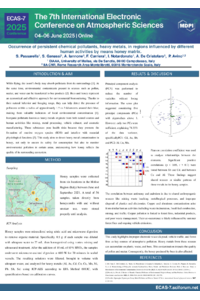
The insect's body may potentially absorb pollutants from its surroundings while it is in flight. Furthermore, the sources of bee products, such as pollen, nectar and water, can be exposed to environmental contaminants, which can be transferred to bee products. Because of these characteristics, bees and honey are low-cost tools that are increasingly being used for environmental biomonitoring, which seeks to detect environmental contaminants within a reasonable radius (1.5–3 km) surrounding the hive. Heavy metals, defined as inorganic chemical pollutants, are a class of contaminants that can be found either in nature or as a result of anthropogenic activity. Anthropogenic sources of heavy metals encompass a wide range of activities, including mining, smelting, vehicle emissions, and the production of cosmetics. These pollutants are of particular concern due to their ability to generate reactive oxygen species (ROS) and disrupt vital bodily functions. This study investigates heavy metals in honey to verify the safety of the honey and evaluate environmental pollution in specific areas, highlighting the interconnectedness of honey and the environment.
Methods
Honey samples, collected from six hives located in the Molise Region of Italy, were mineralised and then analysed with ICP-AES, in accordance with the EPA method 6010C.
Results
The most common metals are aluminium, selenium and antimony. Cobalt, nickel, and cadmium exhibit the highest levels of variability, with standard deviations of 253.3%, 207.2% and 82.4%, respectively. Principal component analysis (PCA) and Pearson correlation were usedto ascertain which metals most accurately represent the data sample and how they are associated with each other in order to hypothesise the anthropic pollution sources.
Conclusion
In the atmospheric domain, forest fires and vehicular traffic were identified asthe two main sources of anthropogenic pollution .
Keywords
biomonitoring
honey
heavy metals
human healt
Poster
Poster MDPI SP b.pdf
Pellet Production: Impact of Pollutants and Associated Health Risks
Impact of a long-distance volcano eruption on aerosol water-soluble organics composition and cytotoxic effects over monocytes