Event submissions
Published
This submission belongs to the session S7. Air Quality of the event The 7th International Electronic Conference on Atmospheric Sciences
Published date
30 May, 2025
Academic Editor
'%3e%3cpath%20d='M12.6657%2010.9104C12.4185%2010.325%2012.0599%209.79327%2011.6097%209.34482C11.1609%208.89508%2010.6293%208.5365%2010.0442%208.28888C10.0389%208.28626%2010.0337%208.28495%2010.0285%208.28233C10.8446%207.69279%2011.3752%206.73249%2011.3752%205.64904C11.3752%203.8542%209.92103%202.39999%208.1262%202.39999C6.33136%202.39999%204.87715%203.8542%204.87715%205.64904C4.87715%206.73249%205.40774%207.69279%206.22393%208.28364C6.21869%208.28626%206.21345%208.28757%206.20821%208.29019C5.62129%208.5378%205.09463%208.89284%204.64265%209.34613C4.1929%209.79493%203.83432%2010.3266%203.58671%2010.9117C3.34345%2011.4845%203.21226%2012.0987%203.20023%2012.7209C3.19988%2012.7349%203.20233%2012.7488%203.20744%2012.7619C3.21255%2012.7749%203.22022%2012.7867%203.22998%2012.7968C3.23975%2012.8068%203.25142%2012.8147%203.26431%2012.8202C3.2772%2012.8256%203.29105%2012.8284%203.30504%2012.8284H4.09109C4.14874%2012.8284%204.19459%2012.7825%204.1959%2012.7262C4.2221%2011.7148%204.62823%2010.7676%205.34617%2010.0497C6.08899%209.30683%207.0755%208.89808%208.1262%208.89808C9.17689%208.89808%2010.1634%209.30683%2010.9062%2010.0497C11.6242%2010.7676%2012.0303%2011.7148%2012.0565%2012.7262C12.0578%2012.7838%2012.1037%2012.8284%2012.1613%2012.8284H12.9474C12.9613%2012.8284%2012.9752%2012.8256%2012.9881%2012.8202C13.001%2012.8147%2013.0126%2012.8068%2013.0224%2012.7968C13.0322%2012.7867%2013.0398%2012.7749%2013.0449%2012.7619C13.0501%2012.7488%2013.0525%2012.7349%2013.0522%2012.7209C13.0391%2012.0947%2012.9094%2011.4855%2012.6657%2010.9104ZM8.1262%207.9024C7.52486%207.9024%206.9589%207.6679%206.53312%207.24211C6.10733%206.81633%205.87283%206.25037%205.87283%205.64904C5.87283%205.0477%206.10733%204.48174%206.53312%204.05596C6.9589%203.63018%207.52486%203.39567%208.1262%203.39567C8.72753%203.39567%209.29349%203.63018%209.71927%204.05596C10.1451%204.48174%2010.3796%205.0477%2010.3796%205.64904C10.3796%206.25037%2010.1451%206.81633%209.71927%207.24211C9.29349%207.6679%208.72753%207.9024%208.1262%207.9024Z'%20fill='%235D1EE1'/%3e%3c/g%3e%3c/svg%3e) Viney Aneja
Viney AnejaCitation
Lorenzo Massi, Federico Girolametti, Behixhe Ajdini, Matteo Fanelli, Silvia Illuminati, Cristina Truzzi, Anna Annibaldi, Size distribution and seasonal evolution of airborne metals in Antarctic atmospheric particulate matter, in Proceedings of The 7th International Electronic Conference on Atmospheric Sciences, 4 June–6 June 2025, MDPI: Basel, Switzerland
Share
Email
Facebook
Twitter
LinkedIn
Size distribution and seasonal evolution of airborne metals in Antarctic atmospheric particulate matter

Lorenzo Massi 1,2

Federico Girolametti 1
'%3e%3cpath%20d='M12.6647%2010.9104C12.4176%2010.325%2012.0589%209.7933%2011.6088%209.34485C11.16%208.89511%2010.6283%208.53653%2010.0432%208.28891C10.038%208.28629%2010.0327%208.28498%2010.0275%208.28236C10.8437%207.69282%2011.3743%206.73252%2011.3743%205.64907C11.3743%203.85423%209.92005%202.40002%208.12522%202.40002C6.33038%202.40002%204.87618%203.85423%204.87618%205.64907C4.87618%206.73252%205.40677%207.69282%206.22296%208.28367C6.21772%208.28629%206.21248%208.2876%206.20724%208.29022C5.62031%208.53783%205.09365%208.89287%204.64167%209.34616C4.19192%209.79496%203.83334%2010.3266%203.58573%2010.9117C3.34247%2011.4846%203.21128%2012.0987%203.19925%2012.721C3.1989%2012.735%203.20135%2012.7489%203.20646%2012.7619C3.21157%2012.7749%203.21924%2012.7868%203.22901%2012.7968C3.23877%2012.8068%203.25045%2012.8148%203.26334%2012.8202C3.27623%2012.8256%203.29007%2012.8284%203.30406%2012.8284H4.09012C4.14776%2012.8284%204.19362%2012.7825%204.19493%2012.7262C4.22113%2011.7148%204.62726%2010.7676%205.34519%2010.0497C6.08802%209.30686%207.07452%208.89811%208.12522%208.89811C9.17592%208.89811%2010.1624%209.30686%2010.9052%2010.0497C11.6232%2010.7676%2012.0293%2011.7148%2012.0555%2012.7262C12.0568%2012.7839%2012.1027%2012.8284%2012.1603%2012.8284H12.9464C12.9604%2012.8284%2012.9742%2012.8256%2012.9871%2012.8202C13%2012.8148%2013.0117%2012.8068%2013.0214%2012.7968C13.0312%2012.7868%2013.0389%2012.7749%2013.044%2012.7619C13.0491%2012.7489%2013.0515%2012.735%2013.0512%2012.721C13.0381%2012.0947%2012.9084%2011.4856%2012.6647%2010.9104ZM8.12522%207.90243C7.52388%207.90243%206.95792%207.66793%206.53214%207.24215C6.10636%206.81636%205.87185%206.2504%205.87185%205.64907C5.87185%205.04773%206.10636%204.48177%206.53214%204.05599C6.95792%203.63021%207.52388%203.3957%208.12522%203.3957C8.72655%203.3957%209.29252%203.63021%209.7183%204.05599C10.1441%204.48177%2010.3786%205.04773%2010.3786%205.64907C10.3786%206.2504%2010.1441%206.81636%209.7183%207.24215C9.29252%207.66793%208.72655%207.90243%208.12522%207.90243Z'%20fill='%235D1EE1'/%3e%3c/g%3e%3c/svg%3e)
Behixhe Ajdini 1
Matteo Fanelli 3

Silvia Illuminati 1

Cristina Truzzi 1

Anna Annibaldi 1
1. Department of Life and Environmental Sciences, Università Politecnica delle Marche, Ancona, 60131, Italy
2. Department of Environmental Sciences, Informatics and Statistics, Ca’ Foscari University, Venice, 30123, Italy
3. Institute of Biological Resources and Marine Biotechnology, National Research Council, Ancona, 60131, Italy
Abstract
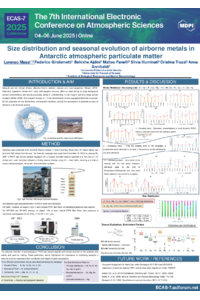
Introduction: Aerosols play a crucial role in Earth's climate system, influencing the balance of radiation and cloud formation. Antarctica, despite its remoteness, provides an ideal environment in which to study background aerosol composition and the long-range transport of pollutants. This study investigates size-segregated elemental composition, seasonal variations, and potential sources of atmospheric aerosols in Antarctica. Methods: Seven size-segregated aerosol samples were collected at Faraglione Camp (~3 km from Mario Zucchelli Station) between November 2019 and January 2020 using a high-volume cascade impactor. Samples were analyzed for major (Na, Ca, K, Mg), minor (Al, Fe, Mn), and trace elements (Cd, Cr, Cu, Hg, Ni, V) using ICP-OES, GF-AAS, and DMA after acid microwave digestion. Results: The elemental concentrations of PM10 followed the order K > Na > Al Ca > Mg Fe > Mn > Cr > Ni > Cu V > Cd Hg. Seasonal trends were element-specific, influenced by katabatic winds and pack ice melting. Notably, Mg, Cu, Cr, and Hg peaked in late November/mid-December, likely due to sea spray emissions, while Fe, V, and Mn showed a decreasing trend. The size distribution analysis identified three modes of particle dispersion: accumulation (0.1–1 µm) and two coarse fractions (~2.5–3 µm and ~9.5 µm). Crustal enrichment factors (EFs) indicated geogenic origins for Mn and Fe (EF < 1), while Cu, Ni, K, Ca, and V enrichment was linked to soil resuspension. Mg and Na showed moderate enrichment (EF ~10), associated with sea spray, while Cd, Cr, and Hg exhibited high EFs (10 < EF < 100), suggesting an anthropogenic influence. Conclusions: These findings underscore the importance of continuous monitoring in assessing the contributions of aerosols to polar environments and their potential climatic and ecological impacts.
Keywords
Sampling and analysis
measurement of air pollution
Sources of atmospheric pollutants
Anthropogenic and natural pollutants
Poster
Lorenzo_Massi_Poster_7th International Congress.pdf
Exposure to PM2.5 while walking in the city center
Severe Wind Shear at Soekarno–Hatta International Airport: The Role of Sea Breeze Front and Meteorological Factors